
Background check laws in the United States run through two parallel systems: state public-records acts, which control access to arrest reports, jail rosters, and police blotters, and federal statutes like the Freedom of Information Act, which govern access to records held by agencies like the Bureau of Prisons. No single national rule decides what you can see. Each state sets its own line between what's open and what's sealed.
Some things are almost always public:
- Police blotters and daily arrest logs
- County jail rosters showing current bookings, charges, and bond amounts
- Basic arrest facts: name, date, location, and the offense charged
Other things are usually restricted, including cumulative criminal history files ("rap sheets"), active investigatory records, and identifying details about juveniles or crime victims. If you need a federal inmate's record right now, your first stop is the BOP Inmate Locator. For anyone in county or state custody, go straight to that county's sheriff's office or jail roster instead.
Key Takeaways
State public-records laws, not a single federal standard, determine whether an arrest or inmate record is publicly accessible, and the rules shift meaningfully from state to state.
| Point | Details |
|---|---|
| State law governs access | Each state's open-records act sets its own rules for arrest and jail records, so check the specific state, not a national standard. |
| Blotters differ from rap sheets | Single-event booking data is usually public; compiled criminal histories are usually restricted. |
| Federal records need FOIA | The BOP Inmate Locator covers basic federal inmate data; deeper records require a formal FOIA request. |
| Denials have remedies | Administrative appeals, mandamus actions, and in-camera review (as in Idaho) can overturn improper denials. |
| Registry Recognizer speeds the search | The database centralizes county-level booking, charge, and mugshot data for informational use, not certified legal proof. |
Table of Contents
- Can You Access This Record? A Quick Checklist
- What's Public and What's Restricted in Arrest Records
- Federal or State: Where to Look First
- How to Request Arrest and Inmate Records
- Sealing, Expungement, and Mugshot Removal
- What to Do When a Records Request Gets Denied
- Verifying Records the Right Way
- Where to Search: Official Tools vs. Commercial Databases
- Why Registry Recognizer Exists
- Finding a Record With Registry Recognizer
- A Reporter's Take on Public Records Access
- Sources
Can You Access This Record? A Quick Checklist
Before you draft a request or waste time on the wrong website, run through four questions.
- Is the person in federal or state/county custody? Federal inmates go through the BOP; nearly everyone else falls under a state or county system.
- Are you asking for a blotter entry or a full criminal history? Single-event booking data is usually open. Compiled histories across multiple arrests are usually not.
- Is the case active or closed? Open investigations carry far more exemptions than closed matters.
- Does your state restrict who can request the record? Some states limit access for incarcerated people, out-of-state requesters, or specific requester categories, according to Prison Policy Initiative.
Pro Tip: Narrow your request to a specific date range, booking ID, or docket number instead of asking for "all records" on a person. Vague requests get denied more often, and agencies can legally charge more to compile broad searches.
If the record you're after belongs to someone in federal custody, check the BOP Inmate Locator first. It won't give you everything, but it tells you whether you're even looking in the right system.
What's Public and What's Restricted in Arrest Records
Every state's public-records law starts from a presumption of openness, but that presumption erodes fast once privacy, safety, or active-investigation exemptions kick in according to the Reporters Committee for Freedom of the Press.
Oklahoma's statute is a good illustration of what "typically public" looks like in practice. State law there requires agencies to disclose an arrestee's name, date of birth, address, physical description, the cause of arrest, and the identity of the arresting officer, along with jail registers and chronological incident lists, per Oklahoma's public records statute. Florida works similarly. Chapter 119 identifies specific incident details, time, date, location, arrestee name, and nature of the offense, that don't count as "criminal investigative information" and therefore must be disclosed unless another exemption applies, per Florida Statutes Chapter 119.
What usually stays restricted:
- Name-indexed criminal histories compiled across multiple jurisdictions
- Records tied to active or ongoing investigations
- Identifying information about victims and juveniles
- Internal law enforcement files not tied to a specific public-disclosure statute
Agencies redact for real reasons: officer safety, witness protection, and the integrity of pending cases. But redaction rules vary by state, and Idaho's public records manual spells out its own definition of "investigatory record" along with what must and must not be withheld, per the Idaho Public Records Law Manual. One more thing worth remembering: "public" doesn't always mean "online." Plenty of counties still require an in-person inspection or a written request even for records that are technically open.
Federal or State: Where to Look First
Picking the wrong system wastes time. Here's how the major sources break down.
| Source | Typical content |
|---|---|
| BOP Inmate Locator | Register number, custody status, projected release date (federal inmates post-1982) |
| County jail roster | Booking date, charges, bond amount, mugshot |
| Police blotter | Chronological log of arrests, usually daily |
| State Department of Corrections | Sentencing status, facility location, parole eligibility |
| FOIA request (federal) | Detailed inmate files beyond what the locator shows |
The BOP Inmate Locator covers federal inmates, generally those in custody after 1982, but it's a summary tool, not a full case file. Anything deeper on the federal side requires a Freedom of Information Act request, often submitted with Form DOJ-361, according to BOP's own FOIA guidance.
Start small. Query the county or city that actually made the arrest before climbing up to the state Department of Corrections or the federal system. Most people never touch federal records at all, because most arrests never leave the county level.
How to Request Arrest and Inmate Records
Filing a records request isn't complicated, but sloppy requests get denied or delayed. Follow these steps.
- Identify the correct custodian. That's usually the sheriff's office, police department, or county clerk that generated the record, not a state-level office.
- Be specific. Name the person, approximate date, and document type (booking sheet, blotter entry, incident report) rather than asking for a broad history.
- Put it in writing when possible. Some states, like Wisconsin, accept oral requests but you get better tracking with written ones, per Wisconsin Statutes §19.34.
- State your preferred format. Ask for electronic copies. It's usually cheaper and faster than a physical print job.
- Include contact information so the agency can follow up with clarifying questions instead of just denying the request outright.
Response times vary sharply by state:
| State/system | Typical response timeline |
|---|---|
| Idaho | 3 working days to acknowledge; 10 working days for resident requests |
| Wisconsin | Notice is often required in advance before inspection |
| Florida | No fixed statutory deadline, but agencies must respond "promptly" |
| Federal FOIA | 20 business days, with possible extensions |
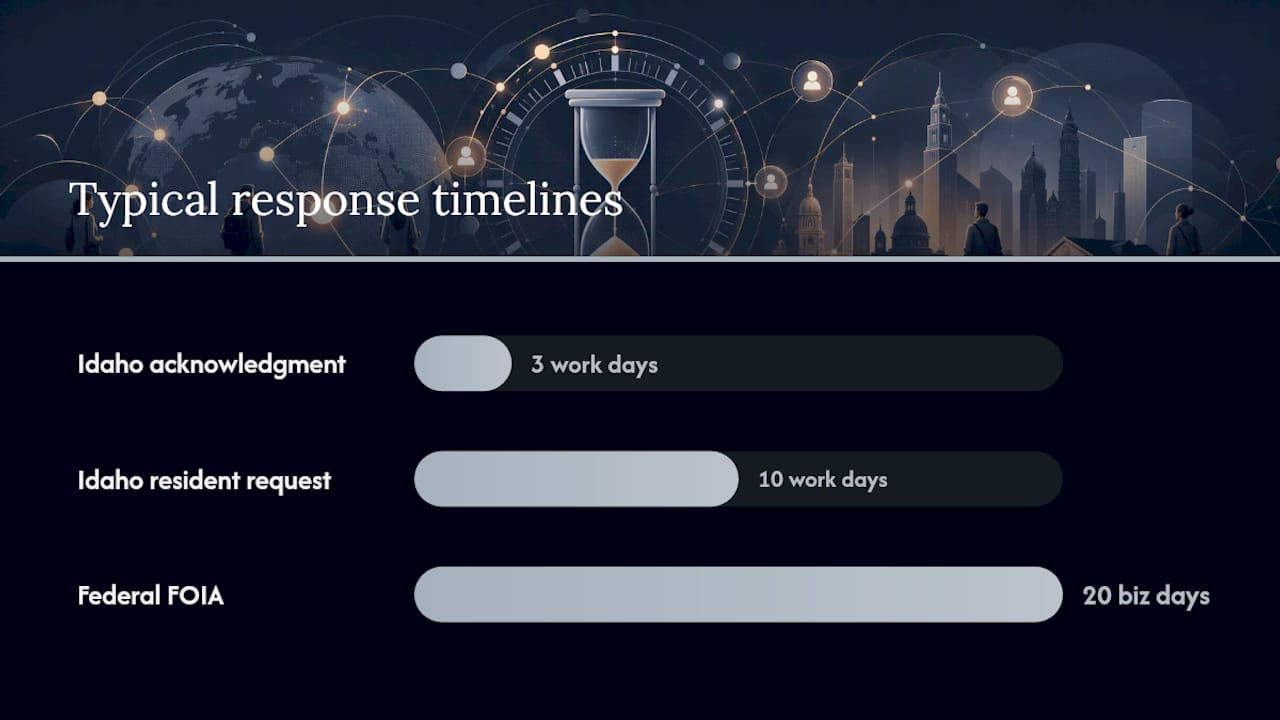
Idaho's deadlines come from its own public records manual. If an agency simply ignores your request past the statutory window, some states treat that silence as a "deemed denial," which opens the door to an appeal even without a written refusal.
On fees: agencies can generally charge for staff time and duplication, according to Washington's public-records fee guidance. You can cut costs by:
- Requesting electronic copies instead of paper
- Narrowing the date range to weeks, not years
- Asking for specific fields rather than an entire database export
Here's a short template you can adapt: "I am requesting copies of [document type, e.g., booking record or incident report] for [name], dated on or around [date], held by [agency name]. Please provide these records in electronic format if available. I can be reached at [contact information] for any questions about this request."
Sealing, Expungement, and Mugshot Removal
Sealing and expungement are not the same as ordinary redaction. Redaction hides specific fields, like a victim's address, while sealing or expunging a record removes it from public view or destroys it entirely, subject to enumerated exceptions like law enforcement access.
Many states have statutory provisions permitting sealing or expungement under specific circumstances, according to a Department of Justice review of criminal justice information access. That's a majority of the country, but the eligibility rules, waiting periods, and covered offenses differ enormously state to state.
If you're trying to get a mugshot taken down or enforce a sealing order, here's the practical path:
- Obtain a certified copy of the court's sealing or expungement order.
- Contact the publishing site or agency directly with the order attached.
- Follow up in writing if the record isn't removed within a reasonable window, and document every contact.
- If the site refuses despite a valid court order, consult an attorney about compliance remedies.
Common limits to expect: courts can still access sealed records in specific circumstances, archival copies sometimes survive outside the original database, and law enforcement retains access even after public-facing removal. Readers dealing with a New Hampshire annulment or expungement case can find procedural detail through resources like this criminal record annulment guide.
What to Do When a Records Request Gets Denied
A denial isn't the end of the road. Here's the realistic sequence.
- Ask for a written denial citing the specific statute. Most states require agencies to explain the legal basis for withholding records, and that citation tells you exactly what to challenge.
- File an internal appeal first, if the agency has that process, before going to court.
- Consider a mandamus action if the agency simply ignores its own statutory duty. This is a court order compelling the agency to act, and it's typically a last resort after administrative appeals fail.
- Understand in-camera review. Idaho's system lets a requester file a verified petition asking a court to examine withheld records privately and decide whether disclosure is legally required, per the Idaho Public Records Law Manual. It's a useful middle ground between blind trust in the agency's judgment and a full public disclosure order.
- Talk to a lawyer before litigating. Court remedies take time and money, and an attorney can often resolve overbroad denials with a single follow-up letter.
Verifying Records the Right Way
Getting the record is only half the job. Getting it right matters more.

Do cross-check every blotter entry against the court docket before you report or rely on it. Do confirm disposition status, arrests don't equal convictions, before implying guilt. Do request certified court documents when the legal outcome actually matters for your story or research.
Don't publish unconfirmed allegations as fact. Don't assume a booking photo means conviction. Don't skip the step of matching booking IDs and dates across sources, since name mismatches happen more often than people expect, especially with common names.
Pro Tip: When a record involves a juvenile, a sealed case, or a domestic violence protective order, treat the identifying details with extra caution even if the raw record is technically public. Legal access and ethical publication are two different standards.
Where to Search: Official Tools vs. Commercial Databases
For federal inmates, start with the BOP Inmate Locator. For everyone else, county jail rosters and police department blotter pages are your primary sources, backed up by state Department of Corrections locators and state open-records portals.
Official government systems have one big advantage: they're the record of origin, so there's no translation error between what the agency has and what you're seeing. The tradeoff is that they're often clunky, county-by-county, and inconsistent in format.
Commercial aggregators solve the fragmentation problem by pulling county-level data into one searchable database. That convenience comes with real caveats: aggregated records can lag behind the original source, mix up people with similar names across jurisdictions, or miss updates like dismissals and expungements. Treat any aggregator result as a lead, not a final answer, and verify anything that matters against the original custodian, whether that's the county sheriff, the court clerk, or the BOP itself.
Why Registry Recognizer Exists
Registry Recognizer was built to solve a specific frustration: county-level arrest data is scattered across hundreds of separate agency websites, each with its own format, update schedule, and search interface. We centralize that information, booking details, charges, jail locations, and mugshots, into one searchable database that's updated on a regular cadence pulled from public agency sources.
We're upfront about what this is and isn't. Registry Recognizer is an informational resource, not a certified legal record and not a substitute for a certified court document when legal proof is required. Data accuracy depends on the underlying agency's own reporting, and disposition status can lag behind real-time court outcomes. If you're using a record for anything beyond general awareness, verify it against the original custodian first.
Finding a Record With Registry Recognizer
If you already know which county to check, Registry Recognizer gets you there faster than hunting through a dozen separate agency sites. The database pulls booking information, charges, jail locations, and disposition status into one searchable interface, filterable by crime type and location, so you're not toggling between a sheriff's portal, a court clerk's page, and a state DOC lookup just to piece together one person's status.
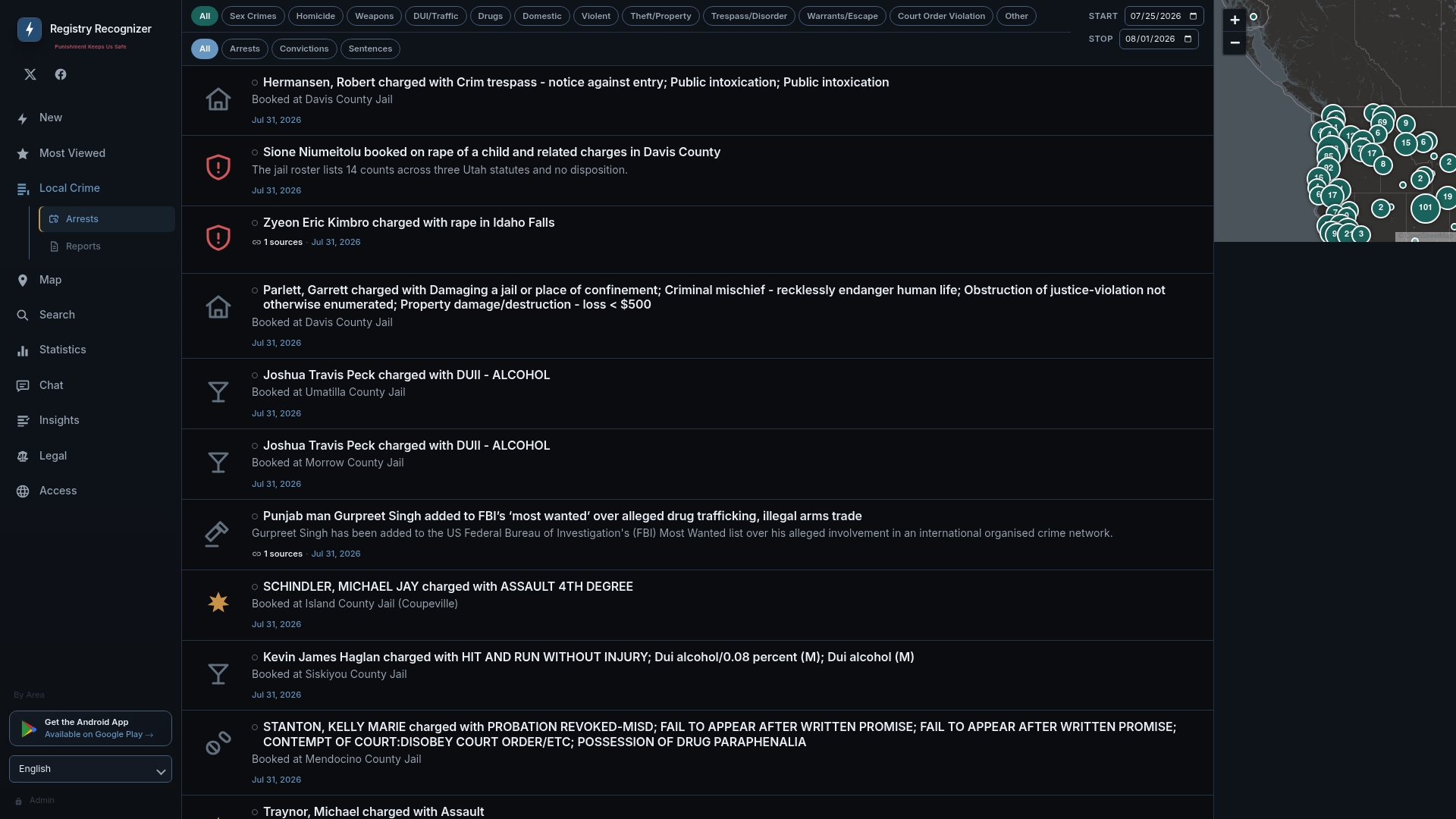
Records like this probation violation booking or this firearm possession charge show the level of detail available, charge language, booking dates, bond amounts, and mugshots where public. One limitation worth repeating: this is a research and awareness tool, not a certified record. If you need documentation for a legal proceeding, employment dispute, or court filing, request the certified version directly from the county clerk or court. For everything else, from journalists checking a name before publication to concerned residents keeping tabs on local activity, start your search on the Registry Recognizer database and use what you find responsibly.
A Reporter's Take on Public Records Access
The biggest misconception about background check laws isn't legal, it's practical. People assume "public record" means "one Google search away." It rarely does. Even in states with strong open-records traditions, the actual record often sits behind a county website that hasn't been redesigned since 2009, a records clerk who answers the phone three hours a day, or a fee schedule that punishes anyone who doesn't know to ask for a narrow date range.
That gap between legal openness and practical access is where most people give up, and it's exactly the gap that favors whoever already knows the system. Journalists with experience filing requests get faster answers than first-timers, not because the law treats them differently, but because they ask better questions. The lesson isn't that the system is rigged. It's that specificity is the entire game. A request for "everything on this person" gets stalled or denied. A request for "the booking report from March 14, 2026, docket number 22-CR-4471" gets answered in days.
The other thing worth saying plainly: sealing and expungement laws exist because arrest records can follow someone long after the case resolves in their favor, and that tension between transparency and second chances isn't going away. Thirty-nine states have built statutory paths to address it. Anyone working with this data, whether compiling it or requesting it, should hold both truths at once: the public has a real interest in knowing what happens in its courthouses and jails, and people who were never convicted have a real interest in not being defined by an arrest forever.
Sources
- BOP: Inmate Locator
- Idaho Public Records Law Manual (Idaho AG Office)
- U.S. Department of Justice / OJP report on access to criminal justice information (NCJRS)