
Bail is the court-set financial condition (or other conditions) that allows a defendant to be released before trial. A bond is the legal instrument or agreement used to satisfy that condition. The two terms get used interchangeably in everyday conversation, but they are legally distinct.
- Who pays: The defendant or their family pays cash bail directly to the court. With a surety bond, a licensed bail bond agent pays the court on the defendant's behalf, and the family pays the agent a nonrefundable premium.
- Refundability: Cash bail posted directly is generally returned at case end, minus any court administrative fees. A bail bond premium paid to an agent is not refunded, regardless of the outcome.
U.S. jurisdiction note: Rules vary significantly by state. A handful of states, including Illinois and Kentucky, have restricted or eliminated commercial surety bail entirely. Always verify local rules.
Table of Contents
- What's the difference between bail and bond?
- What is a bail bond, and what types exist?
- How do you post bail or get a bail bond, step by step?
- What happens if the defendant misses a court date?
- How to check a person's bail or bond status
- Key Takeaways
- The part most people learn too late
- Registryrecognizer can help you find booking and bond details fast
- Useful sources for further reading
What's the difference between bail and bond?
Bail is what the court demands. Bond is how you pay it. That one-sentence answer covers most of the confusion.
| Factor | Bail | Bond |
|---|---|---|
| Who sets it | Judge or magistrate | N/A (satisfies bail set by court) |
| Who pays | Defendant or family (cash) | Bail bond agent (on defendant's behalf) |
| Who holds the money | Court | Court holds agent's guarantee |
| Refundable? | Yes, at case end (minus fees) | Premium paid to agent: no |
| Typical cost | Full bail amount | 10–20% of bail amount (nonrefundable premium; many states set specific caps—New York, for example, uses a sliding scale with a maximum of 10%). |
Three quick scenarios:
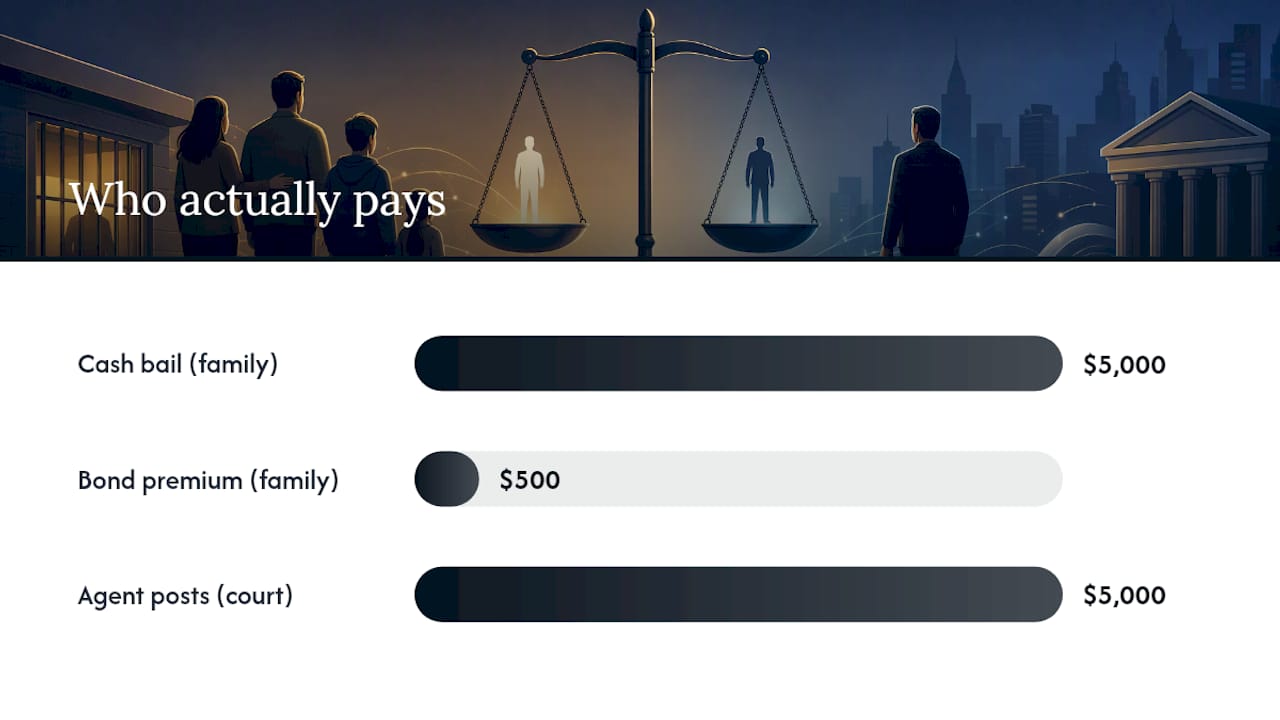
Cash bail: A judge sets bail at $5,000. The defendant's family pays $5,000 directly to the court. If the defendant appears at all hearings, the $5,000 is returned when the case closes.
Surety bond: Same $5,000 bail, but the family can't cover it. They contact a bail bond agent, pay a $500 nonrefundable premium (10%), and the agent posts the full $5,000 with the court.
Release on recognizance (ROR): The judge decides the defendant is low-risk and releases them on a signed promise to appear, with no money exchanged at all.
What is a bail bond, and what types exist?
A bond is the legal agreement, backed by a guarantee, that satisfies the bail requirement. According to the NCSL, states recognize several distinct bond types, and the options available to a defendant depend heavily on their jurisdiction.
Surety bond (commercial bail bond) A licensed bail bond company acts as the surety, guaranteeing the full bail amount to the court. The defendant or their family pays the agent a nonrefundable premium. This is the most common arrangement in states that permit commercial bail. The agent takes on financial risk and, in return, monitors the defendant's compliance.
Cash bond The defendant or a third party pays the full bail amount in cash directly to the court. No agent is involved. The money sits with the court until the case resolves, then it is returned minus any administrative deductions.
Property bond Real estate or other property is pledged as collateral instead of cash. Courts typically require the property's equity to exceed the bail amount by a meaningful margin. If the defendant fails to appear, the court can move to seize the property.
Unsecured or signature bond The defendant signs a written promise to pay a specified amount if they miss court, but no money or property changes hands upfront. This is essentially a financial penalty held in reserve.
Release on recognizance (ROR) No money, no property, no agent. The defendant signs a promise to appear. Judges grant ROR for low-level offenses and defendants with strong community ties and no prior failures to appear.
A few states have moved away from commercial surety entirely. Illinois abolished cash bail in 2023 under the SAFE-T Act. Kentucky has long restricted commercial bail agents. These state-level differences mean the bond options available in one county may not exist in another.
How do you post bail or get a bail bond, step by step?
Paying cash bail directly
- Get the bail amount from the court clerk or the jail's booking desk after arraignment.
- Bring the full amount in an accepted form (cash, cashier's check, or money order; personal checks are rarely accepted).
- Pay at the court clerk's office or the jail's designated payment window.
- Receive a receipt. Keep it. You will need it to claim the refund after the case closes.
- The defendant is processed for release, typically within a few hours of payment.
Using a bail bond agent
- Contact a licensed bail bond agent. Ask for their license number and verify it with your state's insurance or financial services regulator.
- Pay the agent's nonrefundable premium. Bail bond premiums have historically run a percentage of the bail amount, though many states cap the rate. New York, for example, sets a maximum premium schedule tied to the bail amount, and agents in New York are licensed and regulated by the state Department of Financial Services.
- Sign an indemnity agreement. This document makes you (the co-signer) financially responsible if the defendant fails to appear.
- Provide collateral if required. Agents may accept real estate, vehicles, or other assets as security against the full bail amount.
- The agent posts the bond with the court. The defendant is released, usually within hours.
What happens to the money at case end? Cash bail paid directly to the court is refunded to the payer after the case concludes, minus any court-imposed administrative fees. The bail bond premium paid to an agent is gone regardless of verdict. Even a full acquittal does not entitle the family to a refund of the agent's fee.
Pro Tip: Before signing with any bail bond agent, ask for a written breakdown of all fees. Some agents charge additional administrative or monitoring fees on top of the premium. State caps typically cover only the base premium, not add-ons.
What happens if the defendant misses a court date?
Missing a court date triggers a chain of consequences that affects the defendant, any co-signers, and anyone who pledged collateral.
- Arrest warrant: — The judge issues a bench warrant immediately. Law enforcement can arrest the defendant anywhere, at any time.
- Bond company recovery: The agent has a strong financial incentive to find the defendant. In most states, bail bond companies can hire recovery agents (bounty hunters) to locate and return the defendant to custody. The company may also pursue the co-signer and any pledged collateral through civil action.
There are limited remedies. An attorney can file a motion to set aside the forfeiture, arguing good cause for the missed appearance (a medical emergency, for example). In many states, if the defendant is returned to custody within a set period, the court may reduce or vacate the forfeiture. Justia's practical guides note that the window for these motions varies by state and is often short, so acting quickly matters.
A defendant released on bail or bond also faces ongoing conditions: travel restrictions, no contact orders, regular check-ins with pretrial services, and sometimes electronic monitoring. Violating any condition can result in revocation of release and return to jail, even without a missed court date.
How to check a person's bail or bond status
Public records and court clerks are the authoritative sources. Online databases can speed the search considerably, but any result you find online should be confirmed with the court or jail directly before acting on it.
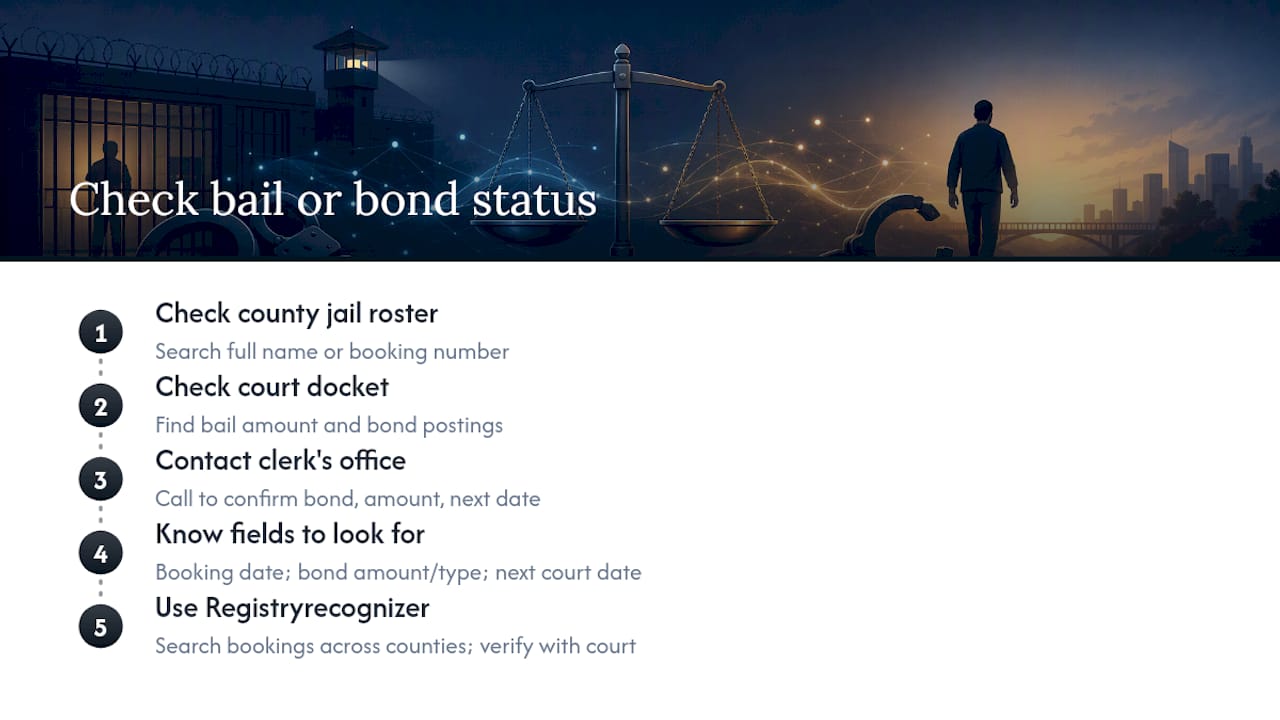
Start with the county jail roster. Most county jails post a searchable online inmate roster that shows current bookings, charges, and bond status in near real time. Search by the person's full name or booking number. The record will typically show whether bond has been posted, is pending, or has been denied. A real booking record may list the bond status explicitly as "No Bond," meaning the judge denied release.
Check the court docket. Most state courts offer an online case lookup system. Search by defendant name or case number to find the docket, which will show the bail amount set, whether bond has been posted, and upcoming hearing dates. Federal cases appear on PACER (Public Access to Court Electronic Records).
Contact the clerk's office. If online records are unclear or outdated, call the court clerk directly. Clerks can confirm the current bond status, the amount, and the next scheduled court date. Have the defendant's full name, date of birth, and case number ready.
Know what fields to look for. When reading a booking or court record, the most useful fields are: booking date, bond amount, bond type (cash, surety, property, ROR, or no bond), bond status (posted, pending, forfeited), next court date, and charge codes.
Pro Tip: Registryrecognizer maintains a regularly updated database of booking records across multiple counties, including bond amount, bond type, and charge details. You can use it to search arrest and bond records quickly, then verify the current status with the court clerk or jail. Online records, including Registryrecognizer's, reflect booking data and may not capture same-day bond postings or court modifications.
Key Takeaways
Bail is the court-set condition for release; a bond is the legal instrument that satisfies it, and the type of bond you use determines your costs, your risks, and whether any money comes back.
| Point | Details |
|---|---|
| Bail vs bond distinction | Bail is set by the judge; a bond is the agreement or payment used to meet that requirement. |
| Cash bail refundability | Cash paid directly to the court is returned at case end, minus administrative fees. |
| Bond premium cost | Bail bond agent premiums typically range from 10% to 20% of the bail amount and are nonrefundable; states may set lower maximums by law. |
| Missing court consequences | A missed court date triggers forfeiture, a bench warrant, and potential collateral seizure by the bond agent. |
| Check status with Registryrecognizer | Use Registryrecognizer's county booking database to find bond amount and type, then confirm with the court clerk. |
The part most people learn too late
Cash bail's biggest trap is not the cost. It is the co-signer agreement. Families sign indemnity contracts without fully reading them, pledge their home as collateral, and then discover that the bond company's obligation to recover the defendant can outlast the criminal case itself. The premium is gone from day one. The collateral risk lingers until the case is fully resolved and the bond is formally exonerated by the court.
The other thing worth saying plainly: ROR is underused because defendants and families do not always know to ask for it. A defense attorney who argues community ties, stable employment, and a clean record at arraignment can sometimes secure release with no money at all. That motion costs nothing to make and can save thousands.
Verify the bond status before assuming someone is still in custody. Courts process releases at different speeds, and a bond posted at 9 AM may not show as cleared in the jail system until late afternoon. Call the jail directly if the online record looks stale.
Registryrecognizer can help you find booking and bond details fast
When someone you know has been arrested, the first practical question is usually: where are they, what are they charged with, and has bond been posted? Registryrecognizer gives you a direct path to those answers.

The Registryrecognizer database pulls booking records from counties across the U.S. and displays them with the fields that matter most: booking date, charges, bond amount, bond type, bond status, and jail location. You can search by name and filter by county or charge type. A record like this probation violation case shows exactly how bond fields appear in a real entry.
Verification reminder: Registryrecognizer reflects booking data as reported by county sources. Always confirm current bond status, hearing dates, and release conditions with the court clerk or the jail directly. This database is a research tool, not a substitute for legal advice or official court records. If you need legal guidance, consult a licensed defense attorney or contact your local public defender's office.
Useful sources for further reading
- Bail — Wex Legal Encyclopedia — Cornell Law School
- Bail bond — Wex Legal Encyclopedia — Cornell Law School
- Bail vs. Bond: Is there a difference? — The Bail Project
- Federal law of bail — Congressional Research Service (R40221)
- Pretrial release conditions — National Conference of State Legislatures (NCSL)
- Bail bond — Investopedia
- Bail information for consumers — New York State Department of Financial Services
- Bail bonds — FindLaw
- Bail and bonds — Justia
This article is general information, not legal advice. Laws and procedures vary by state and jurisdiction. Confirm current rules with the court clerk, your state's official resources, or a licensed defense attorney.
Recommended
- BALFOUR, GLENN THOMAS charged with Arrest: 50B-4 - DV PROTECTIVE ORDER VIOL (M); Arrest Date 07/02/2026; Bond - No Bond; Set By MILLER; · Registry Recognizer
- Bessette, Bridget Ann charged with FELONY POSSESSION SCH II CS · Registry Recognizer
- HOLMES, BRODIE JOHN charged with Felony Stalking; Intimate conduct cause fear to person/family; 2nd or subs · Registry Recognizer
- CHRISTOPHER E ALCANTAR BECK charged with VIOL PROTECT ORDER/DV · Registry Recognizer