
A bench warrant is a judge-issued order that authorizes law enforcement to arrest you for failing to comply with a court order or missing a scheduled court appearance. Unlike an arrest warrant tied to a new crime, a bench warrant arises because a court already has jurisdiction over you and you didn't follow through. It does not expire on its own. If you think one may exist against you, here's where to start:
- Contact the court clerk at the courthouse where your case was filed and ask directly whether a warrant is on record.
- Search public records through your county or state's online court portal, or use a public records database like Registryrecognizer to check for recent arrest or booking entries.
- Consider calling an attorney before taking any further action, especially if the underlying matter involves probation, child support, or a criminal charge.
Pro Tip: Handling a bench warrant proactively almost always produces a better outcome than waiting. A voluntary surrender, arranged through counsel, typically results in a lower bail amount and avoids the humiliation of a roadside arrest during a routine traffic stop.
Key Takeaways
A bench warrant is a judge-issued arrest order that stays active indefinitely until a court recalls it, and voluntary resolution almost always produces better outcomes than waiting to be arrested.
| Point | Details |
|---|---|
| Definition | A bench warrant is a judge-issued order to arrest someone for failing to comply with a court order or missing a court date. |
| Warrants don't expire | Bench warrants remain active in law enforcement databases until a judge recalls or quashes them. |
| Top triggers | Failure to appear, probation violation, unpaid fines, and subpoena nonappearance are the most common causes. |
| Verify with the court | Contact the court clerk directly; public records databases are useful for initial research but not a substitute for official confirmation. |
| Act quickly | Voluntary surrender arranged through counsel typically results in lower bail and faster resolution than a roadside arrest. |
Table of Contents
- What does bench warrant mean, and why do courts issue them?
- How does a bench warrant differ from an arrest warrant?
- How a bench warrant is executed in practice
- What are the consequences of an outstanding bench warrant?
- How to check whether you have a bench warrant
- Ways to clear or resolve a bench warrant
- State differences and statute examples
- Prioritized checklist if you think you have a bench warrant
- Why ignoring a bench warrant always makes things worse
- Sources
What does bench warrant mean, and why do courts issue them?
Courts issue bench warrants for one core reason: someone failed to do what the court required. According to Nolo, common triggers include:
- Failure to appear (FTA): Missing a scheduled court date, whether for a traffic ticket or a felony hearing, is the most frequent cause.
- Probation or parole violation: Failing a drug test, missing a check-in, or picking up a new charge can prompt a judge to issue a warrant on the spot.
- Unpaid fines or child support: Courts treat nonpayment as contempt when a payment schedule was court-ordered.
- Subpoena nonappearance: Witnesses, not just defendants, can receive bench warrants for ignoring a subpoena.
- Contempt of court: Disobeying a court order in any civil or criminal matter qualifies.
The scale of the trigger matters. Missing a traffic court date is serious, but a judge may recall the warrant quickly once you appear and explain. A probation violation warrant is a different situation entirely: the judge may set no bail, and the path to resolution almost always requires an attorney.
Legaldictionary, bench warrants apply in both criminal and civil contexts, including contempt proceedings and subpoenaed witnesses who never show up. Jury duty nonappearance can also result in a bench warrant in some jurisdictions, though courts typically send multiple notices first.
How does a bench warrant differ from an arrest warrant?
The distinction matters because it changes who initiated the warrant, what legal standard was required, and what you're actually facing.
| Feature | Bench Warrant | Arrest Warrant |
|---|---|---|
| Who issues it | Judge, from the bench | Judge, at law enforcement's request |
| Legal basis | Court noncompliance (existing case) | Probable cause for a new offense |
| Probable cause required | Generally not | Yes, supported by affidavit |
| Typical trigger | Missed hearing, contempt, FTA | New criminal investigation |
| Purpose | Compel compliance with court | Initiate criminal proceedings |
The Metropolitan Police Academy's publication on arrest warrants explains the key procedural difference: because the court already has jurisdiction over the person and the judge personally witnessed the noncompliance, a separate probable-cause affidavit is typically unnecessary for a bench warrant. The judge simply acts on what happened in the courtroom.
A concrete example: you're charged with a misdemeanor and released pending trial. You miss your next court date. The judge issues a bench warrant that afternoon, no police investigation required. Compare that to a situation where detectives build a case against someone for fraud, present evidence to a judge, and obtain an arrest warrant. Two very different legal paths, even though both end with someone in handcuffs.
How a bench warrant is executed in practice
Once a judge signs a bench warrant, it enters local and national law enforcement databases, often within hours. From that point, any routine encounter with police can trigger an arrest.
- A traffic stop for a broken taillight surfaces the warrant when the officer runs your license.
- A fingerprint check during booking on an unrelated matter will flag it.
- Border crossings and airport security screenings can reveal outstanding warrants.
After arrest, the typical sequence runs like this:
- You're taken into custody and transported to the local jail for booking.
- Officers record your charges, take a mugshot, and collect fingerprints.
- A bail amount is applied, if the judge set one at the time of issuance. Some judges issue "no bail" warrants, meaning you stay detained until you appear before a judge.
- You're brought before a judge, often within 24–72 hours, who decides whether to recall the warrant, set a new hearing date, or address the underlying violation.
Pro Tip: If you know a bench warrant exists, contact an attorney before walking into a courthouse or police station. In many jurisdictions, a lawyer can arrange a voluntary surrender that includes a pre-negotiated bail amount, which means you may be in and out the same day rather than spending a weekend in a holding cell.
For a real-world look at how booking details and bond conditions appear in public records, this arrest record on Registryrecognizer illustrates the kind of charge and bond information that becomes publicly accessible after an arrest.
What are the consequences of an outstanding bench warrant?
The short answer: the longer you wait, the worse it gets.
On the legal side, an unresolved bench warrant can mean arrest and detention until a judge hears your case, a bail amount higher than what would have been set originally, contempt charges added on top of the original matter, and accelerated probation revocation proceedings. For probation violations specifically, a bench warrant often triggers a separate hearing where the judge can revoke probation entirely and impose the original suspended sentence.

Practically, the consequences extend beyond the courtroom. A bench warrant that leads to an arrest during a traffic stop creates a public booking record. That record can surface in background checks run by employers, landlords, and licensing boards. Travel becomes risky: crossing into Canada or Mexico with an outstanding U.S. warrant can result in detention at the border. International travel carries similar risks.
Does a bench warrant automatically mean jail time? Not necessarily. Many judges will recall a warrant and reset a hearing date if you appear voluntarily and the original matter was minor. But "no bail" warrants do exist, particularly for probation violations and serious criminal cases, and in those situations detention is likely until a judge rules.
How to check whether you have a bench warrant
Start with the most direct source: the court itself.
- Call or visit the court clerk's office where your case was filed. Give them your full legal name, date of birth, and case number if you have it. Clerks can confirm whether a warrant is active.
- Search your county or state's online court portal. Many states publish warrant and case information publicly. Search "[your state] court records online" to find the official portal.
- Check statewide warrant databases. Some states maintain searchable warrant registries through the state police or attorney general's office.
- Use a public records database like Registryrecognizer to look for recent arrest or booking records tied to your name. This can surface whether an arrest on a warrant has already occurred or whether booking records exist.
- Contact local law enforcement non-emergency lines for general guidance, though this carries some risk if a warrant is active.
One important caveat: online availability varies significantly by state and county. Some jurisdictions update records in near real-time; others lag by days or weeks. Public records databases like Registryrecognizer provide arrest and booking information that can be useful for initial research, but they are not official court records and should not be your only verification step for a critical legal decision.
Ways to clear or resolve a bench warrant
Resolution paths depend on why the warrant was issued and how serious the underlying matter is.
- File a motion to recall or quash: An attorney files this on your behalf, asking the judge to cancel the warrant. Courts often grant these for first-time FTAs with a credible explanation.
- Pay outstanding fines or child support: If the warrant stems from nonpayment, satisfying the debt sometimes prompts the court to recall the warrant automatically, though you should confirm with the clerk.
- Voluntarily surrender: Arrange through counsel to turn yourself in at a scheduled time. This signals good faith and often results in more favorable bail terms. For out-of-county situations, understanding how bail bonds work across jurisdictions can help you prepare.
- Negotiate a new court date: For minor FTAs, some prosecutors' offices will agree to a new hearing date in exchange for a voluntary appearance, effectively mooting the warrant.
For a minor failure-to-appear on a traffic matter, the process is usually straightforward: contact the court, explain the situation, appear at the rescheduled hearing, and the warrant is recalled. For a probation violation, the calculus changes. The DC Office of the Attorney General notes that warrants in those situations often carry a bond amount set at issuance, and the first court appearance will address both the warrant and the underlying violation simultaneously.
Pro Tip: Even if you're confident the warrant is minor, having an attorney present at your first appearance after a bench warrant gives you someone who can argue for a lower bond and a faster resolution on the spot.
State differences and statute examples
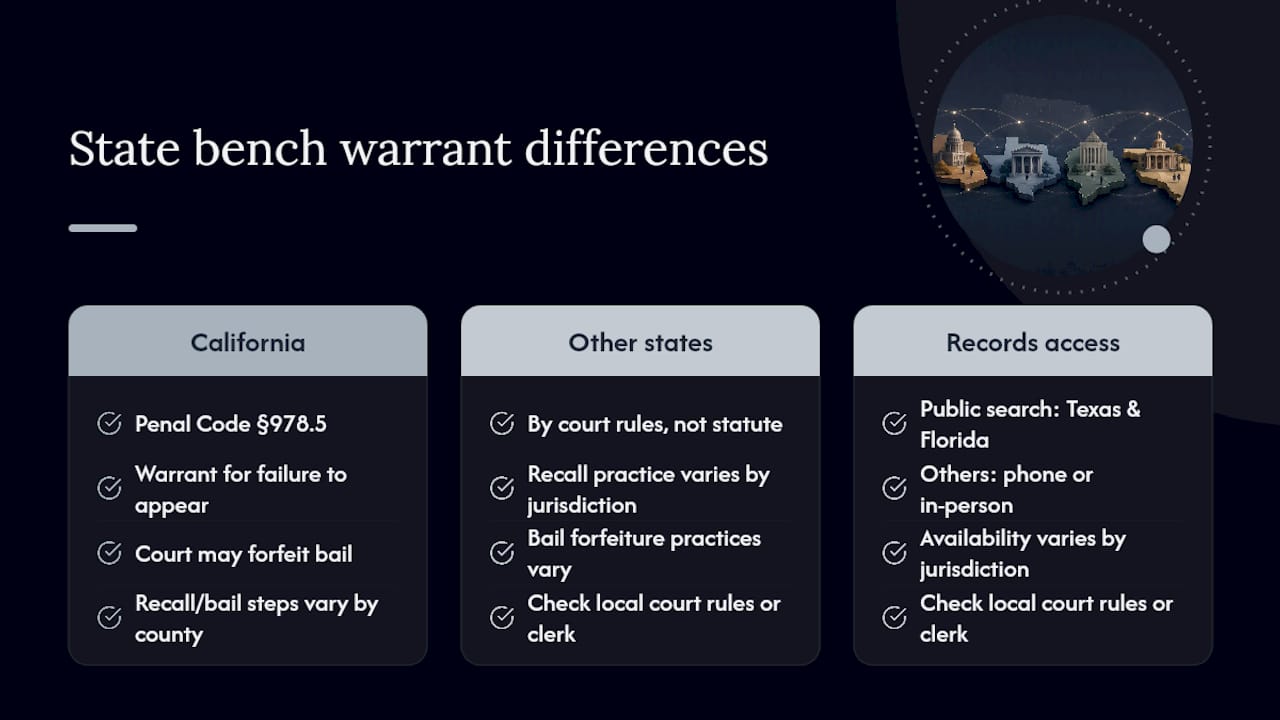
Bench warrant procedures are not uniform across the country. Bail practices, recall procedures, and online record availability all vary by jurisdiction.
California is a useful reference point. California Penal Code § 978.5 specifically addresses bench warrants for failure to appear, authorizing courts to issue warrants when a defendant who has been released on bail or their own recognizance fails to appear. The statute also governs the forfeiture of bail in those circumstances.
California Penal Code § 978.5 provides that a bench warrant may be issued when a defendant who has been released fails to appear as required, and the court may order bail forfeited at the same time the warrant issues. This makes California's bench warrant process one of the more explicitly codified in the country, though the practical steps for recall and bail reinstatement still vary by county.
Other states handle the same situation through court rules rather than statute. In some jurisdictions, a judge can recall a bench warrant at any time before arrest; in others, the defendant must appear in person before the warrant is lifted. Online record availability follows the same pattern: Texas and Florida maintain robust public warrant search tools, while other states require an in-person or phone inquiry.
Always check local court rules or call the relevant clerk's office directly. What applies in Los Angeles County may not apply in a rural Georgia court.
Prioritized checklist if you think you have a bench warrant
- Immediately: Stop and do not travel internationally or across state lines until you know your status.
- Within the hour: Search your county's online court portal and check public records databases for any existing booking entries.
- Within 24 hours: Call the court clerk's office where your case was filed and ask directly whether a warrant is active.
- Within 24 hours: Contact a criminal defense attorney, even for a brief consultation. Many offer free initial calls.
- Within 48–72 hours: If a warrant is confirmed, follow your attorney's guidance on whether to file a recall motion, arrange voluntary surrender, or pay outstanding amounts.
- Document everything: Keep records of every call, payment, and court communication in case a dispute arises later.
- After resolution: Confirm in writing with the court clerk that the warrant has been recalled and obtain a copy of the recall order.
Why ignoring a bench warrant always makes things worse
People underestimate how seriously law enforcement treats bench warrants, even for minor matters. A missed traffic court date feels trivial until a patrol officer runs your plates three months later and you're handcuffed on the side of a highway. That's not a hypothetical: it's the most common way bench warrants get executed.
The other mistake I see repeatedly is over-relying on third-party databases for a definitive answer. Public records sites, including Registryrecognizer, are genuinely useful for initial research and for understanding what's in the public record. But a database showing no recent arrest doesn't mean a warrant isn't active. The issuing court is the only authoritative source.
For complex situations, particularly probation violations or cases where a "no bail" designation is possible, surrendering without counsel is a real risk. A lawyer can sometimes negotiate terms before you walk through the door. Without one, you're at the mercy of whatever the judge decides that morning.
Pro Tip: Call the court clerk first, then an attorney. In that order. The clerk tells you what exists; the attorney tells you what to do about it.
Sources
The claims in this article draw from the following sources. Each serves a different purpose depending on what you need to verify.
- What Happens If You Have an Outstanding Bench Warrant? - Nolo
- Arrest Warrant (Metropolitan Police Academy publication)
- Bench Warrants | Attorney General Brian Schwalb (OAG DC)
- Legaldictionary
For urgent decisions, always prioritize government sources and direct contact with the court clerk over secondary or aggregator sites. State attorney general websites and your state's official court portal are the most reliable starting points for jurisdiction-specific rules.
This article provides general legal information, not legal advice. Laws and procedures vary by state and county. Confirm current rules with the issuing court or a qualified attorney before taking action.
Recommended
- ALLEN, JOHN PERNELL charged with Charge: Unspecified warrant 0 (16-5-23.1(F)(1) - Battery-FVA 1st Offense (M)); Arrest Date 07/14/2026; Bond - No Bond, $0.00; · Registry Recognizer
- SHAWANO COUNTY SEEKS TO ENFORCE COURT ORDER AFTER VIOLATION INCIDENT · Registry Recognizer
- WOOD, TOBIAS CODEE charged with CONTEMPT OF COURT:DISOBEY COURT ORDER/ETC · Registry Recognizer