
A capias warrant is a court-issued writ directing law enforcement to take a named person into custody and bring them before the issuing court. It does not mean you have been convicted of anything. The moment you discover one exists, do two things immediately:
- Check the issuing court's docket for the case number, bond amount, and any scheduled hearing date. Many state courts post this online.
- Call a criminal defense attorney or the court clerk before doing anything else. Ignoring a capias is the one move that guarantees it gets worse.
Registryrecognizer's arrest-record database can help you confirm whether a warrant appears in public booking records, but the issuing court holds the authoritative file. Texas Code of Criminal Procedure Article 23.04, for example, specifies the required elements a capias must contain, which is exactly why reviewing the actual paperwork matters.
Table of Contents
- What a capias warrant legally means and why courts issue it
- Common types of capias warrants and what triggers each one
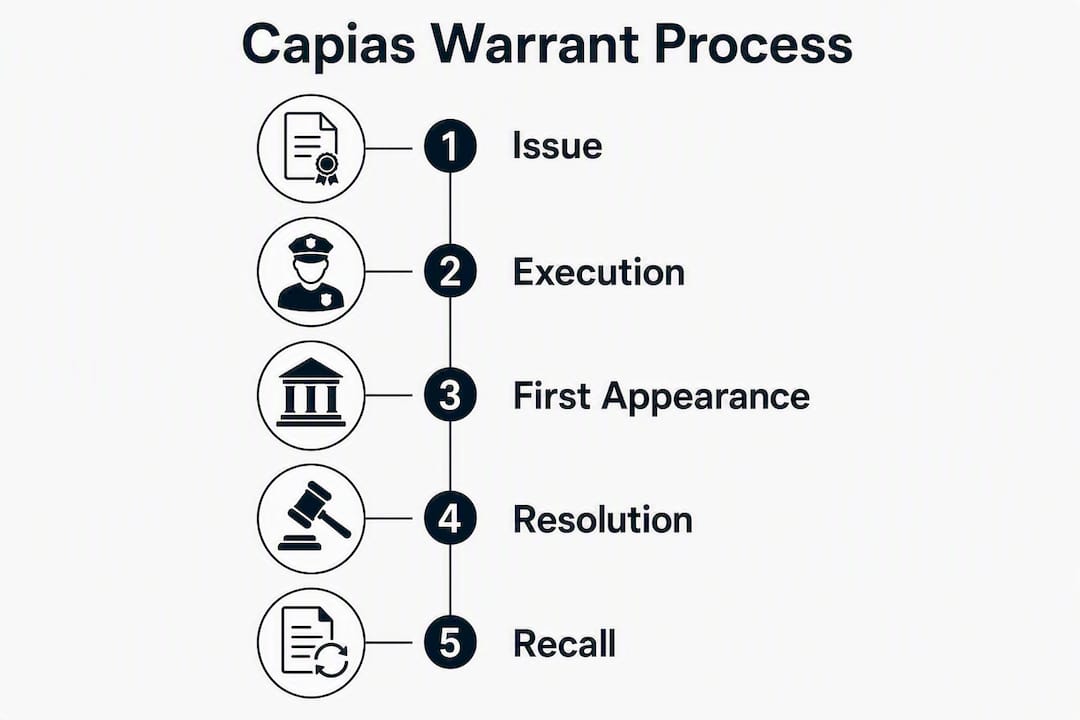
- What happens when law enforcement executes a capias
- How to clear or resolve a capias warrant step by step
- How bond and release work for capias warrants
- Your rights when police enforce a capias warrant
- How capias rules differ across U.S. states
- What Registryrecognizer records reveal about common capias triggers
- Key Takeaways
- Why acting fast on a capias changes the outcome
- Useful sources to verify capias warrant details
What a capias warrant legally means and why courts issue it
The word capias is Latin for "that you take." In modern U.S. courts, it refers to a writ ordering an officer to seize a named person and return them to court. Legal experts are clear that a capias is procedural, not a finding of guilt. Its sole function is to secure your presence before a judge.
Courts issue capias warrants in several situations:
- Failure to appear (FTA) at a scheduled hearing or trial date
- Contempt of court, including ignoring a judge's direct order
- Violation of court-ordered conditions, such as probation terms or a protective order
- Civil judgment enforcement, most commonly child support or alimony, where the arrest is for the failure to appear at a contempt hearing, not for the unpaid amount itself
Courts and jurisdictions often use the terms capias, bench warrant, and arrest warrant interchangeably in practice, but the technical distinction matters. A bench warrant typically originates from a judge's own courtroom after a missed appearance. An arrest warrant is usually tied to a new criminal charge supported by probable cause. A capias sits in the middle: it enforces an existing court obligation rather than initiating a new prosecution.
Common types of capias warrants and what triggers each one
Not every capias is the same. Courts use different labels depending on the purpose, and knowing which type you are dealing with tells you which court to contact and what remedy to pursue.
- Capias ad respondendum ("that you take to answer"): issued to compel a defendant to appear and respond to a civil claim. Rarely used in modern practice but still appears in some state courts.
- Capias ad satisfaciendum ("that you take to satisfy"): historically used to imprison a judgment debtor. Most states have abolished this form, but echoes of it appear in civil enforcement actions.
- Capias pro fine ("capias for the fine"): issued when a person fails to pay a court-ordered fine or fails to appear for a hearing related to an unpaid fine. Common in traffic and misdemeanor courts.
- Capias utlagatum ("capias for the outlaw"): an older writ used against someone declared an outlaw or fugitive by the court. Rarely invoked today, but the concept survives in fugitive warrant proceedings.
- Standard capias / bench capias: the most common modern form, issued after a failure to appear or a probation violation. Many courts simply call this a "capias" with no additional Latin qualifier.
One important caveat: state courts do not always use these labels consistently. The Connecticut State Marshal Commission Manual uses "capias" specifically for civil enforcement failures to appear, while other states fold the same concept into their bench warrant procedures. Always read the issuing court's paperwork to understand exactly what you are facing.
What happens when law enforcement executes a capias
The sequence moves fast once an officer encounters someone with an active capias. Here is what typically unfolds:
- Contact and identification. An officer runs your name during a traffic stop, a routine check, or a call to your address and finds the active writ.
- Arrest and custody. You are taken into custody on the spot. There is no negotiation at the scene.
- Transport and booking. Officers transport you to the county jail or detention facility, where you are photographed, fingerprinted, and processed.
- First appearance before the issuing court or magistrate. This usually happens within 24–72 hours. The judge reviews the underlying case, the reason for the capias, and your history.
- Bond determination. The court sets bond, denies bond, or releases you on your own recognizance depending on the offense and your record.
Possible outcomes at that first appearance range from a simple bond amount you can post immediately to being held without bond until a full hearing. Penalties can include arrest, jail time, additional fines, revocation of any existing bond, or heightened bail conditions going forward. If you were already out on bond in the underlying case, that bond is often revoked automatically when the capias is executed.
Pro Tip: A capias does not expire on its own. Courts keep it active until you appear or the court formally recalls it, which means every traffic stop, every background check, and every interaction with law enforcement carries the risk of arrest.

How to clear or resolve a capias warrant step by step
Voluntary action almost always produces a better outcome than waiting to be arrested. Here is the practical sequence:
- Verify the warrant. Pull the case number from the court's online docket or call the clerk's office directly. Confirm it is active and note the issuing judge's name, the bond amount if listed, and any hold codes.
- Gather your documents. Before you call anyone, have these ready:
- Case number and court name
- Original hearing date you missed (or the condition you allegedly violated)
- Any proof of compliance (payment receipts, treatment completion certificates, employer letters)
- Prior arrest paperwork if relevant
- Contact a criminal defense attorney. An attorney can often file a motion to recall or quash the capias before you set foot in the courthouse, or arrange a voluntary surrender date that avoids a surprise arrest.
- Determine bond or no-bond status. If bond is set, arrange to post it through a licensed bondsman or in cash at the clerk's window. If the warrant is no-bond, your attorney needs to petition the court for a bond hearing.
- Arrange voluntary surrender or a scheduled hearing. Courts routinely treat defendants who surrender voluntarily more favorably than those who are dragged in. Your attorney can often negotiate a specific date and time.
- Attend every subsequent hearing. Missing another date after resolving the first capias almost guarantees a second one with stricter conditions.
Pro Tip: If you cannot afford a private attorney, contact the public defender's office in the county that issued the capias before you surrender. Many offices will accept your case and appear with you at the initial hearing, which can significantly affect bond decisions.
Resolving a capias typically requires addressing the issuing court directly. No amount of time passing will make it disappear on its own.
How bond and release work for capias warrants
Bonding out on a capias works much like bonding out on any other warrant, with one critical variable: the judge's bond order.
- Bond allowed: If the capias lists a bond amount, you or a licensed bail bondsman can post it at the jail or clerk's office. Once posted, you are released pending the next court date.
- No-bond status: Some capias warrants carry a "no bond" designation. This happens most often with violent offenses, repeated failures to appear, or probation violations where the supervising officer has filed a hold. In these cases, you must appear before a judge before any release is possible.
- Own recognizance (OR) release: For minor matters, a judge may release you without requiring any cash, relying instead on your promise to appear.
Bonding out is often possible unless the warrant or judge specifies no-bond status. The practical question to ask the clerk or your attorney is simple: "Does this capias carry a bond amount or a no-bond hold?" That single answer tells you whether a bondsman can help immediately or whether you need a court hearing first.
For context on how bench warrants and capias warrants compare in bond situations, the bench vs. arrest warrant guide at Warrant Bail Bonds breaks down the mechanics clearly.
Can you bond out on a capias? Yes, in most cases, as long as the issuing judge has not entered a no-bond order. Contact the clerk of the issuing court to confirm the bond status before making any other arrangements.
Your rights when police enforce a capias warrant
Law enforcement has real authority when executing a capias, but that authority has limits.
- Right to remain silent: — You have the right to stay silent beyond providing basic identification where state law requires it. Use it.
Pro Tip: The single most effective way to avoid additional charges during a capias arrest is to stay calm, comply physically, and say nothing beyond your name. Resisting arrest or providing false information can add new criminal charges that are entirely separate from the original capias matter.
How capias rules differ across U.S. states
The word "capias" appears in statutes and court rules across the country, but what it means procedurally varies more than most people expect.

Common state-level differences include who can issue a capias (judge only vs. clerk of court), whether a capias requires a bond amount on its face, how long the court waits before issuing one after a missed appearance, and whether the term "capias" is even used or replaced by "bench warrant" or "alias warrant."
Local checklist before you contact the court:
| Item to Confirm | Where to Find It |
|---|---|
| Court name and county | Capias document or online docket |
| Case number | Capias document or clerk's records |
| Issuing judge's name | Capias document |
| Bond amount or no-bond hold | Capias document or clerk's office |
| Clerk's phone number and hours | Court's official website |
| Next scheduled hearing date | Online docket or clerk |
Cuyahoga County's Rule 29, for example, governs exactly when a citation or capias is issued in domestic relations matters, illustrating how local court rules add a layer of specificity that state statutes alone do not capture. When in doubt, consult a local attorney who practices in the issuing court's jurisdiction.
What Registryrecognizer records reveal about common capias triggers
Public arrest records in the Registryrecognizer database show consistent patterns in the circumstances that lead to capias-style enforcement actions. The table below summarizes common trigger categories drawn from records in the database.
| Trigger Category | Example from Records | Typical Outcome |
|---|---|---|
| Probation violation | King, Keion Jacquese, felony probation violation | Capias or hold issued; bond often denied |
| Unspecified warrant / FTA | Allen, John Pernell, unspecified warrant, no bond | Arrested on contact; no-bond status noted |
| Fugitive identification failure | Anthony Quinton Oran Smith, fail to ID fugitive | Additional charges added at booking |
| Court order enforcement | Shawano County court order violation | Enforcement action initiated by county |
| DOC contract / supervision hold | Caprai, Casey Glenn, DOC contract | Held pending DOC review |
Public arrest records reflect booking information at the time of entry. They may not show final case dispositions, charge reductions, or dismissals. Always verify the current status of any warrant or charge directly with the issuing court before drawing conclusions.
These records are useful for understanding whether a warrant has been entered into the public system, but the court docket is the only authoritative source for current status.
Key Takeaways
A capias warrant is a procedural court order compelling your appearance, not a conviction, and voluntary action taken quickly almost always produces better outcomes than waiting to be arrested.
| Point | Details |
|---|---|
| Definition | A capias is a court writ ordering arrest to compel appearance, not a finding of guilt. |
| Immediate actions | Check the court docket for bond status and call an attorney or clerk before anything else. |
| Bond basics | Bonding out is usually possible unless the judge has entered a no-bond order on the capias. |
| Rights during arrest | Invoke your right to remain silent and request counsel immediately upon arrest. |
| Warrants don't expire | A capias stays active until the court recalls it; ignoring it guarantees eventual arrest. |
Why acting fast on a capias changes the outcome
The pattern that stands out most clearly across Registryrecognizer's database is how often no-bond holds appear on records where someone waited to be found rather than addressing the warrant proactively. Judges notice the difference between a defendant who surrendered voluntarily with counsel and one who was picked up on a traffic stop six months after the capias issued.
The fear around the word "capias" is understandable, but practitioners consistently note that clarifying it as a procedural tool, not a criminal verdict, reduces panic and encourages the kind of prompt court contact that actually helps. A capias issued for a missed child support hearing is not the same legal situation as one issued after a violent offense, but both get resolved the same way: show up, with a lawyer, before law enforcement shows up for you.
The best timing for voluntary surrender is almost always before you are arrested, not after. Courts in most jurisdictions allow defense counsel to arrange a surrender date, which gives you control over when and where the arrest happens, often at the courthouse rather than at your home or workplace. That distinction matters practically, not just emotionally.
Check Registryrecognizer to see whether a warrant appears in public booking records, then take that information to a licensed attorney in the issuing county. Public records are a starting point, not a substitute for legal advice.
This article provides general legal information, not legal advice. Warrant procedures vary by state and court. Consult a licensed attorney and verify current rules with the issuing court for guidance specific to your situation.
Useful sources to verify capias warrant details
The sources below are the most reliable places to confirm definitions, procedural rules, and next steps.
- The Law Dictionary: What Is a Capias Warrant? — Plain-language definition with practical context on bond and issuance; a solid first stop for anyone who just found a capias on a docket.
The issuing court's own docket is always the authoritative source for current warrant status. Use the resources above to understand the process, then confirm the specifics with the clerk or a licensed attorney in the relevant jurisdiction.
Recommended
- ALLEN, JOHN PERNELL charged with Charge: Unspecified warrant 0 (16-5-23.1(F)(1) - Battery-FVA 1st Offense (M)); Arrest Date 07/14/2026; Bond - No Bond, $0.00; · Registry Recognizer
- SHAWANO COUNTY SEEKS TO ENFORCE COURT ORDER AFTER VIOLATION INCIDENT · Registry Recognizer
- CAPRAI, CASEY GLENN charged with DOC CONTRACT · Registry Recognizer
- WOOD, TOBIAS CODEE charged with CONTEMPT OF COURT:DISOBEY COURT ORDER/ETC · Registry Recognizer