
A court case number is an alphanumeric ID that typically encodes the filing year, the court or division, the case type, and a sequential number, sometimes followed by judge initials or a local code. Formats vary by state and by court level, so a number alone rarely tells you anything until you pair it with the specific court that issued it.
TL;DR:
- Federal district case numbers follow a consistent pattern of district, year, case type, sequence, and judge initials, making them quickly decodable.
- State court formats vary by jurisdiction, with some, like Massachusetts and California, providing public guides to their structure, while others require direct clerk contact.
- Search accuracy depends heavily on exact replication of the original case number and always attaching the correct jurisdiction to avoid dead ends.
- Judge initials, check digits, and internal codes are not essential for public searches and often cause confusion if treated as key identifiers.
- Matching the case number to its specific court is the most reliable way to prevent false positives or missed records during searches.
Table of Contents
- Understanding case number formats: the common building blocks
- Federal court case number examples: district, appellate, and bankruptcy
- State and local case number examples: MA, NJ, WA, CA, NY, and TX
- How to search using a case number without hitting dead ends
- Registry Recognizer's approach to mapping case numbers to public records
- What actually matters when you're decoding a case number
- Sources
Understanding case number formats: the common building blocks
Every jurisdiction builds its numbers a little differently, but most pull from the same handful of parts. Once you can spot them, decoding an unfamiliar case number from another state takes about ten seconds instead of ten minutes.
- Year component: Usually two or four digits marking the filing year. A "24" or "2024" at the front (or embedded mid-string) tells you when the case entered the system, and matters when you're searching by date range.
- Court or division code: A numeric or letter code identifying which courthouse, division, or judicial district handled the case. Federal courts use these constantly; some state systems skip them entirely.
- Case-type designator: Letters like
cv(civil),cr(criminal),bk(bankruptcy),ap(adversary proceeding), ordm(domestic matter) tell you what kind of legal action it is. - Sequential number: The actual count. Some courts reset this to 1 every January; others run one continuous sequence for years.
- Optional suffixes: Judge initials, check digits, or county codes tacked onto the end, mostly for internal court tracking.
Case-number strings typically run somewhere between 6 and 21 characters, depending on how many of those elements a given court includes and whether judge initials or division codes get appended. The New York Southern District explains that a docket number like "01 Civ. 2345 (CM)" packs the filing year, case type, sequence, and judge initials into one compact string, and that pattern repeats across dozens of courts with only minor variation. Terminology shifts by region too. What one court calls a "docket number," Texas calls a "cause number" and New York calls an "index number," but they all point to the same underlying record.
Federal court case number examples: district, appellate, and bankruptcy
Federal courts follow the most standardized format in the country, largely because they all run through PACER, the electronic public access system that covers appellate, district, and bankruptcy filings nationwide. Once you know the pattern, you can decode almost any federal number on sight.
- District court format. A number like
2:24-cv-01234-ABCbreaks down as:2(division within the district),24(filing year),cv(civil case type),01234(sequential case number), andABC(assigned judge's initials). Criminal cases swapcvforcr; the rest of the structure holds. - Appellate and Supreme Court numbers. These run shorter and skip the division and judge-initial pieces entirely. A federal circuit court appeal might read
24-5678, and a Supreme Court petition might read23-456. Just year and sequence, no case-type letter needed since the court itself implies the docket type. - Bankruptcy's two-number system. Bankruptcy courts publish a complete case number for the initial filing and a shortened version for everything after. The Central District of California's bankruptcy FAQ lays out both formats side by side, and notes that electronic case filing (CM/ECF) and Notices of Electronic Filing (NEFs) generally expect the shortened number on subsequent documents.
Pro Tip: If a federal search comes back empty, drop the judge initials first. That suffix is administrative and rarely required by the search field, even though it's part of the "official" number you see on filings.
State and local case number examples: MA, NJ, WA, CA, NY, and TX
State systems diverge more than federal ones, and a handful of states publish their format logic publicly, which makes them useful reference points even if you're searching in a different state entirely.
- Massachusetts: District Court numbers follow a strict pattern of two-digit year, two-digit court code, two-letter case-type code, and a six-digit sequence, producing something like
1448CV001026. Mass includes a diagram showing exactly where each segment starts and ends. - New Jersey: The federal District of New Jersey uses the standard division prefix format, and local convention often tacks on judge initials the same way New York's Southern District does, so a filer copying a number for a search should expect that suffix to appear even though it's not needed for lookups.
- Washington: Superior court numbers put the two-digit year first, followed by a single digit for case type, then the sequential number, and sometimes a final check digit. Washington's Odyssey case-management migration changed some of those trailing digits to county codes, so an older number and a newer one from the same county can look slightly different even for the same case type.
- California: County superior courts and appellate divisions each run their own numbering, and most local guidance says to drop judge initials when searching, since they're rarely indexed as searchable fields.
- New York: Civil filings use "index number" instead of "case number," a naming quirk that trips up plenty of first-time searchers who assume the terms aren't interchangeable.
- Texas: Courts use "cause number" as the standard term. Format specifics vary enough by county that contacting the clerk directly is often faster than guessing.
How to search using a case number without hitting dead ends
Getting a hit on the first try usually comes down to precision, not luck. A single dropped zero or misplaced hyphen can send a search into a void.
- Copy it exactly. Punctuation, spacing, and leading zeros all matter. A leading zero dropped from "01234" to "1234" can break an exact-match search field.
- Try both short and full forms. This matters most in bankruptcy and federal district cases, where the complete number and the shortened number for later filings genuinely differ.
- Strip local suffixes if the first attempt fails. Judge initials, check digits, and calendar codes are usually there for internal court tracking, not public search indexing, according to library research guidance on docket numbers.
- Always attach the jurisdiction. A number like "24-CV-1234" could exist in dozens of counties simultaneously. State, county, or district context is what makes the number unique.
- Call the clerk if the number looks proprietary. Municipal and local courts frequently run their own numbering schemes that don't match any public template, and no online guide will decode them for you.
Pro Tip: Keep a note of exactly how you typed the number on your first search attempt. If you start removing characters to troubleshoot, it's easy to lose track of what you've already tried and end up looping through the same failed variant twice.
For readers preparing documentation around a case, a partner resource like divvi's AI case audit can help organize scattered filings and communications, and guidance on organizing court communication covers the same problem from a documentation angle.
Registry Recognizer's approach to mapping case numbers to public records
Registry Recognizer's database maps booking and case identifiers the way they actually appear on county systems, not a cleaned-up or reformatted version. That distinction matters because reformatting even slightly, say, dropping a leading zero or swapping a hyphen for a space, can turn a real record into a dead search.
Real entries in the database show this in practice. A record like CAPRAI, CASEY GLENN charged with a DOC contract violation preserves the charge code exactly as the county listed it. Another, KING, KEION JACQUESE charged under case CC24-0246, keeps the county's own prefix and sequence intact rather than normalizing it into a generic format.
Before you search:
- Copy the identifier directly from its original source rather than retyping from memory.
- Note the county or court alongside the number. Identical sequences can exist in different counties.
- If nothing returns, search by name and narrow by county instead of forcing an exact-string match.
What actually matters when you're decoding a case number
Most guides on this topic obsess over teaching you to parse every character in a case number, and that's mostly wasted effort. The year, case type, and sequence tell you almost everything useful. Judge initials, check digits, and calendar codes exist for the court's internal bookkeeping, not for you, and treating them as essential is where most searches go wrong.
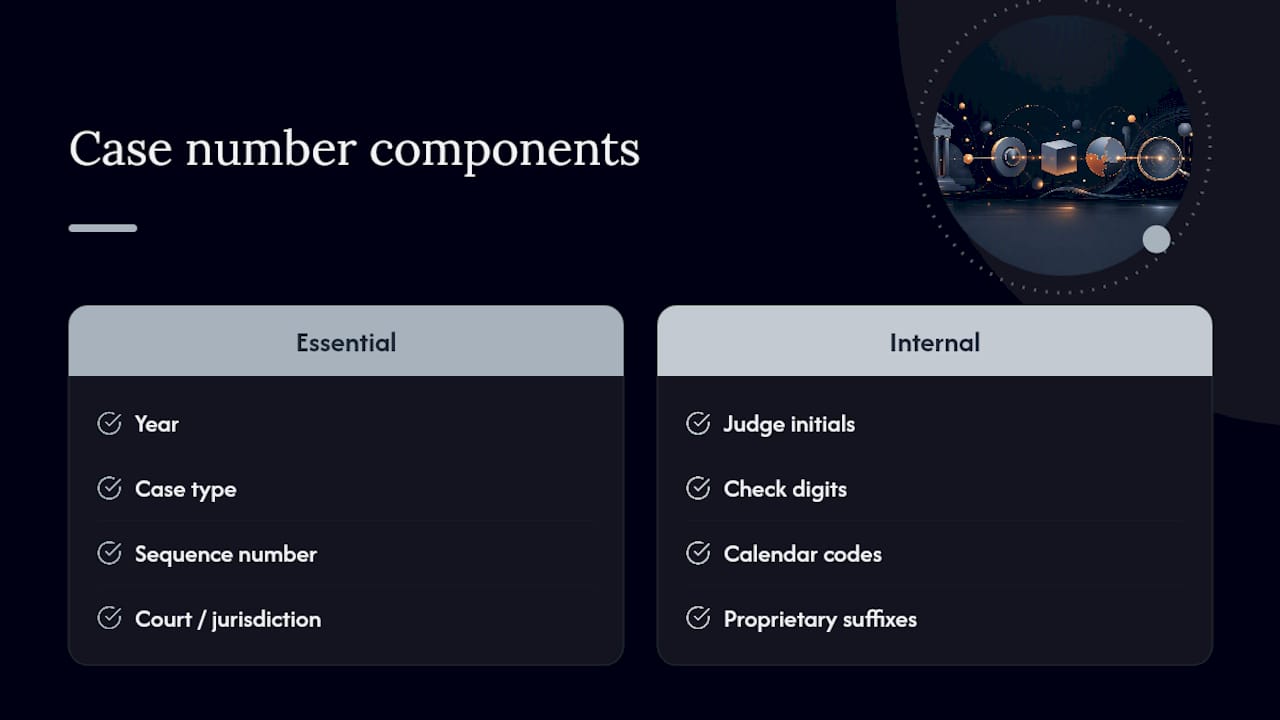
The bigger blind spot is jurisdiction. People treat a case number like a universal key, when it's really only unique within its own court. Two counties can issue the identical string in the identical year for two unrelated cases. If you take away one habit from this piece, make it this: never search a number without the court attached to it. That single step prevents more wrong-record confusion than memorizing every state's formatting quirks combined.
If your number still returns nothing after stripping suffixes and confirming the jurisdiction, stop guessing and call the clerk. Local and municipal courts run enough proprietary schemes that no public guide, including this one, can promise to decode all of them.
— Sean
Ready to look someone up? Search Registry Recognizer's database directly by name or case identifier, or browse a record like Freddy Lopez Molina's booking entry to see how charge codes and case identifiers appear in a real county record.
This article is general information, not a substitute for advice from a qualified lawyer. Consult a qualified legal professional about your own circumstances before acting on anything here.
Sources
- What is a docket number? | U.S District Court
- District Court: Get to know the case number format
- Court case number format (Washington Courts)
- Case number: what does it mean (CACB FAQ)
- PACER