
A criminal charge is a formal accusation. A conviction is a court's finding of guilt, reached by a guilty plea or a trial verdict. That gap between the two matters more than most people realize: prosecutors only need probable cause to file a charge, but a conviction requires proof beyond a reasonable doubt, a far steeper bar. If you or someone close to you has just been charged, the immediate move is simple. Say nothing beyond identifying information, and get a criminal defense attorney on the phone before you talk to anyone else.
Key Takeaways
A charge is an unproven accusation resting on probable cause, while a conviction is a court's final judgment of guilt requiring proof beyond a reasonable doubt.
| Point | Details |
|---|---|
| Different proof standards | Charges need only probable cause; convictions require proof beyond a reasonable doubt. |
| Pleas count as convictions | A guilty plea produces the same legal record as a guilty verdict at trial. |
| Charges can vanish | Dismissal, acquittal, or diversion can end a case without any conviction ever attaching. |
| Sealing rules vary | Expungement and sealing eligibility depend heavily on your state and the case outcome. |
| Records can lag | Public arrest databases may not reflect a later dismissal or acquittal, so verify with the court docket. |
Table of Contents
- Charge vs Conviction: What Filing a Charge Actually Means
- Charge vs Conviction: What It Means to Be Convicted
- From Arrest to Conviction: The Procedural Timeline
- Charged vs Convicted: A Quick Side-by-Side
- How Charges and Convictions Follow You Into Everyday Life
- What to Do the Moment You're Charged
- How Arrest Records Show Charges Before Any Case Is Resolved
- Why the Charge Versus Conviction Confusion Persists
- Sources
Charge vs Conviction: What Filing a Charge Actually Means
A charge starts with a prosecutor, not a jury and not a judge. It is a formal accusation that someone committed a crime, built on probable cause rather than proof. Probable cause just means there's enough evidence to reasonably suspect involvement, a much lower threshold than what's needed to convict.
Charges take different shapes depending on the offense and the state:
- Misdemeanor complaint: filed directly by a prosecutor for lower-level offenses.
- Information: a formal charging document a prosecutor files after a preliminary hearing, common in felony cases in many states.
- Grand jury indictment: used for serious felonies in jurisdictions that require grand jury review before charges proceed.
Once filed, a charge typically becomes part of the public record almost immediately, showing up in county booking logs and arrest databases long before any court ever decides guilt or innocence.
Charge vs Conviction: What It Means to Be Convicted
A conviction happens one of two ways: a jury or judge finds the defendant guilty at trial, or the defendant enters a guilty plea that the court accepts. Either path produces the same legal outcome: a formal judgment of guilt entered into the court record.
The standard for getting there is beyond a reasonable doubt, the highest burden of proof in the American legal system. That's a deliberate design choice. It exists to make sure the state doesn't take someone's freedom on a hunch or a preponderance of suspicion.
A few things follow from a conviction:
- Sentencing comes next, whether that's fines, probation, or incarceration.
- The conviction becomes a permanent part of the criminal record unless sealed or expunged later.
- Collateral consequences, like license restrictions or immigration effects, attach at this point, not at the charging stage.
From Arrest to Conviction: The Procedural Timeline
The distance between being arrested and being convicted involves several distinct legal checkpoints, and each one changes what's actually true about a person's legal status.
- Arrest and booking. Police need probable cause to arrest, but an arrest is not a charge. Someone can be arrested and released with no charges ever filed.
- Arraignment. This is where formal charges are read in court and the defendant enters a plea, guilty, not guilty, or no contest. Bail or release conditions get set here too.
- Pretrial phase. Both sides exchange evidence through discovery. Felony cases often require a preliminary hearing or grand jury review to confirm probable cause exists to proceed. This is also when most plea negotiations happen, and the majority of criminal cases resolve here rather than at trial.
- Trial. If no plea deal is reached, the case goes before a judge or jury, where the prosecution must prove guilt beyond a reasonable doubt. A not guilty verdict ends the case; a guilty verdict produces a conviction.
- Sentencing. Once convicted, whether by plea or verdict, the court imposes a sentence, ranging from fines and probation to incarceration.
- Appeals. A convicted defendant can challenge the outcome, though appeals focus on legal errors, not a fresh retrial of the facts.
Every stage narrows the range of possible outcomes. Someone arrested Monday could be released without charges by Tuesday, or convicted eighteen months later after a trial. The label attached to their case changes at each checkpoint, and so do the stakes.
Charged vs Convicted: A Quick Side-by-Side
Here's where the practical differences show up most clearly:
- Legal status: A charge is an accusation still being tested; a conviction is a finished legal determination of guilt.
- Proof standard: Charges require probable cause; convictions require proof beyond a reasonable doubt.
- Liberty restrictions: Charged individuals may face bail conditions or pretrial release terms; convicted individuals face court-ordered sentences.
- Record permanence: Charges can be dismissed, resolved through diversion, or end in acquittal, all of which leave the record open to sealing in many states. Convictions are far harder to remove.
- Common outcomes: Charges resolve through dismissal, acquittal, diversion, or a plea agreement that converts into a conviction. There's no in-between category. Either the case ends without a guilty finding, or it doesn't.
How Charges and Convictions Follow You Into Everyday Life
Both charges and convictions can surface on background checks and public arrest databases, but they don't carry the same legal weight, and employers, licensing boards, and landlords should treat them differently.
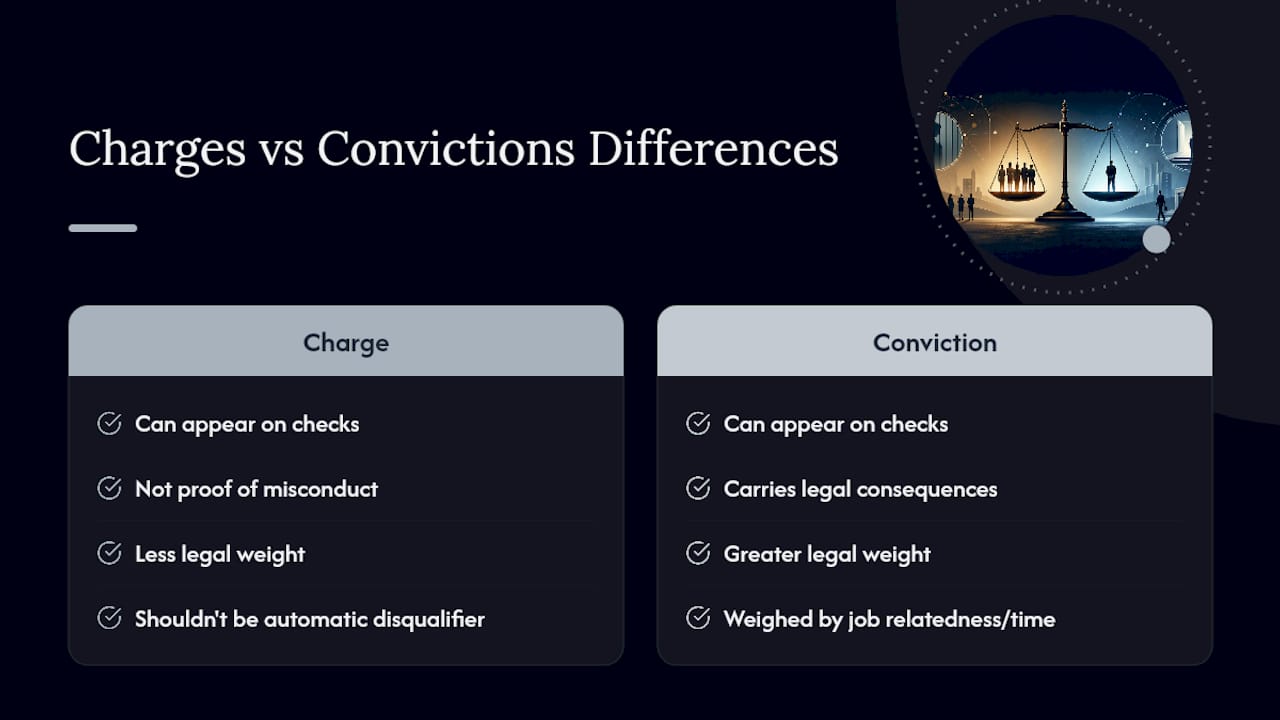
Employment and licensing is where this distinction gets tested most often. The EEOC has advised that an arrest record alone isn't proof of misconduct, and employers are expected to weigh convictions in context, looking at job relatedness and how much time has passed rather than treating a charge as an automatic disqualifier.
Convictions carry consequences a charge alone never triggers. A felony conviction can mean losing certain rights, such as the right to own a firearm, and may also affect voting rights or jury eligibility during incarceration or parole depending on the jurisdiction. Non-citizens face the sharpest edge: certain convictions can trigger deportation proceedings or bar future immigration relief, exposure that a mere charge doesn't create.
Pro Tip: If you're worried about how an old charge or conviction is showing up in a background check, check your eligibility for record sealing or expungement first. Rules vary widely by state and by offense, and dismissed charges usually have far better sealing odds than convictions do.
What to Do the Moment You're Charged
Acting fast and acting smart changes outcomes. Here's the sequence that actually protects you:
- Invoke your rights immediately. Say you want an attorney and stop talking. Anything said to police before counsel is present can be used against you, no exceptions worth risking.
- Preserve evidence and witness details while memories and materials are still fresh. Texts, receipts, security footage, anything relevant should be documented now, not months later.
- Meet every court deadline, starting with arraignment. Missing a court date can add charges on top of the ones you already face.
- Let your attorney evaluate your options. A defense lawyer might push for dismissal if evidence is weak, negotiate a plea to a lesser charge, or take the case to trial if the prosecution's proof falls short of the reasonable-doubt standard. Diversion programs and eventual sealing may also be on the table depending on the charge and your state.
Pro Tip: Stay off social media about your case entirely, and follow every bail or release condition to the letter. Prosecutors do look, and violations of pretrial conditions can undo the exact leniency your attorney is trying to negotiate.
How Arrest Records Show Charges Before Any Case Is Resolved
Registryrecognizer's database publishes booking details, charges, jail locations, and disposition status pulled from county sources, which means a charge can appear the same day someone is booked, long before a case resolves.
That speed comes with a catch: third-party records can lag behind or miss later updates, like a dismissal, acquittal, or sealed conviction. A listing showing a charge is not evidence of guilt.
Anyone using an arrest record to inform a decision, hiring, renting, or personal safety, should treat it as a starting point, not a verdict. Cross-check the disposition against the actual court docket, and when the stakes involve someone's legal status or your own, talk to an attorney about what it really means.
Why the Charge Versus Conviction Confusion Persists
Most of the confusion around charges and convictions doesn't come from bad information. It comes from language that gets flattened in headlines and casual conversation. News coverage says someone was "charged with murder" and readers hear "convicted of murder," even though those are entirely different legal realities separated by months or years of due process.
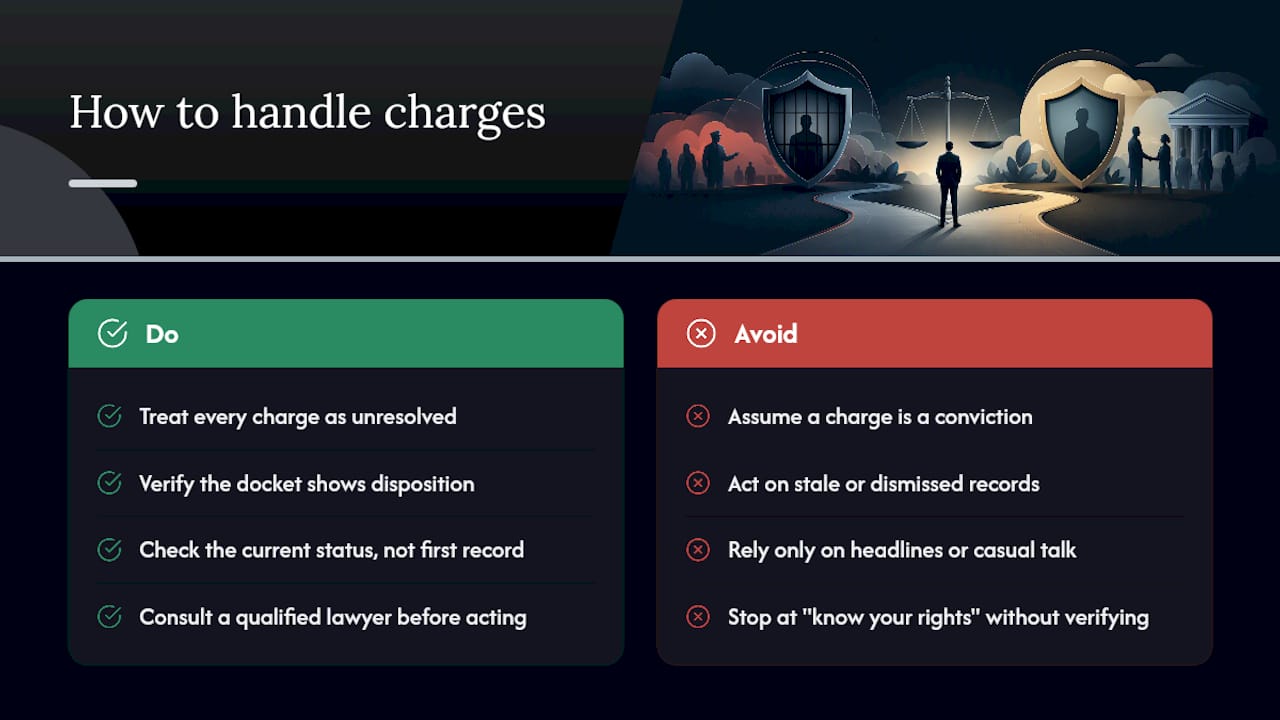
I think the bigger failure is how rarely people are told what to do with that confusion once they notice it. Knowing the definitions is step one. What actually protects someone, whether they're the person charged or someone checking a record on a friend, neighbor, or job candidate, is treating every charge as unresolved until a docket says otherwise. Conventional advice stops at "know your rights." It should go further: verify dispositions before you act on them, because a stale record can cost someone a job or a lease over a case that was dismissed years ago.
If there's one thing worth prioritizing above the legal vocabulary, it's this habit of checking the current status rather than assuming the first record you find is the last word.
— Sean
This article is general information, not a substitute for advice from a qualified lawyer. Consult a qualified legal professional about your own circumstances before acting on anything here.
Sources
- Charged vs. Convicted – What’s the Difference in a Criminal Case?
- Charged vs Convicted in New York ⚖️ - Updated Feb 2026
- Dictionary
- What is the Difference Between Being Charged and Being Convicted? - Rideout Law Group
Recommended
- CHRISTOPHER E ALCANTAR BECK charged with VIOL PROTECT ORDER/DV · Registry Recognizer
- Bessette, Bridget Ann charged with FELONY POSSESSION SCH II CS · Registry Recognizer
- KING, KEION JACQUESE charged with CC24-0246 PROBATION VIOLATION - FELONY · Registry Recognizer
- CAPRAI, CASEY GLENN charged with DOC CONTRACT · Registry Recognizer