
Start at the county sheriff's office. Nearly every county maintains a free online "inmate search" or "jail roster" that returns booking-level detail once you enter a full legal name and date of birth. If nothing turns up there, call the jail's records line directly. Beyond the county, tools like VINELink track custody status nationwide, and the Federal Bureau of Prisons locator covers anyone in federal custody. Keep two things handy before you search anything: the person's full legal name with date of birth, and, if you find a hit, the booking number.
- Full legal name + date of birth: required by nearly every custodial database.
- Booking number: your proof of record if the entry disappears later.
- County sheriff roster first, then VINELink or state/federal lookups if the county comes up empty.
Key Takeaways
Finding a specific county arrest record requires the person's full legal name and date of birth, the correct county sheriff's roster, and a fallback call to the jail's records line if the search comes up empty.
| Point | Details |
|---|---|
| Start at the county sheriff | County jail rosters, not city police logs, hold most current booking records. |
| Use name plus birth date | Full legal name and date of birth are required identifiers for nearly every jail search tool. |
| Save the booking number | Rosters are snapshots; entries can vanish within hours once someone is released or transferred. |
| Call when the search fails | Jail records lines can confirm custody status even when the online roster shows nothing. |
| Check Registry Recognizer for scale | Registry Recognizer speeds cross-county searches, but always verify results against the official sheriff's site. |
Table of Contents
- Where County Booking and Inmate Records Actually Live
- How Do You Search for a Specific County Booking Entry?
- What If the County Roster Shows No Results?
- When to Search State or Federal Systems Instead
- What Won't Show Up in Public Records
- How to Read a County Booking Entry
- Registry Recognizer: A Faster Way to Search Across Counties
- Try Registry Recognizer for Cross-County Searches
- Frequently Asked Questions
- Sources
Where County Booking and Inmate Records Actually Live
County crime statistics, in the sense that matters for finding a real person, live inside sheriff's office databases, not in aggregate crime reports. Each county sheriff runs its own jail, and each jail runs its own online roster. The format varies by county, but the fields rarely do.
A typical county inmate search returns the person's name, a booking number, the charges filed, the bond amount, and their current housing location inside the facility. Some counties add a mugshot; others withhold it depending on local policy or the charge type. The Utah County Sheriff's inmate search is a solid example of the standard format: search by name and birth date, get back a booking snapshot.
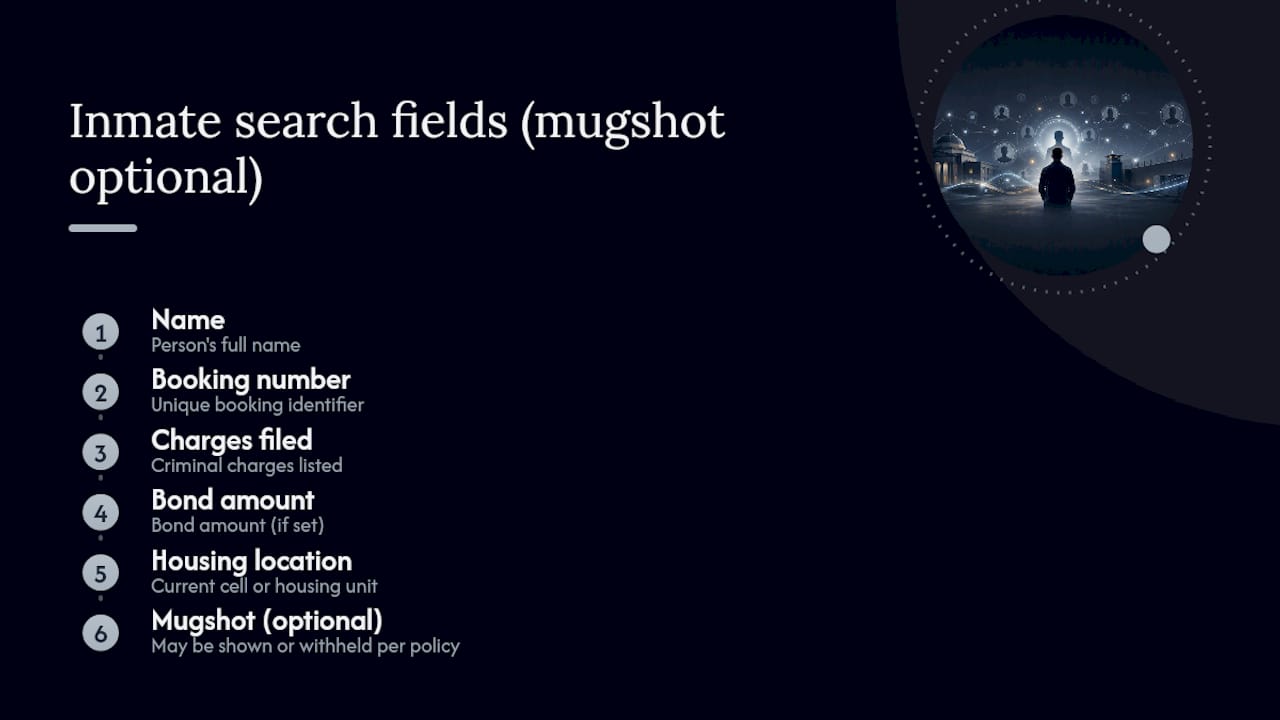
Here's where people get tripped up: city police departments make arrests, but county sheriffs run the jails. If someone gets arrested by city police, they still typically land in the county jail roster, not a separate city database, because county sheriffs operate the booking facility. That's why your first stop should almost always be the county, not the city police department's site.
Custody shifts to a different system entirely once someone is convicted and sentenced to more than a year. At that point, they usually move to state Department of Corrections custody, and county rosters stop showing them. Federal charges route to Bureau of Prisons systems from the start, bypassing county jails except for short pretrial holds.
Pro Tip: If a name search returns five people with the same name, add a middle initial or narrow by approximate booking date. Most rosters let you filter by date range even if the main search box doesn't advertise it.
How Do You Search for a Specific County Booking Entry?
Finding one specific person in one specific county jail is a five-minute task if you follow the sequence in order. Skip steps and you'll waste time searching the wrong system.
- Confirm the county. An arrest in a city doesn't always mean the county you'd assume. Cross-reference the city against its county, especially in states where city and county boundaries don't line up neatly (parts of Virginia and Louisiana are notorious for this).
- Search the sheriff's inmate roster. Use the full legal name exactly as it would appear on a driver's license, plus the date of birth. If the tool offers filters, try booking date range or booking number if you have a partial one.
- Record the booking number and timestamp the moment you find it. This is the detail that saves you later, because county jail rosters function as snapshots in time and a person can disappear from the list within hours of posting bond or being transferred.
- Verify the entry before you rely on it. Check that the facility location, listed charges, and bond amount are internally consistent. A booking number with no matching charge field, or a facility that doesn't operate as a jail, is a sign of a data lag.
If you're not sure which county has custody, or the county roster comes back empty, VINELink is worth checking next. It aggregates custody status across many county and state facilities and tends to update faster than you'd expect for a government-adjacent tool.
- No results on the county site? Try alternate spellings of the last name.
- Hyphenated or compound last names sometimes get filed under only the first half.
- Nicknames and maiden names rarely appear. Search the legal name on record.
Pro Tip: Screenshot the roster entry the moment you find it, with the timestamp visible. Booking numbers are facility-specific, so there's no national lookup tool that works across every jail once that snapshot rotates out.
What If the County Roster Shows No Results?
A blank search result rarely means "no arrest happened." More often it means the timing is off, the record hasn't posted yet, or the person already moved to a different system. Bookings that happened within the last few hours sometimes haven't propagated to the public-facing roster yet, and people released on bond can vanish from the list before you even finish reading this sentence.
Calling the jail's records line is usually your most effective next move when the website comes up dry. Have the full legal name, date of birth, and an approximate arrest date ready before you dial. Ask specifically whether the person is currently in custody, and if not, when they were released or where they were transferred.
- Ask for the booking number if the person is confirmed in custody.
- Ask whether charges have been formally filed or are still "pending review."
- If they've been released, ask which court will handle the case, so you can track disposition separately.
For anything beyond a quick phone confirmation, most counties accept a formal records request. Larimer County's Sheriff's Office, for example, charges a $7.50 nonrefundable search fee plus $0.25 per page for arrest and charge summary requests, and keeps records going back to 2005. Note that the sheriff's records office typically doesn't maintain final case dispositions. You'll need court records for that.
Pro Tip: Check for a self-service online request portal before mailing in a paper form. It's almost always faster than a formal written request that takes several business days to process.
When to Search State or Federal Systems Instead
County jails hold the majority of people in custody on any given day: recent arrestees, pretrial detainees, and people serving sentences under a year. But once custody shifts, so does the correct database.
- State DOC custody: typically triggered by a felony conviction with a sentence over a year. Search your state's Department of Corrections offender lookup tool, not the county roster.
- Federal custody: triggered by a federal charge (drug trafficking across state lines, federal fraud, weapons charges tied to federal statutes). Use the Bureau of Prisons inmate locator.
- Immigration detainer: triggered by an ICE hold layered on top of a criminal charge. Check ICE's detainee locator directly rather than assuming the county roster will reflect it.
Usa is a useful starting point when you're not sure which of these systems applies, and it links out to NARA's archives for older federal cases that predate digital record-keeping.
What Won't Show Up in Public Records
Not everything gets published, and that's by design, not by accident. Sealed and expunged records disappear from public view entirely once a judge orders it, regardless of how the original booking looked. Juvenile records stay confidential in nearly every state except under narrow circumstances involving certain violent felonies.
- Sealed or expunged cases: removed from public rosters once the court order takes effect.
- Juvenile bookings: confidential in almost all states, with rare statutory exceptions.
- Mugshots: some counties restrict release depending on charge severity or ongoing case status.
- Retention windows vary by county. Larimer County keeps searchable records back to 2005, but plenty of smaller counties keep far shorter windows.
Something to keep in mind: using arrest records to harass, discriminate, or defame someone can create real legal exposure for you, separate from whatever the record itself shows. If your use case touches on how law enforcement conduct factored into an arrest, a resource like Calil Law's overview of law enforcement misconduct is worth a look before you draw conclusions from a booking entry alone.
How to Read a County Booking Entry
A booking entry is not a verdict. It's a snapshot of a moment in the justice process, and treating it as a final legal outcome is the single most common misread of these records.
- Booking number: the facility's internal identifier. Note it immediately; it's your proof if the entry rotates off the roster.
- Charges listed: these are booking charges, often filed by the arresting officer, not the formal charges a prosecutor ultimately pursues.
- Bond amount: what's required for release pending trial. "No bond" doesn't necessarily mean the person stays in custody indefinitely.
- Disposition: the actual case outcome (conviction, dismissal, plea) lives in court records, not the sheriff's booking database. Always check the county or state court system separately before treating any charge as settled fact.
Registry Recognizer: A Faster Way to Search Across Counties
When you don't know which county to check, or you're comparing records across several jurisdictions at once, going sheriff-by-sheriff gets slow fast. Registry Recognizer aggregates booking entries, mugshots, charges, and jail locations across counties into one searchable database, updated on a regular basis, so you're not guessing which of 3,000-plus county websites to check first.
- Use it when you're unsure which county has custody, or need to scan several counties for a common name.
- Use it as a starting point, not a final source. Aggregators pull data on a delay compared to the county's own system.
- Always cross-check the booking number and facility details against the county sheriff's official roster before citing the record anywhere formal.
A record like this booking entry shows exactly what to expect: charges, bond, and booking specifics laid out the way the source county reported them.
A Note on Using These Records Responsibly
Treat a booking charge as an allegation, not a conviction, and check court disposition records before you repeat one publicly. Respect sealed and juvenile record restrictions even when you find a workaround. If you're building a public claim on a record, corroborate it against the official county source first.
Try Registry Recognizer for Cross-County Searches
Calling six different sheriff's offices to check one name across county lines wastes an afternoon most journalists and researchers don't have. Registry Recognizer puts county booking data, mugshots, charges, and jail locations into one searchable database, so a cross-county name check takes minutes instead of a string of phone calls.
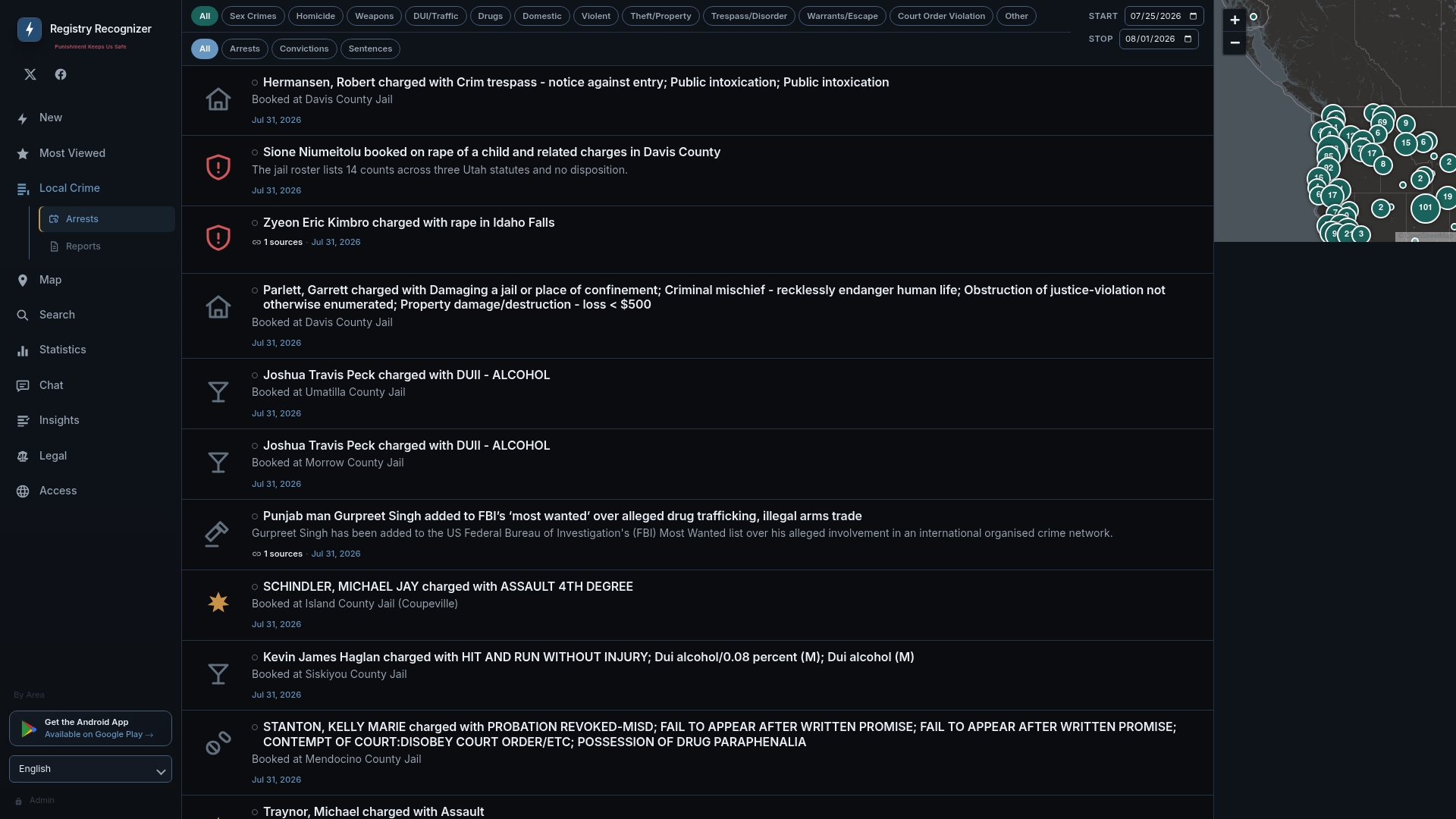
That speed comes with one condition: always confirm the booking number and facility details against the official county sheriff's roster, or by calling the jail's records line, before you rely on anything for a legal filing, published story, or formal decision. Browse a sample record like this probation violation booking to see the level of detail available, then run your own search on Registry Recognizer to see how a cross-county lookup compares to checking each county one at a time.
Frequently Asked Questions
Is county crime statistics the same as an FBI crime rate report? No. In this context, county crime statistics refers to individual, searchable arrest and booking records, not aggregate crime-rate data published by agencies like the FBI's UCR program.
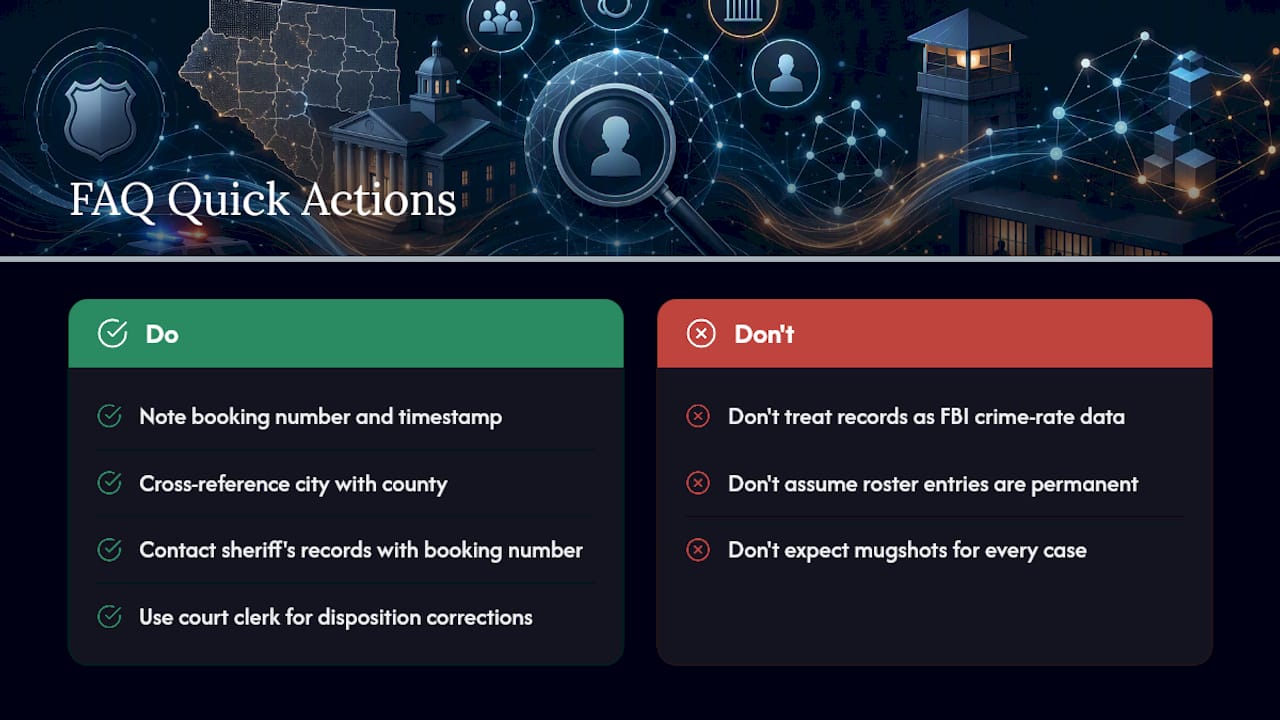
How current are county jail roster listings? They're near real-time snapshots, but people move through custody quickly. An entry can disappear within hours if someone posts bond or gets transferred, so note the booking number and timestamp the moment you find it.
What if I only know the wrong county? Cross-reference the city where the arrest happened against its actual county, since city and county lines don't always match public assumption. A directory like Arrest Ledger can help you identify the right sheriff's office for a given location.
Can I get someone's mugshot from a county jail record? Sometimes. Availability depends on the county's policy and the charge type; some jurisdictions restrict mugshot release for certain cases or have removed them from public rosters entirely.
What should I do if I find inaccurate information in a booking record? Contact the county sheriff's records department directly, provide the booking number, and ask about their correction process. Errors in booking charges get resolved differently than final court dispositions, which require going through the court clerk instead.
This article is general information, not a substitute for advice from a qualified lawyer. Consult a qualified legal professional about your own circumstances before acting on anything here.
Sources
- Utah County Sheriff — Inmate Search
- Larimer County Sheriff's Office — Records
- Usa
- Salt Lake County Sheriff — Jail
Recommended
- Murder suspect Jayden V. Cayou arrested in Marinette, WI · Registry Recognizer
- ALLEN, JOHN PERNELL charged with Charge: Unspecified warrant 0 (16-5-23.1(F)(1) - Battery-FVA 1st Offense (M)); Arrest Date 07/14/2026; Bond - No Bond, $0.00; · Registry Recognizer
- KING, KEION JACQUESE charged with CC24-0246 PROBATION VIOLATION - FELONY · Registry Recognizer