
A DOC number is the unique identifier a state Department of Corrections assigns to a person in its custody or supervision. It exists for one purpose: tracking that individual accurately across mail, visitation, transfers, and public records. Every state issues and manages its own DOC numbers, so a number from one system carries no meaning or validity in another.
TL;DR:
- DOC numbers vary by state and are not interchangeable; they are internal identifiers used solely within each state's correctional system.
- Accurate searches require confirming the correct state and using additional details like date of birth or facility name, especially for common names.
- State systems do not connect, so a DOC number from one state holds no validity outside that jurisdiction, and public records are often incomplete for sealed or juvenile cases.
- Using Registry Recognizer can provide quick insights into recent bookings, but certified records must be obtained directly from the relevant state DOC for legal or official purposes.
- Confusion often arises between corrections DOC numbers and document control numbers, so ensure the correct identifier is used based on the form or context.
Table of Contents
- DOC Number Meaning: Formats You'll Actually See
- Why the DOC Number Matters for Mail, Visits, and Lookups
- How to Find a DOC Number Using State Offender Lookup Tools
- Why a DOC Number Only Works Within Its Own State
- DOC Number vs. Document Number: A Common Mix-Up
- How Registry Recognizer Fits Into Your Search
- The Part Nobody Explains Well About DOC Numbers
- Search Records Now, Confirm With the State Later
- Sources
DOC Number Meaning: Formats You'll Actually See
A DOC number isn't a Social Security number or a driver's license ID. It's an internal tracking tag, created the moment someone enters a state correctional system, and it stays tied to that person's institutional record even after release in many states. The format, length, and even the label change depending on which state issued it.
Washington's Department of Corrections assigns a unique identification number to each person under its jurisdiction, and that number remains the primary way the agency identifies someone currently or formerly in its system. New York does something more layered: its Department of Corrections and Community Supervision (DOCCS) uses a Department Identification Number, or DIN, built from the year of intake, a letter representing the reception facility, and a four-digit sequence. DOCCS also references the New York State Identification Number, or NYSID, a separate criminal-history identifier tracked statewide.
Labels vary state to state, so it helps to know the common ones before you search:
- DOC number — the general term most states use on inmate records and lookup tools
- DIN — New York's Department Identification Number, tied to intake year and facility
- NYSID — New York's broader criminal-history identifier, distinct from the DIN
- Offender ID — the term some states use interchangeably with DOC number
Why the DOC Number Matters for Mail, Visits, and Lookups
The number does real work. It's not bureaucratic decoration.
- Mailing correspondence. Wisconsin's Department of Corrections requires every piece of mail to carry the recipient's full legal name plus their DOC number, and mailroom rules vary by facility. Skip the number, and the letter can get delayed, returned, or rejected outright.
- Public record searches. Common names generate dozens of false matches in a lookup tool. A DOC number narrows results to exactly one person, which matters when you're trying to confirm you've found the right individual and not someone who happens to share a name.
- Internal case management. Corrections staff use the number for classification decisions, transfer logistics, and case file continuity across facilities.
Pro Tip: Keep a written copy of the exact DOC number and spelling of the full name before contacting a facility. Mailroom staff process high volumes and can't troubleshoot vague requests.
How to Find a DOC Number Using State Offender Lookup Tools
Start by confirming the state where the person is or was incarcerated. This sounds obvious, but it trips people up constantly. Someone arrested in one state and later transferred, or someone with a record in a neighboring state, will not show up in the wrong system no matter how carefully you search.
Once you know the state, go to that state's official offender or inmate search page. Most systems ask for:
- Full legal name (try variations: maiden names, middle names, common misspellings)
- Date of birth, which sharply narrows results
- Facility name, if known
Washington's DOC site lets you search its six-digit ID system directly. New York's DOCCS parolee lookup tool references both DIN and NYSID in its own glossary, so knowing which number a form is asking for saves a wasted search. Wisconsin's DOC publishes general inmate information alongside its mail requirements, useful if your search doubles as a mailing task.
When a search returns nothing, don't assume the record doesn't exist. Common names generate multiple entries, and adding a date of birth or middle name to a query dramatically cuts down false positives in these systems. If the official tool still fails, contact the facility directly or reach out to the state DOC's public records office. Spelling errors, name changes, and data entry lag are the usual culprits.
Why a DOC Number Only Works Within Its Own State
There's no national DOC number and no single federal registry that consolidates every state's corrections identifiers. Each state runs its own system, built for its own recordkeeping needs, and none of them talk to each other automatically.
That has real consequences for how you search and what you can expect to find:
- A DOC number from Texas means nothing if you plug it into a Georgia lookup tool. The systems don't cross-reference.
- Federal-level tools like the National Sex Offender Public Website aggregate specific categories of offender data across states, but that's a narrow exception built for one purpose. It doesn't replace or unify state DOC numbering.
- Public lookup tools show what the state has decided to make public. Sealed records, juvenile cases, and certain expunged entries won't appear, and that's by design, not a glitch in the search.
- If you need a record for legal purposes, a court filing, or employment verification, a public lookup usually isn't sufficient. You'll need a state-certified record request through the DOC's official records office.
Treat every public offender search as a starting point for identification, not a substitute for certified documentation when the stakes are formal.
DOC Number vs. Document Number: A Common Mix-Up
"DOC" gets used differently depending on which government office you're dealing with, and that causes real confusion on forms.
A corrections DOC number identifies a person inside a state prison or supervision system. A document number, sometimes called a document control number, identifies a specific printed copy of a form, like a birth certificate, driver's license, or state ID. These serve entirely different functions, and mixing them up is one of the most common errors people make on official paperwork.
Where you find each one differs too:
- Corrections DOC number: printed on inmate correspondence, listed on state offender lookup results, referenced in facility records
- Document control number: printed directly on the physical ID, license, or certificate, usually in a corner or near a barcode
Read the exact wording on any form before submitting a number. An agency asking for a "document number" wants the ID printed on your card, not a corrections identifier, even if both happen to use the abbreviation "DOC" somewhere in casual conversation.
How Registry Recognizer Fits Into Your Search
Registry Recognizer maintains a searchable, regularly updated database of arrest and inmate records by county, including booking details, charges, jail locations, and disposition status. It's a fast way to check whether someone has a recent booking record or to cross-reference basic details before diving into a state DOC portal.

It's not a substitute for official state records when you need certified documentation, a court filing, or verified DOC-number confirmation. Use it to narrow your search quickly, then confirm anything that matters legally through the state's own offender lookup system.
The Part Nobody Explains Well About DOC Numbers
Most guides treat DOC numbers as a single, uniform thing, and that's the core mistake. They're not standardized at all. Washington's clean six-digit system and New York's layered DIN and NYSID setup exist because each state built its corrections IT infrastructure independently, decades apart, with no coordination. Anyone expecting a "national inmate ID" is working from a false assumption baked into how people talk about corrections data.
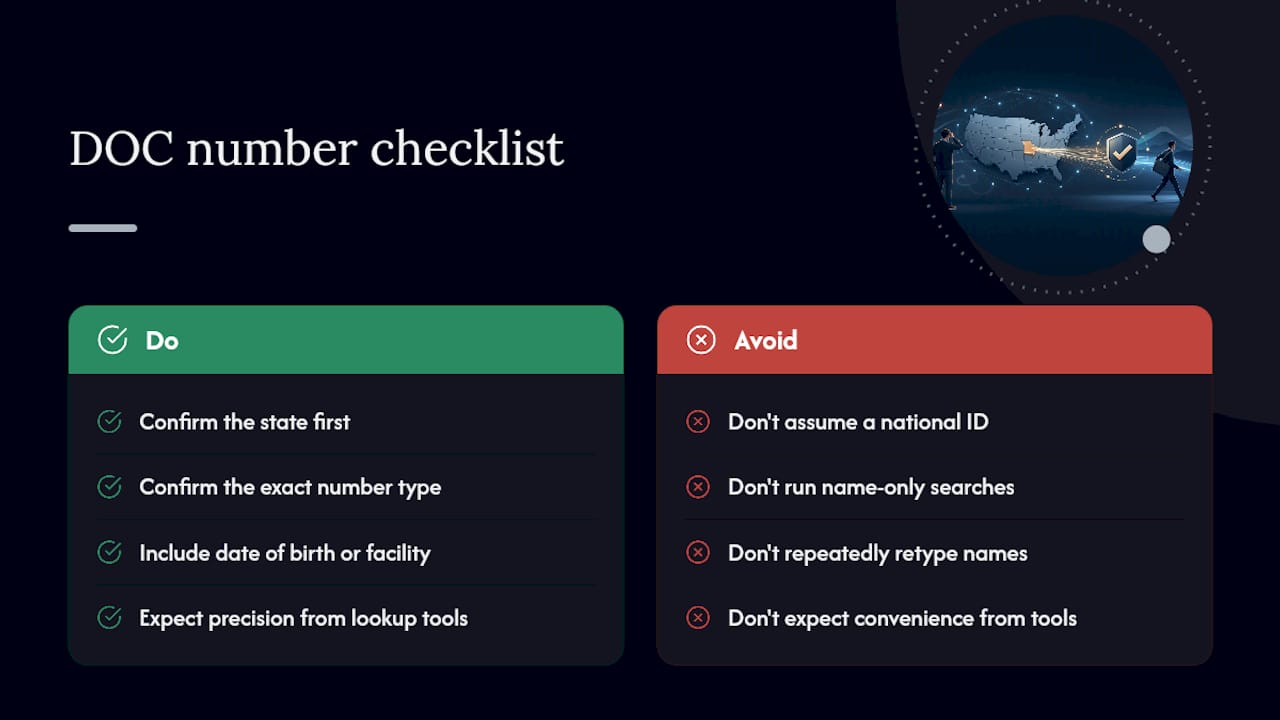
The bigger blind spot is on the search side. People assume a name search alone should work, then get frustrated when a common name returns forty results. The fix isn't a better search tool. It's knowing that a date of birth or facility name will do more to narrow results than any amount of retyping the same name. Official DOC lookup tools are built for precision, not convenience, and that tradeoff catches people off guard.
If there's one habit worth adopting, it's this: confirm the state first, then the exact number type the form is asking for, before you touch a search bar. That single step prevents most of the dead ends people run into.
— Sean
Search Records Now, Confirm With the State Later
Registry Recognizer gives you a fast, searchable way to check county-level arrest and inmate records without waiting on a state portal to load results. That speed matters when you're trying to confirm a booking, a charge, or a jail location right now, not after digging through a dozen different county sites.
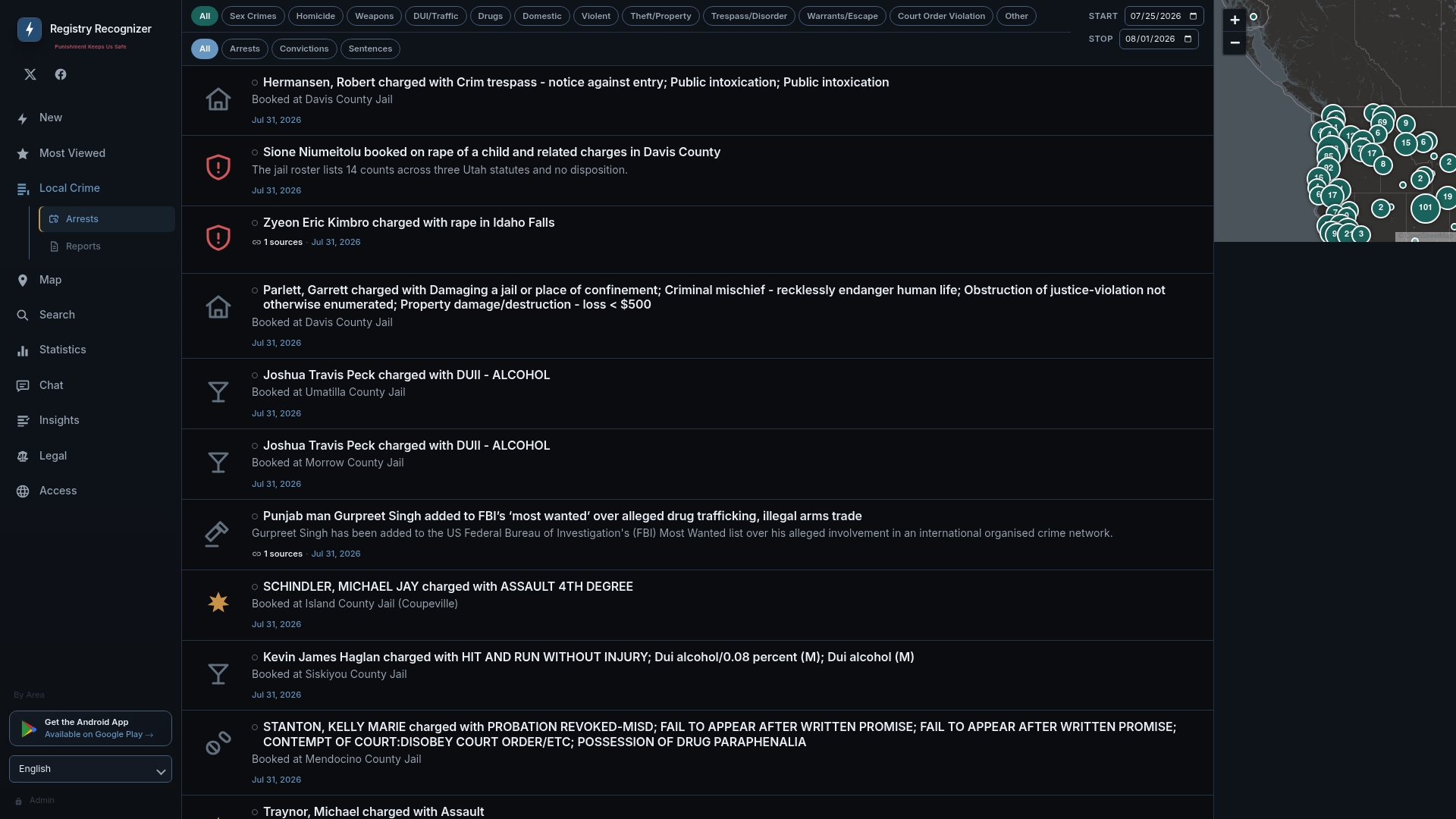
Search the Registry Recognizer database to check for recent bookings, charges, and facility details across counties. If you need a certified DOC number for legal, employment, or official purposes, treat what you find here as a lead, then confirm it directly through the relevant state Department of Corrections. For a sense of what a full record listing looks like, this sample booking record shows the kind of detail the site tracks.
Sources
For definitions and format examples, Washington's DOC publishes its own glossary of terms, and New York's DOCCS maintains a parolee lookup glossary covering DIN and NYSID. Wisconsin's DOC lists mailing and general inmate information by facility. For document-number confusion specifically, LegalClarity's breakdown is a solid reference, and for broader corrections context, the National Institute of Justice covers recidivism research and system-level background.