
Start with the official locator for the jurisdiction that holds the person: the Federal Bureau of Prisons for federal inmates, the state Department of Corrections for state prisons, and the county jail roster for anyone in pretrial or local custody. Add the NSOPW or ICE detainee locator if the case involves a registered sex offender or possible immigration hold. Expect to see location, custody status, and sometimes a projected release date; photos and exact release timing are often limited.
TL;DR:
- Searching by official locator should start with jurisdiction-specific tools, prioritizing federal, then state, then county databases, based on known details.
- Name matches are unreliable for common names; adding identifiers like birthdate or inmate numbers greatly improves search accuracy.
- County sheriff rosters update faster for recent arrests, making them essential when looking for very recent bookings or transfers.
- Public inmate records typically show basic custody details but exclude sensitive information such as medical records or photographs.
- Registry Recognizer can locate very recent county arrests before they appear in official state or federal systems, but results must always be verified with official sources.
Table of Contents
- How to Find an Inmate: A Step-by-Step Checklist
- Searching Federal Inmates Through the BOP Locator
- Finding Inmates in State Prisons and County Jails
- Sex Offender Registries and Immigration Detainee Searches
- Why Can't I Find an Inmate? Common Search Problems
- What Inmate Records Show, and What They Don't
- Registry Recognizer: A Faster Look at Recent County Bookings
- What Most Search Guides Get Wrong
- Still Can't Find Them? Try Registry Recognizer's County Search
- Sources
How to Find an Inmate: A Step-by-Step Checklist
Before you open a single search box, gather what you actually know. A search built on a full legal name, date of birth, and any known alias will beat a guess every time.
Run your search in this order to save time:
- Collect identifiers first: full legal name, birthdate, known aliases, and any inmate number you've seen on paperwork or a receipt.
- Search the BOP inmate locator if you suspect federal charges.
- Move to the state DOC for whichever state handled sentencing or is currently holding the person.
- Check the county jail roster if the case is recent or the charge sounds local (DUI, disorderly conduct, a probation violation).
- Add NSOPW or an ICE detainee search only if those circumstances apply.
If a common name returns dozens of hits, add the date of birth or try partial-name search options most state tools support. Some older or clunkier state sites behave inconsistently on mobile browsers, so switching to a desktop browser occasionally clears up a blank results page.
Searching Federal Inmates Through the BOP Locator
The BOP inmate locator covers people incarcerated in federal custody from the early 1980s to the present, and it takes more than just a name. You can search by:
- Full name (last name required, first name recommended)
- BOP Register Number, formatted as #####-###
- DCDC Number
- FBI Number
- INS Number
Searching by number instead of name removes almost all ambiguity, especially for common surnames. If you have a register number from court paperwork or a facility letter, use it first.
Pro Tip: If a name search on the BOP site returns nothing, don't assume the person was never federal. Try last name only with no first name entered. Some state DOCs handle partial matches better than the federal system does.
Two limitations trip people up constantly. First, the public locator generally does not display inmate photos. Second, release dates can lag behind reality because sentence calculations are being revised under the First Step Act, so a date you see today might shift. The BOP itself advises checking back periodically rather than treating any displayed release date as final. If a result shows "Released" or "Not in BOP custody," that doesn't mean the person is free. It often means custody has shifted to a state prison, a county jail, or a term of supervised release, and your next stop should be the relevant state or county tool.
Finding Inmates in State Prisons and County Jails
Federal and state custody are two different systems, and neither one automatically shows you the other. State DOCs generally hold people who have already been sentenced. County jails, by contrast, often hold people awaiting trial, serving short local sentences, or waiting on a transfer. If you're not sure which applies, check both.
Every state runs its own database with its own identifier. New York uses a DIN (Department Identification Number), and its incarcerated-individual lookup covers current inmates along with certain former ones, recommending you gather any accepted identifying details before you search. Texas uses a TDCJ number. Pennsylvania runs a combined inmate and parolee locator that requires you to pick the right state resource for wherever the person was actually convicted or held, since PA's own system only covers Pennsylvania custody.
Search behavior varies by state, too. Virginia's system, for example, typically wants at least the first letter of a first name plus a full last name, or an inmate ID, and it offers separate locators for people currently incarcerated versus those under parole or community supervision.
A few practical notes worth keeping in mind:
- County sheriff rosters update faster than state systems for very recent arrests.
- Some state maintenance windows take a locator offline for hours at a stretch, usually overnight.
- If you know the state of conviction but not the current facility, the DOC's main locator, not the county jail site, is your best first stop.
Pro Tip: When a state search comes up empty, try the county where the arrest happened rather than the county where the person lives. Jail bookings follow the arrest location, not the home address.
Sex Offender Registries and Immigration Detainee Searches
Inmate locators and offender registries answer two different questions, and mixing them up wastes time. An inmate locator tells you where someone is in custody right now. A sex offender registry tells you whether someone is registered, regardless of whether they're currently incarcerated.
The Dru Sjodin National Sex Offender Public Website lets you run a single national query across state and territory registries instead of checking each one individually. It's a registry, not a live custody tracker, so a registered offender who is also currently jailed may still show up separately in a state DOC or county system.
Immigration custody runs on its own track entirely. If you believe someone is being held by U.S. Immigration and Customs Enforcement, standard BOP and state locators won't help. You'll need ICE's own detainee locator system or direct contact with an ICE field office. Add this search only when the person's situation genuinely involves immigration enforcement, not general criminal custody.
Why Can't I Find an Inmate? Common Search Problems
Most failed searches trace back to one of three issues, and each has a fix.
- Wrong jurisdiction. Confirm whether the case is federal, state, county, tribal, or immigration related before you keep hammering the same database. A federal drug charge and a county DUI arrest live in completely separate systems.
- Transfers and confusing status labels. "In transit," "released," and "not in custody" don't all mean freedom. They can mean a transfer between facilities is underway. Call the facility if a status label doesn't match what you expected.
- Name and spelling mismatches. Nicknames, hyphenated last names, and simple misspellings block more searches than people realize. Try partial names, add the date of birth, and use any known alias.
Pro Tip: If you end up calling a facility's records office, have the person's full legal name, date of birth, and approximate arrest date ready. Ask specifically for "custody status," not just "is this person there," since the answer you get can differ depending on how you phrase the question.
When online tools dead-end, a phone call to the records office or booking desk resolves more cases than another round of retyping a name into a search box.
What Inmate Records Show, and What They Don't
Public inmate lookups tend to follow a similar pattern across agencies. You'll typically find:
- Full name and any listed identifiers (register number, DIN, TDCJ number)
- Age, race, and sex as recorded at booking
- Current facility or jail location
- Custody status
- A scheduled release date, when the agency has calculated one
What you generally won't find: medical records, sealed juvenile history, and in some agencies, photographs are withheld entirely depending on state policy. If you need certified copies for a legal proceeding, request them directly from the holding agency rather than relying on a public locator printout. Public records exist for transparency and safety awareness, not as a substitute for court-admissible documentation.
Registry Recognizer: A Faster Look at Recent County Bookings
State and federal locators are built for confirmed, processed custody. They're not built for speed. A booking that happened six hours ago at a county jail often hasn't reached a state DOC database yet, and it may never touch a federal one at all.
That gap is where Registry Recognizer does its best work. The database aggregates county arrest rosters, booking details, charges, and jail location data, which means it can surface an arrest before it shows up anywhere else.
| Scenario | Best tool |
|---|---|
| You don't have an inmate ID yet | Registry Recognizer, by name |
| Arrest happened very recently | Registry Recognizer or county sheriff site |
| Person was sentenced to state prison | State DOC locator |
| Person is in federal custody | BOP inmate locator |
The one rule that matters more than any other: treat a Registry Recognizer result as a strong lead, not a final answer. Confirm custody status with the BOP or the relevant state DOC before you act on anything you find.
What Most Search Guides Get Wrong
Most advice on this topic treats the search like it's one database with one front door. It isn't. It's a patchwork of federal, state, county, and registry systems that don't talk to each other, and the biggest mistake people make is picking one tool, getting a blank result, and assuming the person isn't in custody anywhere.
The order matters more than the tool. Jurisdiction first, identifiers second, name spelling last. Skip that sequence and you'll burn twenty minutes on the wrong state's DOC site before it occurs to you to check the county where the arrest actually happened.
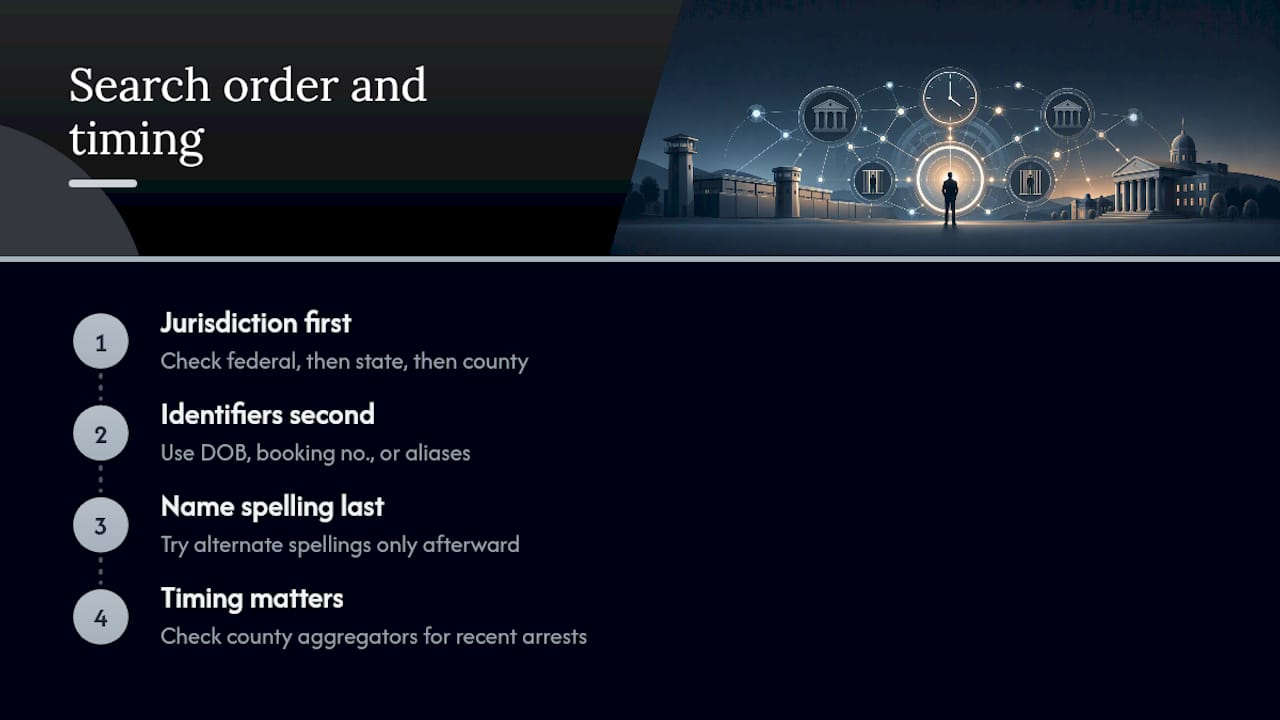
The other overlooked piece is timing. Official .gov locators are accurate but slow to update, especially in the window right after an arrest. That's exactly where a county-level aggregator earns its place in the process, not as a replacement for the BOP or a state DOC, but as the tool that catches what hasn't synced yet. Readers who understand that gap spend far less time confused by a "no results found" page that simply hasn't caught up with reality.
Prioritize jurisdiction over cleverness. Get that right, and everything else in the search gets easier.
— Sean
Still Can't Find Them? Try Registry Recognizer's County Search
When the official locators come up empty and you suspect the person was arrested recently, Registry Recognizer gives you a faster window into county-level bookings than most state or federal systems can offer on day one.
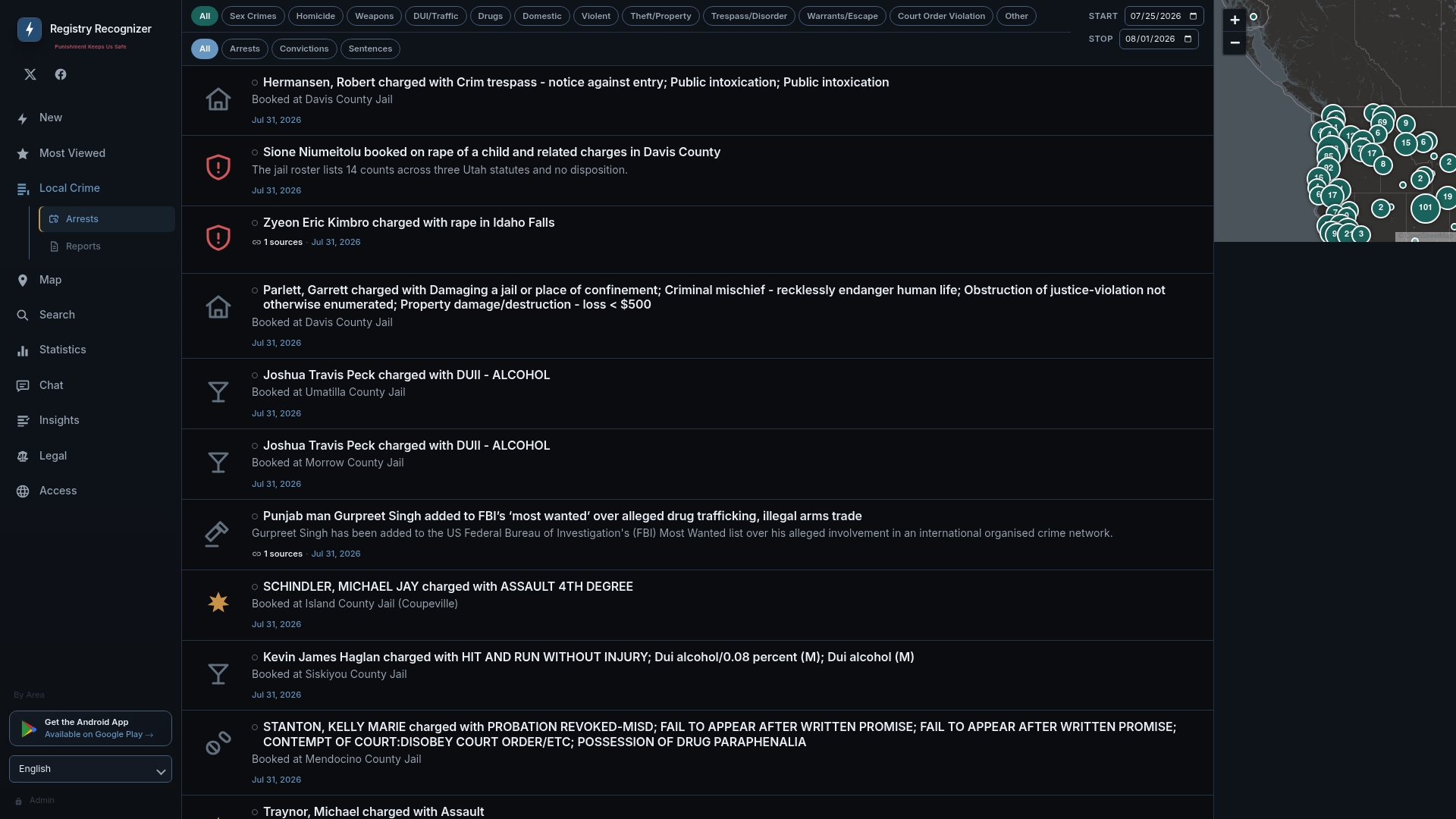
Running a search takes a few seconds: enter the full name (or as much of it as you have) and let the database pull matching county arrest records, including charges, booking dates, and jail location. If you get a hit, treat it as your lead, then confirm it against the BOP locator or the appropriate state DOC before relying on it for anything official. Browse a sample booking record to see the level of detail typically available, then head to the Registry Recognizer homepage to start your own search and verify what you find with the official agency holding that person.