Start with the county sheriff's inmate roster where the arrest happened. Most counties post a searchable "Inmate Search" or "Who's in Jail" tool on the sheriff's website, and you search it using the person's full legal name and date of birth. If that roster shows nothing, do not assume the person was released. County systems lag, especially outside business hours, so the next move is a phone call to the jail booking desk. Give the full name and date of birth and ask staff to confirm custody status directly.
A resource like Registry Recognizer keeps county-level rosters, booking details, and charges updated so you are not starting from zero on an unfamiliar county site.
Quick recap of the fastest path:
- Search the county sheriff's online roster first, using full legal name and DOB.
- If nothing appears, call the jail booking desk or the arresting agency directly.
- Have the booking number ready if you have one. It resolves name mismatches instantly.
- Use a county roster database like Registry Recognizer to check multiple counties without hunting down separate sheriff sites.
Key Takeaways
Locating a county booking record fastest requires searching the correct county's sheriff roster by full legal name and date of birth, then confirming by phone when the roster comes up empty.
| Point | Details |
|---|---|
| Start at the county level | Search the sheriff's inmate roster for the county where the arrest happened, not a state or national database. |
| Use exact identifiers | Full legal name, date of birth, and booking number (if available) prevent false matches on common names. |
| Call when the roster fails | Booking desks can confirm custody in real time when online records lag or show nothing. |
| Know the legal limits | State public-records laws determine what's released; file a formal request with name, DOB, and jurisdiction if needed. |
| Use Registry Recognizer for speed | Its updated county rosters surface booking numbers, charges, and bond status across many counties in one search. |
Table of Contents
- How Do You Search County Jail Rosters to Find Inmates?
- What If the Online Search Turns Up Nothing?
- Why Records Sometimes Never Show Up Online
- What Reporters and Researchers Get Wrong About Jail Records
- Find County Bookings Faster With Registry Recognizer
- Frequently Asked Questions
- Sources
How Do You Search County Jail Rosters to Find Inmates?
Searching a county roster correctly takes about five minutes once you know the sequence. Skip a step and you will either miss the person entirely or misidentify a stranger with the same name.
1. Pin down the county. Jail rosters are county property, not state or national databases. If you know the city or the arresting police department, you can usually work backward to the correct sheriff's office. Someone arrested in Miami will show up on a Miami-Dade Corrections inmate lookup, not a statewide Florida database. Someone booked near Los Angeles goes through the Los Angeles County inmate search run by the Sheriff's Department, and bookings near Las Vegas run through the Clark County jail system, not a Nevada state portal.
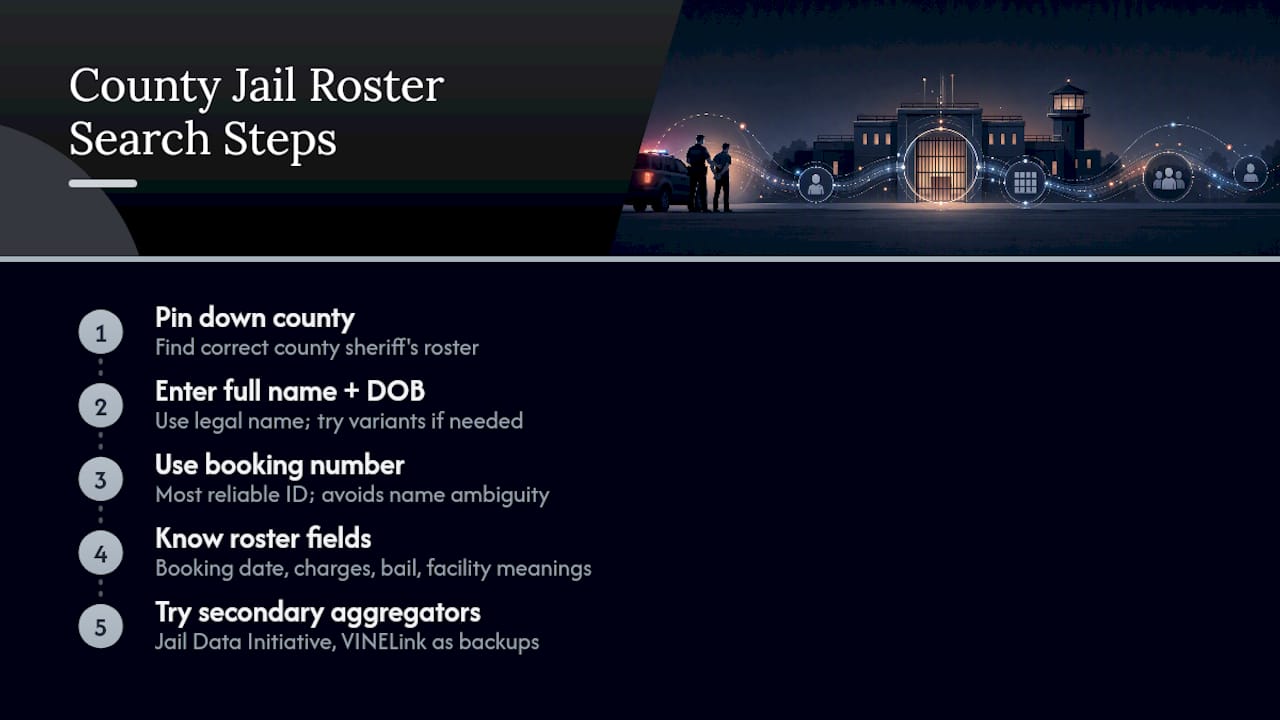
2. Enter the full legal name and date of birth. Nicknames and shortened names fail more searches than any other single mistake. "Bob" will not pull up "Robert." If the first search returns nothing, try common name variants, hyphenated last names, and any known aliases.
3. Use the booking number if you have one. This is the single most reliable identifier in the entire system. A booking number, sometimes called an inmate ID, ties directly to one specific arrest event, so it eliminates any ambiguity between two people who share a name. Practitioners who work with jail data regularly lean on booking numbers for exactly this reason, since name-only searches produce false matches constantly in counties with common surnames.
4. Know what the fields mean. Most rosters return a standard set of data: booking date, charges (sometimes with statute codes), bail or bond amount, and current facility. "No bond" usually means a judge has not yet set bail or the charge is not bondable. A blank bail field does not mean the person was released. It often means the case has not been processed far enough for a bond hearing.
5. Try a secondary aggregator if the county site fails. Projects like the Jail Data Initiative pull and standardize roster data from many counties into one searchable format, which helps when you are not sure which county to check first. VINELink offers victim notification lookups in participating states. Both are useful backups, but neither replaces the county's own roster for real-time accuracy. Coverage gaps and reporting lag are common, particularly in smaller counties.
Pro Tip: Search Broward County jail inmates or any other roster with the last name only and a wide date range first if you're unsure of the exact spelling. Narrowing too fast is how legitimate matches get missed.
What If the Online Search Turns Up Nothing?
A blank search result does not mean the person is not in custody. It usually means the roster has not caught up yet, or you searched the wrong county. Small and rural jurisdictions in particular sometimes still process bookings by hand, and data entry delays of several hours, or occasionally a full day or more, are not unusual. That gap is exactly why phone verification exists as a formal fallback.
Facility guidance consistently points to the same solution: call the booking desk directly. Staff can confirm an individual's presence using full legal name and date of birth, and that verification happens in real time, unlike a roster update.
Before you call, gather:
- The person's full legal name, including any middle name, and date of birth.
- A booking number or case number, if you have one from an arrest notification or court paperwork.
- The approximate date and location of the arrest, since it helps staff narrow which facility to check.
Most county jail websites list a non-emergency booking desk number, sometimes under a "Contact Us" or "Records" tab. If you cannot find it on the sheriff's site, a general search for "[county name] jail booking phone number" usually surfaces it fast, as does the local court clerk's directory. Call during standard business hours when possible. Overnight desks are often staffed thinner and slower to pull records.
Staff may tell you the person is not listed, that they cannot release information due to a hold or protective order, or they may redirect you to the arresting agency or court clerk if the person has already been transferred or arraigned. That redirect is normal, not a stonewall. Custody status changes fast in the first 24 to 48 hours after an arrest.
Why Records Sometimes Never Show Up Online
The United States does not run one national jail database. It runs roughly roughly three thousand separate county jail systems, each with its own software, its own update schedule, and its own rules about what gets posted publicly. That fragmentation is the root cause of most failed searches, not user error.
State law adds a second layer of variation. What one county considers public record, including mugshots or disciplinary history, another state may restrict by statute. Public access to jail records runs through state public-records law, and there is no single federal standard that overrides those differences. A facility's own policy page, like Orange County's inmate records policy, typically spells out exactly which intake fields the office releases and which it withholds.
When neither the roster nor a phone call resolves the question, a formal public-records request is the next step. To file one effectively, include:
- The full legal name and date of birth of the person in question.
- The approximate arrest date and the specific jurisdiction (county and agency).
- A clear statement of what records you are requesting (booking log, charges, disposition).
Response times vary by state and by county workload, ranging from a few business days to several weeks. Larger metro jails with dedicated records staff, like a Los Angeles County arrest records office, tend to respond faster than a small rural sheriff running records requests part time alongside other duties.
What Reporters and Researchers Get Wrong About Jail Records
Name-only searches are the most common mistake I see in this work. Common names produce multiple matches across the same county, and without a booking number, it is easy to attach the wrong charge to the wrong person. Always verify by phone before you publish or act on anything a roster shows.
State restrictions catch people off guard too. A field that's public in one county, a mugshot, a disciplinary note, may be sealed by statute two counties over. Treat every roster result as a starting point, not a confirmed fact, until a human at the facility verifies it.
Find County Bookings Faster With Registry Recognizer
Chasing down a booking record means checking dozens of separate county sites, each with different search fields and update schedules. Registry Recognizer consolidates regularly updated county-level rosters, so you get booking details, charges, and facility locations without hunting through a different sheriff's portal for every county.
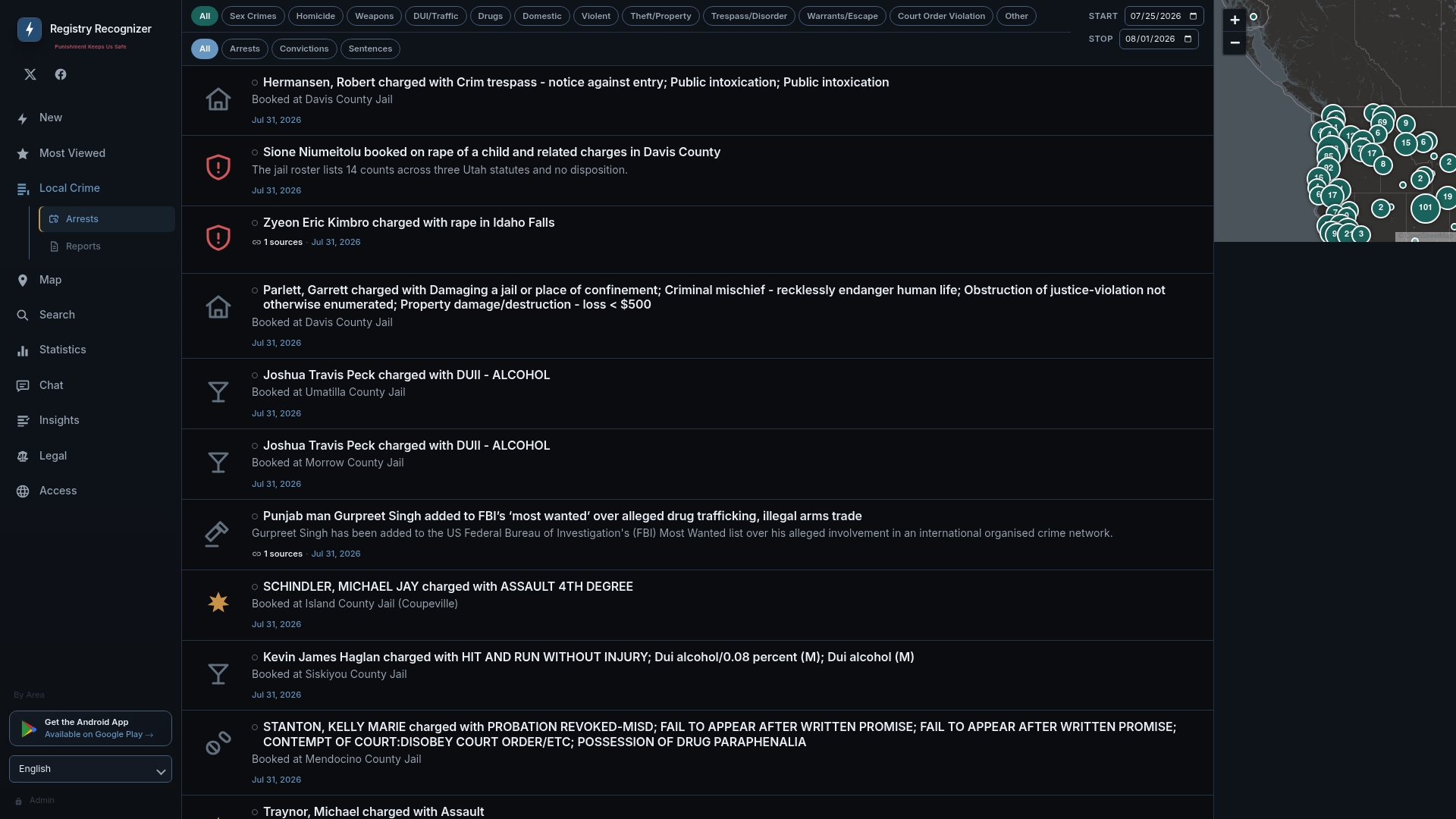
A record on the site might show something like a probation violation charge with the booking number, charge code, and bond status listed together, or a no-bond arrest entry showing exactly why bail has not been set. That level of detail speeds up the identification step covered above. It does not replace an official court record or a certified document for legal proceedings. If you need something for a court filing, you still contact the clerk or the arresting agency directly. If bail or bond status is confusing once you find a record, a primer on how bail works in felony cases explains what those figures actually mean.
Search a name on Registry Recognizer, and once you locate a match, follow up with a call to the listed jail or a check of the county court docket to confirm current status before you rely on it.
Frequently Asked Questions
How do I find federal inmates versus someone in a county jail? This guide covers county and local jail bookings, which is where most recent arrests land and where the vast majority of searches for a specific person's custody status should start. County sheriff rosters, searched by full legal name and date of birth, resolve the majority of these cases directly.
What information do I need before I start searching? Have the person's full legal name, date of birth, and, if possible, a booking number or approximate arrest date. These identifiers cut search time down dramatically and prevent misidentifying someone with a common name.
Why does a county roster show no results for someone I know was arrested? Update delays are common, especially in smaller counties that process bookings by hand. It can also mean you're searching the wrong county. Call the jail booking desk directly to confirm.
Can I get a mugshot or full disposition record online? It depends on the state. Some counties post mugshots and full charge details publicly; others restrict them by statute. Check the facility's own records policy or file a formal public-records request if the roster doesn't show what you need.
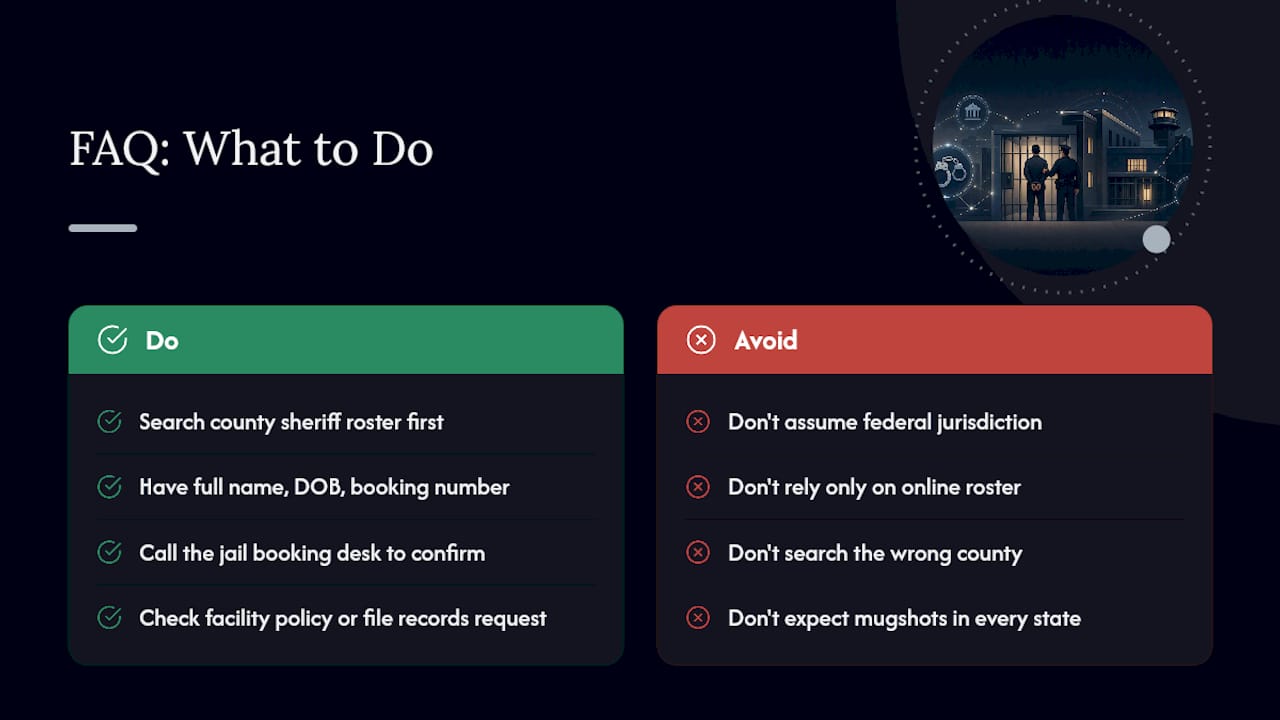
Is a phone call really faster than an online search? Often yes, particularly in the first 24 to 48 hours after an arrest, when roster data is most likely to lag behind the actual booking.
Sources
- Bureau of Justice Statistics — correctional institutions
- Cornell Law — legal resources on public records and statutes
- Jail Data Initiative — documentation
Recommended
- Murder suspect Jayden V. Cayou arrested in Marinette, WI · Registry Recognizer
- ALLEN, JOHN PERNELL charged with Charge: Unspecified warrant 0 (16-5-23.1(F)(1) - Battery-FVA 1st Offense (M)); Arrest Date 07/14/2026; Bond - No Bond, $0.00; · Registry Recognizer
- SHAWANO COUNTY SEEKS TO ENFORCE COURT ORDER AFTER VIOLATION INCIDENT · Registry Recognizer