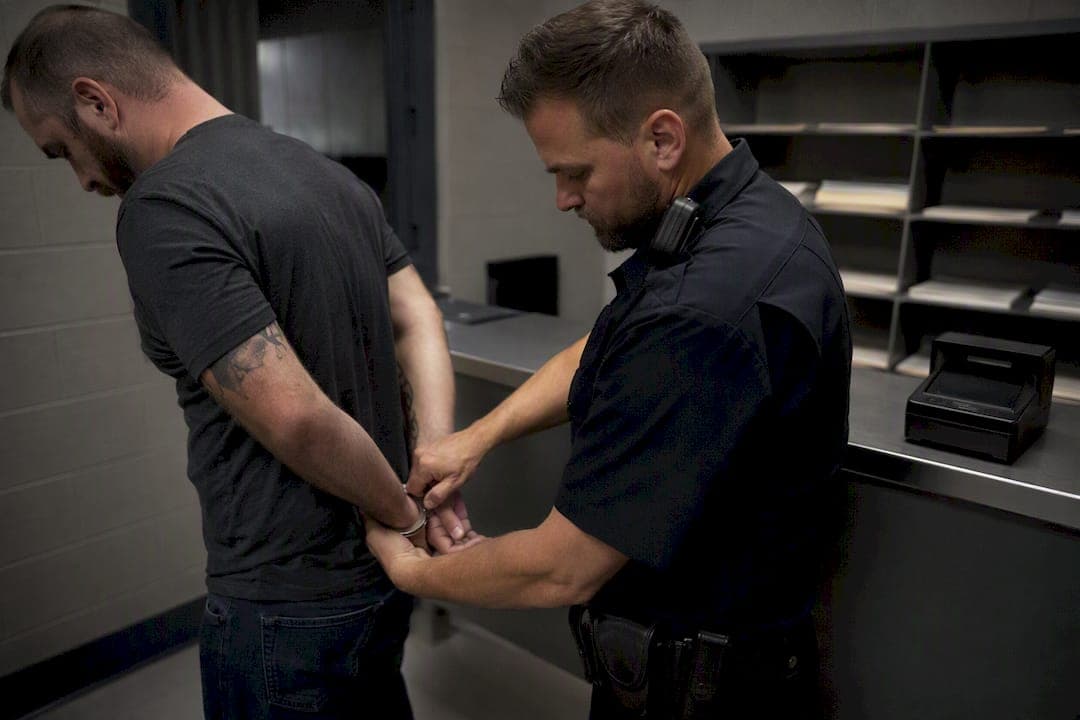
An indictment is a formal charge returned by a grand jury; an arrest is law enforcement taking someone into physical custody. They are separate legal events, and either one can happen first. Neither means the person is guilty of anything.
- Indictment: A grand jury reviews evidence in secret and decides there's probable cause to formally charge someone with a crime.
- Arrest: An officer takes a person into custody based on probable cause or an active warrant, then books them into a facility.
The immediate fallout differs, too. An indictment typically triggers a warrant or summons ordering the person to court. An arrest triggers booking, a bail determination, and a prompt initial court appearance, usually within a day or two.
Key Takeaways
An indictment is a grand jury's formal charging decision, while an arrest is law enforcement physically taking someone into custody, and neither one implies guilt.
| Point | Details |
|---|---|
| Different actors decide | A grand jury votes on indictments; a police officer or magistrate authorizes an arrest. |
| Federal felonies require indictment | The Fifth Amendment mandates grand jury indictment for federal felonies, though states vary. |
| Indictment isn't guilt | It only reflects probable cause; trial requires proof beyond a reasonable doubt. |
| Sequence can go either way | Arrests often precede charges in street crime; indictments often precede arrest in white-collar cases. |
| Verify custody fast | Registryrecognizer's county rosters show booking, charges, and bond status to confirm what's happened after an arrest. |
Where to Verify the Legal Details
- DOJ guidance on when indictment is required
- Federal Rules of Criminal Procedure, Rule 9
- Cornell Law's explainer on indictments
This article is general information, not a substitute for advice from a qualified lawyer. Consult a qualified legal professional about your own circumstances before acting on anything here.
Table of Contents
- Indictment vs. Arrest: Who Decides and What Changes
- What Happens First: The Arrest Path vs. the Indictment Path
- What Rights Actually Apply During Each Process
- What to Do Immediately After an Arrest or Indictment
- Checking Arrest Records: What Registryrecognizer Shows
- Sources
Indictment vs. Arrest: Who Decides and What Changes
The clearest way to separate these two events is to ask who made the decision and what standard they applied.
- Who decides. A grand jury, a panel of ordinary citizens, decides whether to indict. A police officer or detective decides whether to make an arrest, sometimes with a magistrate's sign off on a warrant beforehand.
- What standard applies. Both rely on probable cause, the same low bar, but they test it differently. Grand jurors hear evidence presented only by the prosecutor, in sealed, secret sessions, and vote on a "true bill" (indict) or "no bill" (decline). An arrest can happen on the street the moment an officer has probable cause, no hearing required.
- What each action legally means. An indictment is a charging document. It opens the door to prosecution but proves nothing at trial. An arrest is a custody action. It can happen with no charges filed yet, or it can happen the same day a warrant issues from an indictment.
- Federal requirement vs. state variation. The Fifth Amendment requires a grand jury indictment for federal felonies. States are not bound by that rule. Many rely instead on prosecutors filing a charging document called an information, often after a preliminary hearing where a judge, not a grand jury, tests the evidence.
Grand juries typically run 16 to 23 members, and at least 12 must agree to return an indictment. That concurrence threshold matters because it means a prosecutor cannot simply decide to charge someone federally for a felony. They need a majority of a civilian panel to sign off, even though the defendant never gets to argue their side in that room.
What Happens First: The Arrest Path vs. the Indictment Path
The sequence of events depends entirely on which mechanism starts the case.
When an arrest comes first, the timeline moves fast. Police develop probable cause, take someone into custody, and book them. Federal Rule 5 requires prompt presentation to a judicial officer, generally within 48 hours, where the person hears the charges and a judge sets conditions of release. State timelines vary but follow the same basic shape: booking, then an initial appearance within a day or two.
When an indictment comes first, things move differently. A prosecutor spends weeks or months presenting evidence to a grand jury before any arrest happens. Once jurors return a true bill, the court typically issues a warrant or, in less severe cases, a summons ordering the defendant to appear voluntarily. This is common in complex financial crimes, drug conspiracies, and public corruption cases, where investigators build a paper trail long before anyone gets handcuffed.
Prosecutors sometimes hold indictments under seal specifically to protect an ongoing investigation or prevent a flight risk from disappearing before an arrest can happen. A sealed indictment can sit quietly for weeks while agents finish other pieces of a case, then get unsealed the moment an arrest warrant executes.
- White-collar and conspiracy cases lean toward the indictment-first path because building the evidence takes time.
- Violent crime, domestic disputes, and DUI stops almost always run the arrest-first path because probable cause exists in the moment.
- In some white-collar investigations, defense counsel negotiates a voluntary surrender once they learn an indictment is coming, avoiding a public arrest at home or work.
Pro Tip: If your attorney tells you an indictment might be coming, ask about voluntary surrender. Turning yourself in on your own terms, at a time you and counsel arrange, almost always looks better to a judge than getting picked up by surprise.
What Rights Actually Apply During Each Process
A lot of confusion about grand juries comes from television, and television gets this wrong constantly.
- You have no right to sit in on your own grand jury proceeding.
- Your attorney generally cannot accompany a witness into the grand jury room, even if that witness is you.
- An indictment is not proof of anything. It only means jurors found probable cause, a far lower bar than the proof beyond a reasonable doubt required for conviction at trial.
- Where a grand jury isn't used, a prosecutor can file an information, often following a preliminary hearing where a judge, not a panel of citizens, evaluates the evidence in open court.
An indictment can sit sealed for weeks, sometimes months, while investigators finish surveillance, protect a cooperating witness, or track down a suspect before an arrest warrant executes. The person named in a sealed indictment may have no idea it exists until the moment of arrest.
That secrecy is a feature, not a loophole. It exists to protect the integrity of an ongoing investigation, not to ambush defendants unfairly.
What to Do Immediately After an Arrest or Indictment
The steps differ depending on which event you're facing, but the underlying goal is the same: protect your rights and get counsel involved fast.
If you've been arrested:
- Stay silent beyond identifying information. Anything else waits for your lawyer.
- Ask for an attorney clearly and immediately, even if you plan to hire your own later.
- Write down or have someone note the arrest time, location, and the charges cited by the arresting officer.
- Do not consent to any search of your car, home, or phone without counsel's advice.
If you've been served with a summons or learn you've been indicted:
- Do not ignore the document or assume it will resolve itself.
- Call an attorney the same day, before responding to anyone from law enforcement or the prosecutor's office.
- Ask counsel whether voluntary surrender makes sense, especially in a case that started with a sealed indictment.
Checking bond status and custody information quickly matters, too, whether for yourself or a family member. This example arraignment guide walks through what typically happens at that first court date, including bail conditions.
Pro Tip: Before you call a bail bondsman or start researching bond amounts, verify the actual charges and custody status through the county's own records rather than relying on secondhand information from a phone call or a rumor.
Checking Arrest Records: What Registryrecognizer Shows
Registryrecognizer maintains county-by-county arrest rosters with booking dates, charge language, bond amounts, and jail location, useful for confirming what happened after an arrest.
- Records typically show booking date, charge description, and current custody or bond status.
- An entry reflects that someone was arrested and booked, not that a grand jury indicted them or that a court convicted them.
- Records can lag behind sealed indictments, since sealed cases by design stay out of public databases until unsealed.
- Always confirm details with the county clerk or court record before relying on them for a legal decision, and loop in an attorney for anything beyond situational awareness.
Why the Distinction Actually Changes Your Next Move
Knowing whether you're facing an arrest or an indictment changes the tactical calculus immediately. Arrest calls for damage control in the moment. An indictment often means there's still time to negotiate surrender terms with counsel before anything public happens. Pairing that legal advice with timely public records cuts down on ugly surprises.
— Sean
Track Custody Status Without Waiting on a Phone Tree
Court clerks close at 5:00 PM. Investigations don't stop for anyone's schedule, and neither should your ability to check on a booking. Registryrecognizer gives you a way to search county rosters directly, seeing charge language, bond figures, and jail location the moment a booking posts, instead of sitting on hold or driving to a courthouse window.

That matters most in the early hours after an arrest, when family members are scrambling to figure out where someone is being held and what the bond situation looks like. A searchable record can confirm the basics in minutes rather than hours, freeing you to spend that time calling an attorney instead of a jail switchboard. It won't replace certified court documents or legal advice, but as a first check on custody and charge status, it's often the fastest tool available. Search the Registryrecognizer database now to see how current a county's roster is before you need it.
Sources
- When indictment required | US Department of Justice
- What does it mean to be indicted by a grand jury? | University of Washington School of Law (2024)
- Indictment | Wex | Legal Information Institute (Cornell)
- What is an Indictment? | FindLaw
Recommended
- BALFOUR, GLENN THOMAS charged with Arrest: 50B-4 - DV PROTECTIVE ORDER VIOL (M); Arrest Date 07/02/2026; Bond - No Bond; Set By MILLER; · Registry Recognizer
- Jones, Jeremiah booked on 7 charges · Registry Recognizer
- KING, KEION JACQUESE charged with CC24-0246 PROBATION VIOLATION - FELONY · Registry Recognizer
- GREEN,DEQUINCEY charged with INDECENCY W/CHILD-3F BMPD 24-01117 J12F24-366 · Registry Recognizer