
The fastest way to check for outstanding warrants is to start with the U.S. Marshals Service Warrant Information System for federal matters, then move to PACER for federal court filings, and then hit your state DPS portal and county sheriff's website for local warrants. For most people, the county level is where results actually show up. Whatever you find online, call the issuing court or a criminal defense attorney before you walk into a police station. That single step keeps a routine inquiry from turning into an immediate arrest.
Where to start right now:
- Federal warrants: U.S. Marshals Service Warrant Information System, then PACER for court filings
- State warrants: Your state's Department of Public Safety or court case portal
- County warrants: County sheriff's warrant list and county clerk's online docket
- Arrest and booking records: Registryrecognizer's searchable database for county-level arrest and inmate records
- Immediate action: Verify any result by calling the issuing court or consulting a criminal defense attorney before going in person
Key Takeaways
There is no single national public database for outstanding warrants, so a reliable check requires moving through federal, state, and county sources in sequence and confirming any result directly with the issuing court.
| Point | Details |
|---|---|
| Start federal, then go local | Check USMS WIS and PACER for federal warrants, then state DPS portals and county sheriff lists. |
| Verify with the issuing court | Online results are not real-time; call the clerk to confirm a warrant is still active. |
| Hire an attorney before surrender | A defense attorney can arrange voluntary surrender and bail, reducing immediate arrest risk. |
| Avoid paid lookup sites | Private warrant-search services often carry stale data; official .gov sources are more reliable. |
| Registryrecognizer for arrest records | Use Registryrecognizer to locate booking details and charges as a complement to official warrant checks. |
Table of Contents
- 1. How to check for federal warrants using USMS and PACER
- 2. How to check state and county warrants through official portals
- 3. Step-by-step: what to gather and how to run the searches
- 4. Why online warrant searches can miss results
- 5. What to do if you find a warrant
- 6. Fees and access differences across federal and state systems
- 7. Is it legal to check someone else's warrant status?
- 8. How jail rosters, booking logs, and arrest reports fit into a warrant search
- What the official sources actually tell you (and what they don't)
- Registryrecognizer: a fast starting point for arrest and booking records
- Sources
1. How to check for federal warrants using USMS and PACER
Federal warrants and state warrants are completely separate systems, and that distinction matters before you search.
The U.S. Marshals Service Warrant Information System tracks federal warrants and supports fugitive investigations. Public access to the full database is restricted; it is primarily a law enforcement tool. What you can do is submit a Freedom of Information Act request if you believe a federal warrant exists under your name, though that process takes time.
PACER (Public Access to Court Electronic Records) is the more practical option for most people. It gives you access to federal court dockets across every district. If a federal grand jury has indicted someone or a judge has issued a warrant tied to a federal case, the related filings often appear in PACER once the case is no longer sealed. The PACER Case Locator, a free search tool within the PACER system, lets you search by name across all federal courts without paying per page.
- PACER charges $0.10 per page for most documents; the Case Locator search itself is free
- You need a PACER account to access dockets, which takes a few minutes to set up at pacer.uscourts.gov
- Sealed indictments and active fugitive warrants will not appear in public PACER results
Pro Tip: If you suspect a federal warrant but PACER returns nothing, that absence is not confirmation. Call the clerk's office of the relevant federal district court directly, or hire a federal criminal defense attorney. Federal warrants tied to active investigations are routinely sealed and will not show up in any public search.
2. How to check state and county warrants through official portals
For most people, county-level sources are the fastest and most direct route. State and local warrants far outnumber federal ones, and the search tools are often free.
The practical approach works in three tiers:
- County sheriff's warrant list: Many sheriff's offices publish active warrant lists on their websites, searchable by name. These are updated regularly and cover the most common warrant types: bench warrants for missed court dates, arrest warrants for criminal charges.
- County clerk's online docket: Court case search tools let you pull up a case by name or case number. A bench warrant issued in an open case will often appear as a docket entry.
- Statewide portal: Some states, like Washington, offer a statewide court case search that covers traffic tickets, missed appearances, and criminal filings across multiple counties in one search.
The Arizona Department of Public Safety, for example, runs a public warrant search tool at the state level. It covers warrants entered into the state system, but as Arizona DPS itself warns on its site, results are not updated in real time and courts remain responsible for confirming whether a warrant is still active.
Pro Tip: County sheriff and clerk sites often give the most direct answer because they are the originating source. If the online tool is unclear or shows a result you cannot interpret, call the clerk's office. A two-minute phone call beats an hour of second-guessing a search result.
3. Step-by-step: what to gather and how to run the searches
Before you search anything, collect these identifiers. Missing even one can cause a valid warrant to slip through.
What to have ready:
- Full legal name, including middle name
- All known name variations and aliases
- Date of birth (exact)
- County or counties where you have lived, worked, or been cited
- Previous addresses in other states if you have moved
- Any prior case numbers you are aware of
Search workflow:
- County sheriff's website: Search the warrant list by full name. Try name variations if the first attempt returns nothing.
- County clerk's online case search: Look up your name in the criminal case index. Check for open cases with warrant entries in the docket.
- State DPS or statewide court portal: Run a name search at the state level to catch warrants from counties you may have overlooked.
- PACER Case Locator: Search your name across all federal districts for any federal filings.
- USMS Warrant Information System: Submit a FOIA request if you have specific reason to suspect a federal warrant.
- Call the clerk: If any result is ambiguous or you want confirmation, call the court clerk for the county or district where the warrant allegedly originates.
One important technical note: NCIC, the FBI's National Crime Information Center, holds warrant data from agencies across the country, but it is strictly restricted to law enforcement. There is no single national public database for all outstanding warrants. That means a clean result from one county search does not clear you in another.
Spelling matters more than most people expect. Florida's FDLE system and similar state databases can register aliases or variant identifiers, meaning a warrant filed under a nickname or a misspelled name will not surface in a standard name search. Always try alternate spellings and any known aliases before concluding the search is clean.
4. Why online warrant searches can miss results
A clean search result does not mean no warrant exists. Several factors can hide an active warrant from any public search.
What online searches cannot show:
- Sealed warrants: Judges can seal warrants during active investigations. The Reporters Committee for Freedom of the Press notes that arrest and search warrants are subject to a balancing test for public access and are often unavailable until charges are filed or the investigation closes.
- Juvenile records: Warrants tied to juvenile proceedings are generally confidential and will not appear in public searches.
- Jurisdictional gaps: A warrant issued in one county may not appear in another county's system or in a statewide portal if the originating agency has not entered it yet.
- Data delays: The San Diego County Sheriff's warrant database updates hourly and explicitly warns that results may not reflect immediate changes. Arizona DPS carries the same caveat. Most official portals do.
Statistic callout: The FBI's NCIC holds warrant data from thousands of agencies nationwide, but access is restricted to law enforcement only. No public tool can replicate it.
On paid warrant-search websites: Experts consistently warn against them. These services often recycle stale data pulled from public records months or years old, charge fees for information you can get free from official sources, and carry no accountability when results are wrong. Stick to .gov sources and direct court contact.
5. What to do if you find a warrant
Finding your name in a warrant search is alarming, but acting without a plan makes the situation worse.
Verification checklist:
- Write down the docket or warrant number, the issuing court, and the listed charge
- Call the clerk's office of the issuing court to confirm the warrant is still active
- Ask whether a bond amount has been set and what the charge category is
- Do not go to a police station or courthouse to "check in" without legal guidance
Walking into a police lobby to ask about a warrant is one of the most common mistakes people make. According to legal guides, doing so can result in immediate arrest on the spot, with no opportunity to arrange bail in advance.
Legal next steps:
- Call a criminal defense attorney before contacting law enforcement. An attorney can verify the warrant's status, obtain bail information, and often arrange a voluntary surrender on terms that allow you to post bond before being booked.
- For bench warrants (typically issued for missed court dates), an attorney can sometimes file a motion to recall or quash the warrant, which resolves it without an arrest.
- For arrest warrants, voluntary surrender arranged through counsel is almost always safer than waiting to be picked up.
Pro Tip: A criminal defense attorney can often confirm a warrant's status with a single call to the court or sheriff, then arrange a surrender time that lets you post bail immediately. That process, done right, can mean the difference between a few hours and an overnight stay in custody.
See how court order enforcement plays out in real cases to understand what happens after a warrant is acted on.
6. Fees and access differences across federal and state systems
Most state and county warrant searches are free. PACER is not.
Cost breakdown:
- County sheriff warrant lists: Free in most jurisdictions; searchable directly on the sheriff's website
- County clerk case search: Free in most states; some charge a small fee for certified copies of documents
- State DPS or court portals: Generally free for basic name searches
- PACER: $0.10 per page for documents; the PACER Case Locator search is free; accounts with under $30 in quarterly charges are waived
- Certified copies: Requesting a certified copy of a warrant or court order from a clerk's office typically costs $5–$25 depending on the jurisdiction, payable by check or money order
If you need a certified copy of a warrant for legal proceedings, you must request it directly from the clerk of the issuing court. Online search results are not certified documents and carry no legal weight in court.
7. Is it legal to check someone else's warrant status?
Most warrant records are public records. Checking them is generally legal. The line is in how you use what you find.
What is generally public:
- Active warrant lists published by sheriff's offices
- Court docket entries showing warrant issuances in criminal cases
- Booking records and arrest logs at county jails
What is not public:
- Sealed warrants tied to ongoing investigations
- Juvenile court records and warrants
- Grand jury materials, which remain sealed until an indictment is unsealed
Using public warrant information to harass, threaten, or confront someone can expose you to civil or criminal liability. If you find a warrant for someone you believe poses a danger, the appropriate step is to contact law enforcement, not to act on the information yourself. The San Diego County Sheriff's warrant database explicitly warns users not to attempt citizen arrests based on its data.
When local policies or court rules limit online access, the right move is to contact the court clerk directly and explain your purpose. Clerks routinely assist journalists, attorneys, researchers, and concerned citizens with public records requests.
8. How jail rosters, booking logs, and arrest reports fit into a warrant search
Jail rosters and booking logs are not warrant databases, but they are useful at a specific point in the process.

A jail roster shows who is currently in custody at a county facility: name, booking date, charges listed at intake, and sometimes bond status. What it does not show is whether an active warrant exists for someone who has not yet been arrested.
| Source Type | Typical Content | Best Use |
|---|---|---|
| Warrant list (sheriff) | Active warrant names, warrant numbers, charge categories | Confirming an outstanding warrant before arrest |
| Court docket | Case filings, warrant issuance entries, hearing dates | Verifying warrant details and case status |
| Jail roster / booking log | Current inmates, booking date, intake charges | Confirming an arrest has occurred after a warrant is served |
Booking records, like those indexed by Registryrecognizer, show charges at the time of arrest, jail location, and booking details. They are a useful complement to a warrant check: if a warrant has been served and the person is in custody, the booking record will confirm it. If the roster shows no booking, that does not mean no warrant exists.
Pro Tip: Use jail rosters to confirm an arrest after a warrant is served, not to prove a warrant is still active. A person may have a live warrant and simply not yet been picked up. The warrant list and court docket are the authoritative sources for active status.
What the official sources actually tell you (and what they don't)
The conventional wisdom around warrant searches tends to go one of two ways: either people assume a quick Google search will surface anything outstanding, or they assume the process is so complicated that only a lawyer can navigate it. Both are wrong.
The real picture is messier. Official portals are genuinely useful, but they come with disclaimers that most users skip right past. Arizona DPS says its data is not real-time. San Diego County Sheriff says its database updates hourly and warns against acting on it. These are not boilerplate disclaimers. They reflect a real operational gap: warrants are issued by courts and entered into databases by clerks, and that process takes time.
The bigger mistake is treating a clean search result as clearance. The FBI's NCIC holds the most complete warrant data in the country, and it is completely off-limits to the public. That means any public search, however thorough, is working with incomplete information by design.
The one step that actually closes that gap is a phone call to the issuing court or a conversation with a defense attorney. Not a paid lookup service. Not a third-party aggregator. A direct call to the source. That is the part most guides bury at the end. It belongs at the top.
Registryrecognizer: a fast starting point for arrest and booking records
When you need to locate arrest records, booking details, or charge information tied to a specific person or county, Registryrecognizer gives you a searchable, regularly updated database covering counties across the United States. You can filter by crime type, location, and offense category, and each record includes booking information, charges, jail location, and disposition status where available.
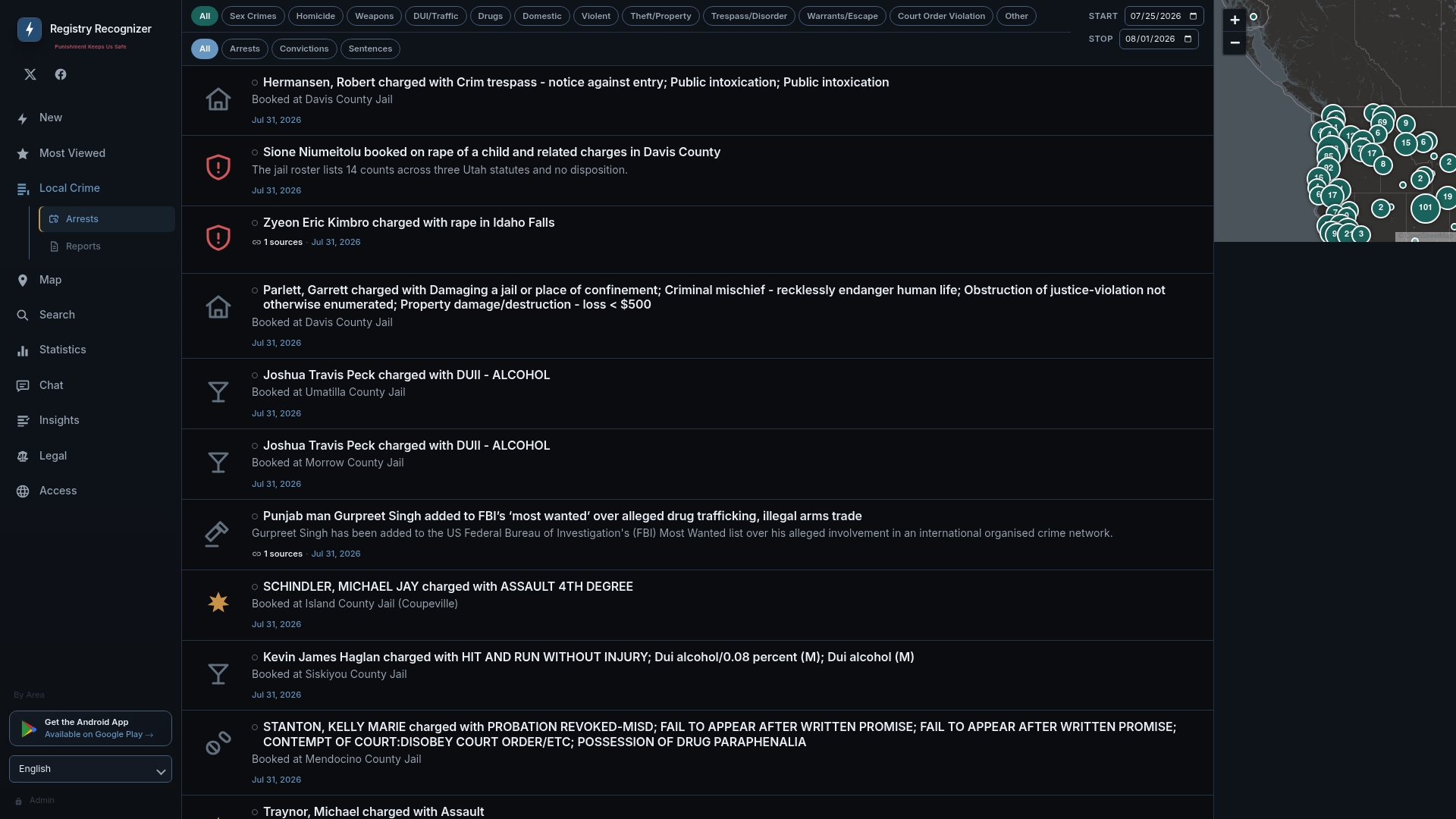
Registryrecognizer is not a replacement for official court verification or legal counsel. It is a fast starting point: use it to locate public arrest records, confirm a booking has occurred, or research charge details before you contact the court or sheriff directly. For an example of how warrant-related charges appear in the database, see this warrant-related booking record. Once you have identified a record of interest, the next step is always to verify active warrant status with the issuing court or a licensed attorney.
Sources
These are the canonical .gov sources to check first, in order of scope:
- Warrant Information System
- Public Access to Court Electronic Records | PACER: Federal ...
- Warrant Search | Department of Public Safety
- How to Check If You Have an Outstanding Warrant | Know Your Rights
This article provides general information about publicly available warrant search resources and is not a substitute for legal advice. Confirm current warrant status with the issuing court or a licensed criminal defense attorney.
Recommended
- SHAWANO COUNTY SEEKS TO ENFORCE COURT ORDER AFTER VIOLATION INCIDENT · Registry Recognizer
- ALLEN, JOHN PERNELL charged with Charge: Unspecified warrant 0 (16-5-23.1(F)(1) - Battery-FVA 1st Offense (M)); Arrest Date 07/14/2026; Bond - No Bond, $0.00; · Registry Recognizer
- WASHINGTON, CHRISTOPHER DEANDRE charged with DC26-904336 TAMPERING WITH PHYSICAL EVIDENCE; DC26-904334 TRAFFICKING-METHAMPHETAMINE; T9915348 NO INSURANCE; T9915349 DRIVE W/SUSPENDED LIC; T9915347 NO SEAT BELT · Registry Recognizer
- CHRISTOPHER WAYNE WOODCOCK charged with CARRYING CONCEALED WEAPON - GUN (M) · Registry Recognizer