
- Know the county? Go to the sheriff's office or jail roster page directly.
- Only have a name? Try statewide inmate search tools first, then narrow down.
- Need a federal inmate? The Federal Bureau of Prisons locator covers custody records from 1982 to the present, though it rarely posts photos.
Fact: No single national database of mugshots exists. Records are scattered across thousands of counties and agencies, which is exactly why the search order matters more than the search engine you use.
Key Takeaways
Finding a mugshot in the United States works best when you search official county and state sources first and treat commercial databases as a cross-check, not a final answer.
| Point | Details |
|---|---|
| Start local | Check the county sheriff or jail roster before trying state or federal locators. |
| Federal records rarely show photos | The BOP inmate locator confirms custody status but almost never posts a booking image. |
| Records requests work | A written public-records request to the arresting agency is often the most reliable free option, per FindLaw. |
| Verify before trusting | Commercial sites can show outdated charges even after a dismissal or expungement. |
| Use Registry Recognizer to cross-check | Registry Recognizer aggregates county-level booking data and charges into one searchable, regularly updated resource for cross-referencing a name before filing an official request. |
Table of Contents
- What's the Best Order to Search for a Mugshot?
- Are Commercial Mugshot Sites and Apps Reliable?
- How to Request a Mugshot or Booking Photo Officially
- How Registry Recognizer Fits Into Your Search
- Why Some Mugshots Never Show Up in a Search
- What the Research Actually Tells Us About Finding Mugshots
- Find Verified Arrest Records Faster With Registry Recognizer
- Where to Go for Official Records
- Frequently Asked Questions
- Sources
What's the Best Order to Search for a Mugshot?
Work outward from the smallest, most specific jurisdiction to the largest.
- Pin down the arrest location. Court notices, a citation, a bail receipt, or even a local news story naming the arresting agency will tell you exactly which county or city to search.
- Check the county sheriff or jail roster first. This is where a fresh booking photo is most likely to actually appear online.
- Move to the state DOC locator if the county turns up nothing, especially if the person may have been transferred to state custody.
- Check the federal BOP locator only if you have reason to believe the charge is federal, such as a case involving federal agents or a U.S. Attorney's office.
- Search the county court clerk's docket to confirm names, dates, and case numbers, which helps you rule out a duplicate name match.
- Scan local news archives using the person's full name and city, since local outlets sometimes run booking photos for arrests that don't make it onto an agency's own website.
Use quotation marks around the full name in search engines, and add the county or city name to cut down on false matches. If the person has a common name, add an approximate arrest date or a known charge type to narrow results further.
Pro Tip: Cross-reference any photo you find against a second source, like a court docket or a database such as Registry Recognizer, before assuming it's the right person. Common names produce more mismatches than people expect.
Are Commercial Mugshot Sites and Apps Reliable?
Commercial mugshot sites pull from the same public rosters official agencies publish, but they don't always refresh that data once a case changes. A charge that got dismissed six months ago might still show up as an open case on a site that scraped it once and never updated.
The business model on many of these sites is worth understanding before you rely on one. Ad revenue funds the free search, and a separate "reputation management" arm often charges a fee to remove a listing, even when the underlying record was public in the first place. Some sites have been criticized for this exact pay-to-remove pattern, according to a wikiHow guide on finding mugshots.
Before trusting a commercial result, check a few things:
- Does the listing show a booking date and case number you can verify against a court docket?
- Does the site show any indication of when it last updated the record?
- Is there a clear, free way to correct or flag outdated information, or does every path lead to a paid removal service?
- Does the name match include a middle name, date of birth, or county, not just a first and last name?
How to Request a Mugshot or Booking Photo Officially
When an online search comes up empty, a records request is your next move, and it works more often than people assume, since FindLaw notes that going directly to the arresting agency is usually the most effective free option.
- Identify the exact agency that made the arrest. This is usually the police department or sheriff's office named on the arrest report, not the county where the person now lives.
- Find the agency's records or FOIA contact, typically listed on its website under "public records request" or "records division."
- Submit a written request naming the person, approximate arrest date, and, if known, the case or booking number. A simple line like "I am requesting a copy of the booking photo and arrest report for [name], arrested on [date], under case number [if known]" works in most jurisdictions.
- Expect a fee. Some agencies charge per-page copying costs; others bill hourly for staff time to search and redact records.
- Expect variable timing. Some sheriff's offices respond within days; others take weeks, especially if the record needs redaction for sensitive information.
- If denied, ask for the specific exemption cited. State public-records laws vary, and FindLaw's analysis confirms that what counts as a releasable "mugshot" and the exemptions that apply differ by state.
- Consult an attorney if the record involves a juvenile, a sealed or expunged case, or a denial you believe was made in error.
How Registry Recognizer Fits Into Your Search
Registry Recognizer compiles arrest rosters and booking information across counties into one regularly updated database, built specifically to bring transparency to local criminal activity that would otherwise require checking dozens of separate county sites.
- Each record typically includes booking details, charges, and jail location, formatted consistently regardless of which county it came from.
- A listing such as the Freddy Lopez Molina record shows the format: charge, booking date, and jail location laid out in one place.
- It's an editorial and reference resource, not a certified court record. Always confirm details with the arresting agency or the court clerk before relying on a listing for anything official, like a background check or legal decision.
Why Some Mugshots Never Show Up in a Search
Not every arrest produces a public mugshot, and that's often by design rather than an oversight in your search.
- Juvenile arrests are almost universally shielded from public release.
- Sealed or expunged records get removed from official channels, though commercial sites frequently miss the memo.
- Active investigations sometimes justify withholding booking photos temporarily for safety or procedural reasons.
- Dismissed charges may still show up online because, as FindLaw explains, a court order is often needed before a commercial site will actually take a listing down.
If your search turns up nothing, that itself is information. File a public-records request or call the court clerk directly. A blank result usually means the record is sealed, was never posted, or sits with an agency you haven't checked yet.
What the Research Actually Tells Us About Finding Mugshots
The conventional wisdom treats mugshot searches like a single Google query away from an answer. That's backward. The real obstacle isn't finding a website. It's the fact that criminal records are scattered across thousands of separate county and agency systems with no shared standard for what gets posted, when, or for how long.
What gets overrated: commercial "instant mugshot" sites. What gets underrated: the plain, old-fashioned public-records request. Most people skip it because it sounds bureaucratic, but a short written request to the right agency often produces the actual, verified booking photo when a search engine produces nothing but noise.
If there's one habit worth adopting, it's this: verify before you assume. A name match on a random site is not confirmation. A booking number cross-checked against a court docket is. Readers who start at the county level, use official locators as their backbone, and treat aggregator sites like Registry Recognizer as a cross-reference tool rather than a final word will spend a lot less time chasing dead ends.
Find Verified Arrest Records Faster With Registry Recognizer
Chasing down a booking photo across a dozen county websites eats an afternoon fast. Registry Recognizer solves that specific problem: instead of hunting through separate sheriff, jail, and court sites one by one, you get a single, regularly updated database covering arrests across multiple counties, with booking details, charges, and jail locations already organized and searchable in one place.
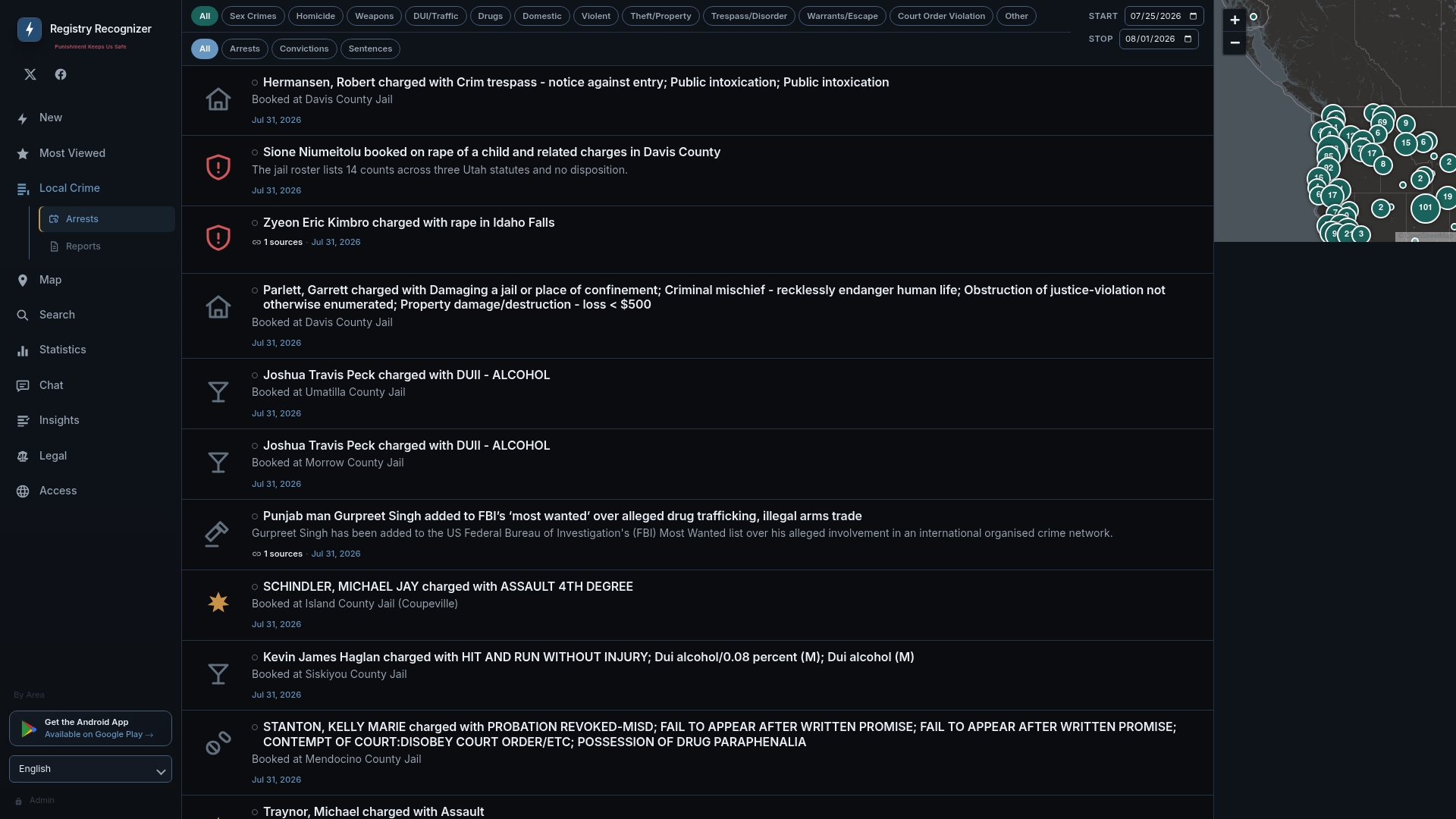
That matters most for the exact situation this article covers: you have a name and maybe a county, and you need a reliable starting point before deciding whether a formal records request is even necessary. Records like the King, Keion Jacquese booking listing show exactly what you'll find: charge, booking date, and jail location laid out clearly, without needing to know which specific county portal to check first.
Head to Registry Recognizer and search the name you're looking for. If you get a match, use it as your starting point for verification with the official agency; if you don't, you've just ruled out one more source before filing a records request.
Where to Go for Official Records
- Federal Bureau of Prisons inmate locator for federal custody status and FOIA guidance.
- Usa for state and local corrections contacts.
- National Archives guidance on researching prison records for older or historical federal records.
Frequently Asked Questions
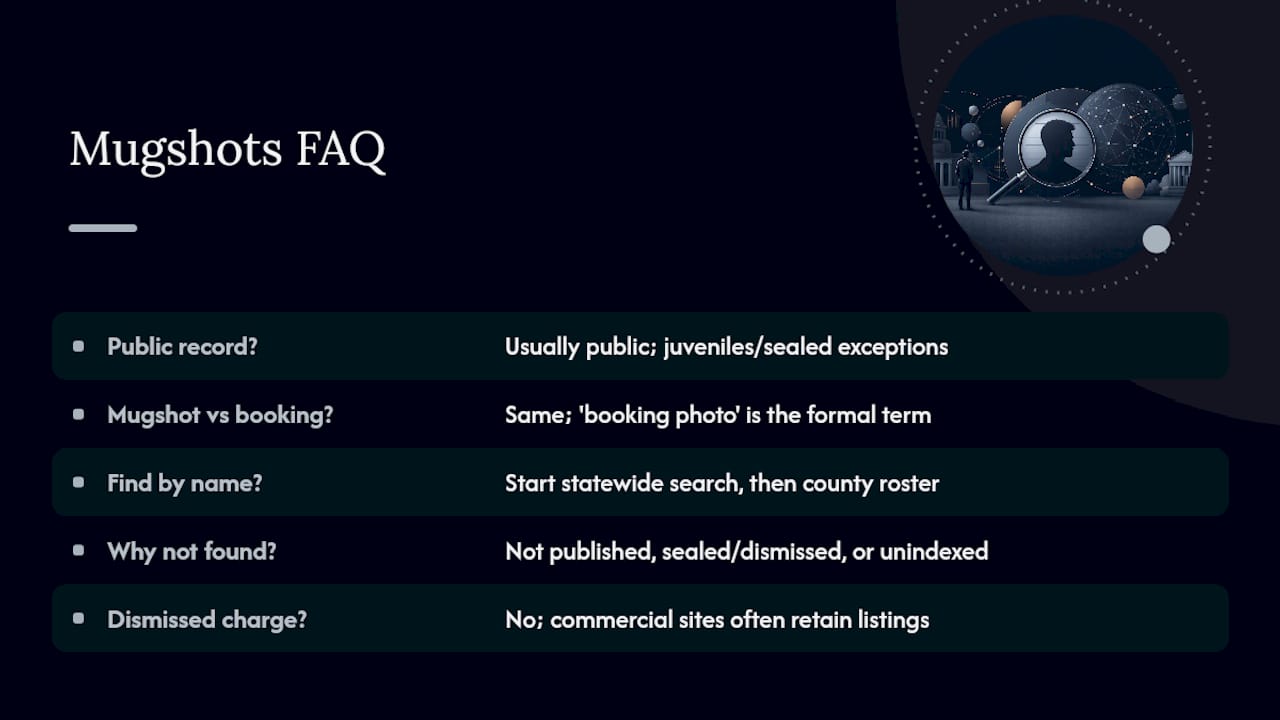
Are mugshots public records? In most states, yes, mugshots taken at booking are considered public record, but exceptions exist for juveniles, sealed cases, and certain active investigations. Availability and format vary significantly by state and agency.
What's the difference between a mugshot and a booking photo? They're the same thing. "Mugshot" is the common term; "booking photo" is the more formal name used in agency records and court documents.
How do I find booking photos if I only know the person's name? Start with a statewide inmate search tool or a database like Registry Recognizer, then narrow to the specific county sheriff or jail roster once you identify the likely jurisdiction.
Why can't I find a mugshot even though I know someone was arrested? The agency may not publish photos online, the case may have been sealed or dismissed, or the record may simply not exist in any searchable database yet. A direct records request to the arresting agency is the most reliable next step.
Does a dismissed charge get removed from mugshot websites automatically? No. Commercial sites often keep the original listing unless someone requests removal, and some require a court order or documented disposition before taking it down.
Login to enter a peer comment (or grade)
Voters:
Peer comments on this reference
Login to enter a peer comment (or grade)
Return to KudoZ list
KudoZ™ translation help
The KudoZ network provides a framework for translators and others to assist each other with translations or explanations of terms and short phrases.
See also:1) 2)
Term search
• All of ProZ.com
• Term search
• Jobs
• Forums
• Multiple search
•
Muscat
Manama
Kuala Lumpur
Jakarta
Bandar Seri Begawan
Islamabad
Kabul
Dubai
Kathmandu
Karachi
Dhaka
New Delhi
Ranguni
Bangkok
Rangún
Colombo
Naypyidaw
New Delhi
Kolkata (Calcutta)
Yangon
Mandalay
Kuala Lumpur
Kuching
Petaling Jaya
Cebu City
Manila
Batam
Bandung
Denpasar
Jayapura
Makassar
Medan
Palembang
Semarang
Surabaya
Yogyakarta
Kuala Lumpur
George Town
Malacca
Johor Bahru
Kuantan
Kota Kinabalu
Ipoh
Kuching
Alor Setar
Kuala Terengganu
Bandar Seri Begawan
Vientiane
Ho Chi Minh City
Hanoi
Da Nang
Hai Phong
Phnom Penh
Battambang
Siem Reap
Sihanoukville
Bangkok
Chiang Mai
Pattaya
Phuket
Nonthaburi
Krabi
Hat Yai
Ayutthaya
Kanchanaburi
Chonburi
Nakhon Pathom
Nakhon Ratchasima
Rayong
Songkhla
Suphan Buri
Surat Thani
Udon Thani
Ubon Ratchathani
Nakhon Sawan
Nakhon Si Thammarat
Lopburi
Chachoengsao
Chiang Rai
Nong Khai
Trang
Yala
Prachuap Khiri Khan
Samut Prakan
Samut Sakhon
Sing Buri
Chai Nat
Loei
Mukdahan
Nakhon Nayok
Phatthalung
Phrae
Prachin Buri
Ranong
Roi Et
Sa Kaeo
Satun
Trat
Uthai Thani
Uttaradit
Yasothon
Ang Thong
Bueng Kan
Buriram
Chumphon
Kalasin
Kamphaeng Phet
Khon Kaen
Lamphun
Maha Sarakham
Mae Hong Son
Nakhon Phanom
Nan
Narathiwat
Nong Bua Lam Phu
Pathum Thani
Pattani
Phang Nga
Phetchabun
Phetchaburi
Phichit
Phitsanulok
Sakon Nakhon
Samut Songkhram
Sisaket
Sukhothai
Surin
Tak
Yala
Amnat Charoen
Kanchanaburi
Nakhon Sawan
Nong Khai
Phang Nga
Ratchaburi
Sa Kaeo
Sing Buri
Trang
Uthai Thani
Yasothon
This article is general information, not a substitute for advice from a qualified lawyer. Consult a qualified legal professional about your own circumstances before acting on anything here.
Sources
Official sources rank first because they're the record of origin. Everything else, including commercial mugshot sites, ultimately pulls from these same agencies, just later and less reliably.
Local police and sheriff booking logs are the most likely place to find an actual mugshot if one is posted online at all. Many sheriff's offices run a public "recent bookings" page that updates daily and includes a photo alongside the charge.
County jail inmate rosters often show who's currently in custody, sometimes with a booking photo, sometimes just a name and charge. Availability depends entirely on the county's own policy, not any statewide rule.
State Department of Corrections (DOC) locators cover people sentenced to state prison, not just county jail. Photo availability is inconsistent. Some states publish a full photo gallery; others show text only.
The federal BOP inmate locator covers only federal inmates and, per Usa, works alongside state-level tools as the two primary official portals. It almost never displays a booking photo.
Court clerk portals and docket entries won't usually show a mugshot, but they confirm arrest dates, charges, and case outcomes, which matters when you're trying to verify a photo you found elsewhere is actually the right person and case.
Recommended
- ANTHONY QUINTON ORAN SMITH charged with FAIL TO ID FUGITIVE INTENT GIVE FALSE INFO PC 38.02(D)(2) · Registry Recognizer
- MORGAN CORDELL charged with Possess Receipt Controlled Substance · Registry Recognizer
- JACKSON, MARCHELL charged with M26-07-0239 DISCHARGE GUN OCCUPIED/UNOCCUPIED BUILD/VEHICLE · Registry Recognizer