
For federal criminal charges, PACER is the official system, covering every U.S. district, appellate, and bankruptcy court docket. For state or local charges, your state's judicial branch portal or the county clerk's office is where the actual record lives. Start with the full legal name and date of birth, or a case number if you have one. If you're checking multiple counties at once, an aggregator like Registryrecognizer can save you from bouncing between a dozen separate county sites.
Three things to do right now:
- Search PACER first if you suspect a federal charge (drug trafficking, fraud, gun charges tied to federal statutes).
- Search the relevant state judicial portal or county clerk site for anything else, including most DUIs, theft, and assault charges.
- If you don't know the county, try the state-level index before running county-by-county searches.
Pro Tip: Type the name exactly as it would appear on a booking sheet, including middle initials. Court databases are notoriously literal. "Bob Smith" won't find "Robert James Smith" even if they're the same person.
Key Takeaways
Finding criminal charges requires matching the jurisdiction to the right system: PACER for federal cases, state or county portals for everything else, and exact name-and-DOB matching throughout.
| Point | Details |
|---|---|
| Match system to jurisdiction | Use PACER for federal charges; use state judicial portals or county clerks for state and local cases. |
| Get your inputs exact | Full legal name, date of birth, and case number dramatically improve search accuracy. |
| Budget for fees | PACER charges small per-page fees; some state systems like New York's CHRS charge per search. |
| Expect restricted records | Sealed, expunged, and juvenile cases won't appear in standard public searches. |
| Use Registryrecognizer for speed | It aggregates arrest and booking data across counties for quick, informational lookups before pursuing certified records. |
Table of Contents
- Where to look first for criminal charges by jurisdiction
- What information do you need to search for criminal charges?
- How much does it cost to check criminal charges online?
- Why can't I find a record that should exist?
- How to get certified copies once you find a case
- When does an aggregator like Registry Recognizer actually help?
- Search faster across counties with Registry Recognizer
- Frequently Asked Questions
- Sources
Where to look first for criminal charges by jurisdiction
Federal and state courts run on entirely separate systems, and picking the wrong one wastes time. PACER covers federal district, appellate, and bankruptcy dockets, but you need a registered account to search and download documents. It's built for federal crimes: mail fraud, drug trafficking across state lines, firearms offenses prosecuted federally, and similar charges.
Most criminal charges, though, never touch federal court. DUIs, theft, assault, and drug possession typically get filed at the state or county level, which means your state's judicial branch website or the county clerk's office is the real starting point. Connecticut's Judicial Branch portal and Tennessee's Davidson County search tool are good examples of how varied these state systems look. If a federal case is more than a few years old, it may have been transferred out of PACER entirely and into National Archives holdings, which keep older federal case files once they leave active court custody.
| System | Scope | Typical cost | Records included |
|---|---|---|---|
| PACER | Federal courts nationwide | Small per-page fee | Dockets, filings, case status |
| State judicial portal | Statewide cases | Often free to search | Charges, hearing dates, dispositions |
| County clerk office | County-level cases | Free search, paid copies | Full case file, certified documents |
If a name search on any of these turns up nothing, that doesn't always mean there's no record. It sometimes means you're searching the wrong jurisdiction, or the record hasn't been digitized and you need to call or visit the clerk's office directly.
What information do you need to search for criminal charges?
The difference between a clean hit and a frustrating dead end usually comes down to what you type into the search box. Before you start, gather:
- Full legal name, spelled exactly as it would appear on official documents.
- Any known aliases or maiden names.
- Date of birth, which most systems require to confirm you've found the right person.
- Case number, if you have one from a news report or prior search.
- The county or state where the arrest or filing likely occurred.
Run the search in this order: confirm jurisdiction first, then try the exact full name plus date of birth. If that returns nothing, widen to partial name matches or known aliases. If you already have a case number, search by that directly, since it usually pulls the record faster than any name search. When docket search fails entirely, try the local arrest or booking portal instead. Some systems, like the Texas DPS Criminal History Name Search, automatically try several name and date-of-birth combinations behind the scenes.
Pro Tip: When you don't know the county, run searches across a few likely neighboring jurisdictions in parallel rather than one at a time. It's faster than guessing wrong and starting over.
How much does it cost to check criminal charges online?
Most searches are cheaper than people expect, but not always free. PACER charges a small per-page fee for accessing dockets and documents, which adds up fast if you're pulling full case files rather than just checking status. Many state portals let you search and view basic charge information at no cost, but they often charge for certified copies or bulk data extracts.
State-level systems vary widely on pricing. New York's CHRS statewide search charges a fee for an exact name-and-date-of-birth match, while Texas charges a small amount per search credit through its DPS system. County clerk offices typically let you search public terminals for free but charge modest fees, often a few dollars per page, for certified copies or research assistance.
- PACER: free to browse case lists, small per-page fee for documents.
- State portals: free basic search in many states, fees for certified data.
- County clerks: free terminal access, paid certified copies.
Before running a large batch of searches on a paid state system, check that state's fee schedule so you're not surprised by a bill for a dozen name lookups.
Why can't I find a record that should exist?
Not every criminal case shows up in a public search, and that's by design, not a glitch. Sealed records and expunged cases are removed from public view once a court grants that status, and the rules for what qualifies vary significantly by state. Juvenile cases are almost universally restricted, regardless of jurisdiction.
What you typically can see in a public record: the charges filed, docket entries showing the case's progress, and the final disposition (convicted, dismissed, acquitted). What you typically can't see: sealed convictions, most juvenile proceedings, and any record a court has ordered expunged. This is general information, not legal advice, and expungement law differs from state to state.
If you believe a record should be sealed or expunged but it's still showing up:
- Contact the court clerk where the case was filed to ask about its current status.
- Request a copy of any sealing or expungement order for your own records.
- Consult an attorney if the record is affecting a background check or employment decision.
How to get certified copies once you find a case
Locating the case is only step one. If you need the record for anything official, whether it's court-certified documents or a hiring decision, you'll need to go further than a screenshot of a search result.
- Note the exact docket or case number from the search result.
- Check whether the portal offers downloadable filings directly (PACER often does, for a per-page fee).
- Contact the county clerk to request certified copies if you need an official version, and ask about processing time and fees.
Pro Tip: Before relying on any downloaded document for official use, confirm the disposition field is current. Online portals sometimes lag behind real court activity by days or weeks.
When does an aggregator like Registry Recognizer actually help?
Official portals are authoritative, but they're also fragmented. If you're checking someone's history across three or four counties, or trying to confirm a booking happened at all before you dig into court paperwork, running each county's system separately eats hours. This is where a compiled database earns its keep, particularly for journalists tracking a story across jurisdictions, researchers compiling patterns, or anyone doing a quick status check before deciding whether a deeper official search is worth the fee.

| Source type | Scope | Cost | Search granularity |
|---|---|---|---|
| Official court portal | Single jurisdiction | Free to paid per record | Name + DOB, case number |
| County aggregator | Multiple counties at once | Free browsing | Name, charge type, location |
Records like this probation violation charge or this aggravated assault booking show the level of booking and bond detail an aggregator can surface quickly. That said, an aggregated database is informational. It's not a substitute for a certified copy from a clerk's office or PACER when you need something that will hold up officially.
Quick do's and don'ts from working with court data
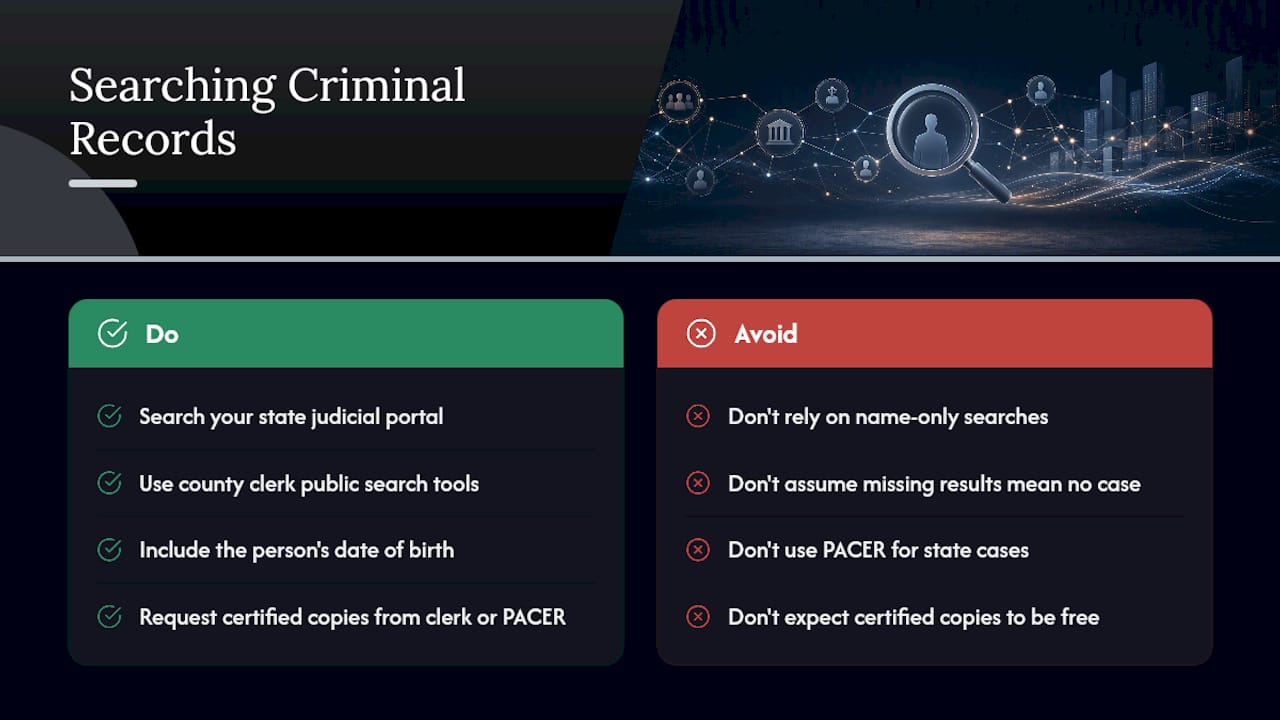
Verify spelling before trusting a "no results" screen. Treat every online hit as a starting point, not a final answer. Expect the same charge to be labeled differently in Texas than in Ohio. Timelines for certified copies run days, not minutes.
Search faster across counties with Registry Recognizer
Checking one county's clerk site is manageable. Checking six of them for the same name, on six different interfaces with six different quirks, is where most people give up. Registryrecognizer solves that specific problem: it's a searchable database of arrest and booking records pulled from counties nationwide. It is updated regularly, so you're not toggling between a dozen government sites to get a basic picture.
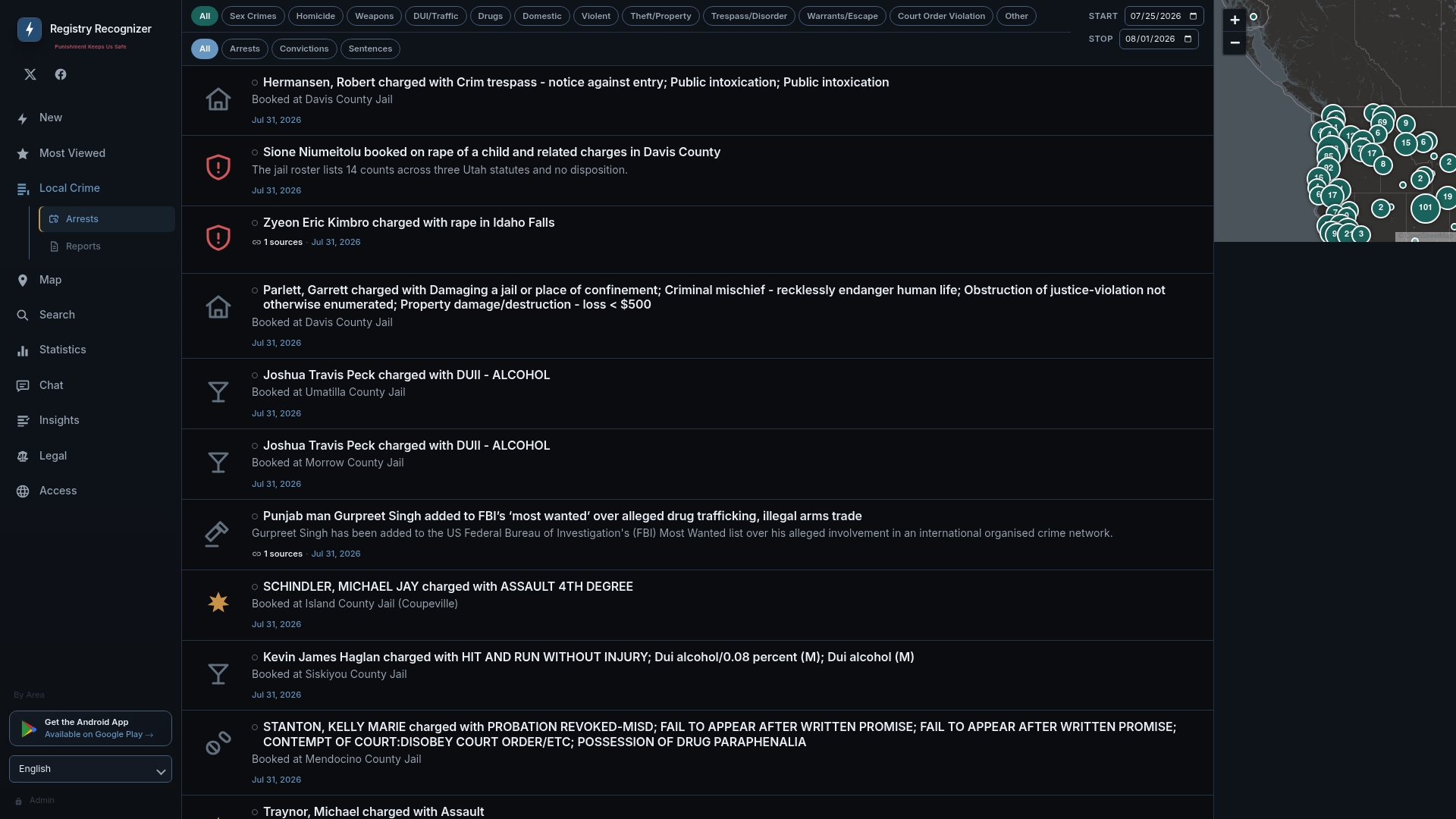
You can search a name, browse recent bookings by location, or filter by charge type to see patterns in local activity. Records like this probation violation entry show the kind of charge and bond detail available at a glance. Keep in mind that if you need a certified copy for legal, employment, or official use, that still has to come from the clerk's office or PACER directly. For a quick first look, though, start a search on Registryrecognizer and see what turns up before you commit to a county-by-county chase.
Frequently Asked Questions
How do I look up criminal charges against someone for free? Start with your state's judicial branch portal or the county clerk's public search tool. Most let you search by name at no cost, though certified copies typically carry a fee.
Can I search for criminal records using just a name? Yes, but results improve significantly when you add a date of birth. Name-only searches on common names often return multiple matches or no results due to exact-spelling requirements.
What's the difference between PACER and a state court portal? PACER covers federal cases only, like district, appellate, and bankruptcy court dockets. State portals and county clerk sites cover everything filed at the state or local level, which includes most common charges.
Why would a criminal charge not show up in an online search? The record may be sealed, expunged, or involve a juvenile case, all of which are typically restricted from public view. It's also possible the case was filed in a different jurisdiction than expected.
How do I get an official copy of a criminal case record? Contact the county clerk where the case was filed for state cases, or use PACER's document download feature for federal cases. Certified copies usually require a request and a small fee.
Sources
- Find a Case (PACER)
- National Archives court records
- Criminal History Record Search | New York Courts