
A police blotter is a chronological log of daily police activity; an arrest log is a curated register of custodial arrests and booking actions. They are not the same record, and mixing them up leads to real mistakes. If you need to know whether someone was taken into custody, check the arrest log. If you want a broader picture of what happened in a neighborhood on a given night, the blotter is your starting point.
- Police blotter: real-time, chronological log of calls, incidents, and officer activity — covers everything from noise complaints to felony stops
- Arrest log (booking log): a curated register produced after booking — lists people taken into custody, with formal charge codes, booking numbers, and jail location
- Key practical difference: an arrest can appear in a blotter as a detention before it ever reaches the arrest log; the log confirms custody and formal charges
Key Takeaways
A police blotter and an arrest log serve different purposes: the blotter captures real-time police activity chronologically, while the arrest log is a curated post-booking register that confirms custody and formal charges.
| Point | Details |
|---|---|
| Blotter vs arrest log purpose | Blotters log all police activity in real time; arrest logs record custodial bookings with formal charges. |
| Public records status | Both are generally public in the U.S., but state exemptions for juveniles, victims, and active investigations apply. |
| Disposition gap | Neither record shows final case outcomes; court dockets are the authoritative source for verdicts and dismissals. |
| Timing difference | An arrest appears in a blotter within minutes; the arrest log may not update until hours after booking is complete. |
| Registryrecognizer | Aggregates public arrest and booking records by county into a searchable database for faster, centralized research. |
Table of Contents
- What is a police blotter, exactly?
- What is an arrest log and how does it differ?
- How do blotters and arrest logs compare side by side?
- What information do entries actually contain?
- Are blotters and arrest logs public records in the U.S.?
- How do different states handle blotter and arrest log access?
- How do you find or request a blotter or arrest log?
- What are the limitations of relying on blotters and arrest logs?
- When you need more than a blotter: better sources for serious research
- How Registryrecognizer turns scattered logs into searchable records
- What reporters, researchers, and private citizens should actually know
- Registryrecognizer gives you searchable arrest records without the paperwork
- Sources
What is a police blotter, exactly?
Merriam-Webster defines a blotter as "a book in which daily records are entered" — and that plain-language framing holds up in practice. A police blotter is a chronological log of daily police activity: every call dispatched, every stop made, every incident reported, entered in the order it happened. According to LegalClarity, in the vast majority of U.S. jurisdictions, blotter entries are treated as public records under state open-records laws that mirror FOIA principles, though accessibility and redaction rules vary by state.
What you typically find in a blotter entry:
- Date and time of the incident
- Location (address or block-level)
- Incident type (e.g., "disturbance," "traffic stop," "suspicious person")
- Responding officer's unit number
- Brief narrative or disposition code (e.g., "GOA" — gone on arrival)
- Case or incident number for cross-reference
A blotter entry does not mean a crime was committed, and it does not mean anyone was arrested. It is a raw activity log. A typical line might read: "03/14 02:17 — 400 block Oak St — Disturbance — Unit 14 — Case #2026-04412." No names, no charges, no outcome. That is the blotter's job: capture what happened, when, and where, in real time.
What a blotter is not: it is not a final case file, not a charging document, and not proof of guilt or even of an arrest. Agencies sometimes publish edited versions for local media or their own websites, stripping out victim names and sensitive details before release.
What is an arrest log and how does it differ?
An arrest log, also called a booking log or arrest register, is a record of custodial arrests. It is produced after a person has been booked into jail, which means it contains information that a blotter entry simply cannot have at the moment of initial contact. The City of Santa Clara's publicly posted arrest log is a clean example: it lists arrests with the subject's name, date of birth, arrest date and time, case number, charges, and bond information, and it is updated on a schedule rather than in real time.
Typical arrest log fields:
- Full legal name and date of birth
- Booking number
- Arrest date and time
- Formal charge codes (e.g., "PC 459 — Burglary")
- Arresting agency and officer
- Jail or detention facility location
- Bond amount or "no bond" notation
The timing difference matters. An arrest may appear in a blotter as a detention within minutes of the stop. That same arrest may not appear in the booking log until hours later, after processing is complete. The arrest log is the curated, post-booking record; the blotter is the raw, real-time feed.
A typical arrest log entry looks like: "Smith, John A. | DOB 05/12/1988 | Booked 03/14/2026 04:32 | Case #2026-04412 | PC 459 Burglary | Bond: $25,000 | County Jail." The formality is the point.
How do blotters and arrest logs compare side by side?
The police blotter vs arrest log distinction comes down to four dimensions: chronology, scope, indexing, and disposition data.
- Chronology vs. curation: A blotter is immediate and sequential — entries go in as events happen. An arrest log is curated and produced after booking, which means it may lag the blotter by hours.
- Scope: Blotters cover every type of police activity. Arrest logs cover only custodial arrests. A traffic warning, a welfare check, a noise complaint — all appear in a blotter, none in an arrest log.
- Indexing: Most blotters are published chronologically and are not searchable by name. That is not an accident. As the Hawaii Attorney General's 1991 opinion explains, regulators historically required chronological access to blotters specifically to prevent name-indexed searches from creating partial criminal-history databases. Arrest logs, by contrast, are typically indexed by name and booking number.
- Disposition data: Neither record reliably tells you how a case ended. Blotters almost never include final dispositions. Arrest logs may note initial charges but rarely reflect whether charges were dropped, reduced, or resulted in conviction.
Pro Tip: If you find a name in an arrest log, that entry reflects an arrest, not a conviction. Charges change after booking. Always cross-reference with court docket records before drawing conclusions.
What information do entries actually contain?
The fields below show what you can realistically expect in each record type, and where gaps or redactions are common.
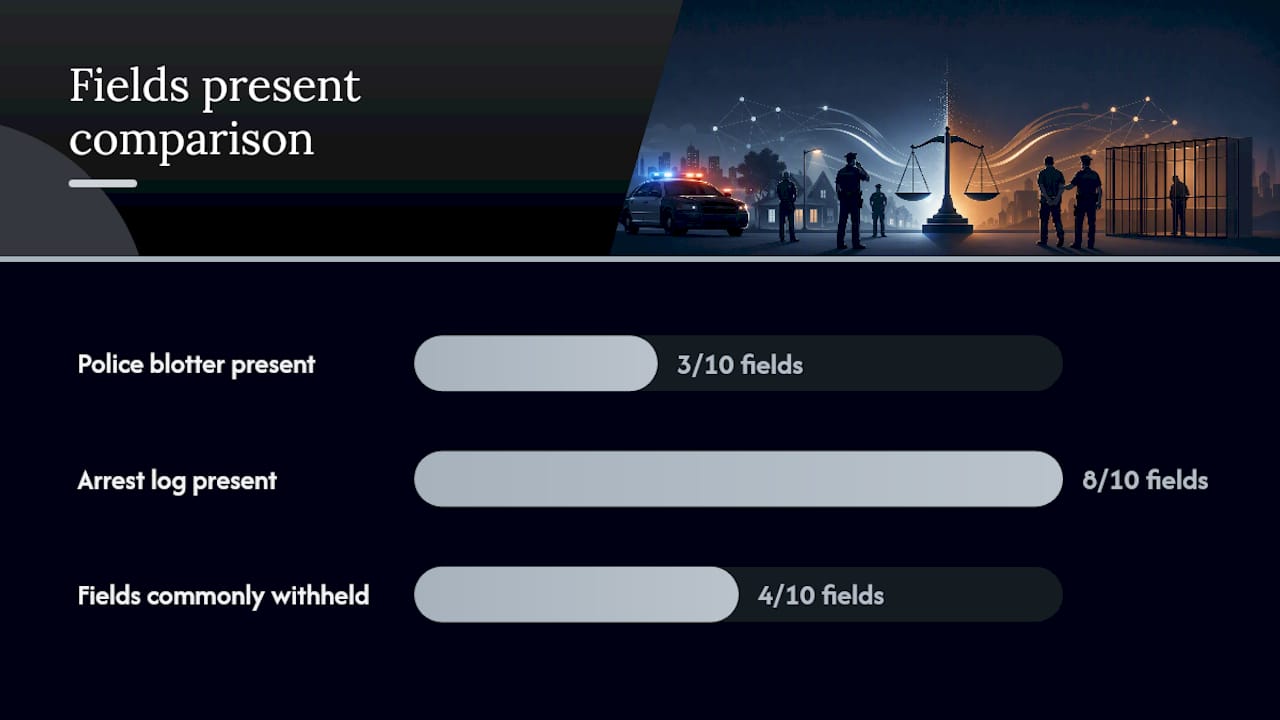
| Field | Police Blotter | Arrest Log | Redaction Notes |
|---|---|---|---|
| Date and time | Yes | Yes | Rarely redacted |
| Location | Yes (often block-level) | Yes (jail address) | Victim address may be withheld |
| Incident/charge type | Brief code or label | Formal charge code | Usually public |
| Subject name | Rarely | Yes | Juvenile names withheld |
| Date of birth | No | Yes | Sometimes redacted |
| Booking/case number | Sometimes | Yes | Public in most states |
| Officer/unit | Sometimes | Yes | Varies by agency |
| Bond amount | No | Often | Public in most states |
| Final disposition | No | Rarely | Must be sought from court records |
| Victim identity | No | No | Withheld under most state statutes |
New York's Committee on Open Government has consistently held that agencies may withhold portions of blotters and incident reports when records contain investigative details, witness identities, juvenile information, or other sensitive data — but the baseline record itself remains public.
"Blotters and incident reports differ in content from formal investigative files. Blotters are generally accessible under open-records law, and agencies may withhold limited details to protect investigations or privacy, according to the New York Committee on Open Government
Reading charge codes when they appear: most agencies use state penal code citations (e.g., "PC 187" for California homicide) or local ordinance numbers. A quick search of the state's penal code index will decode them. Some agencies use internal shorthand like "DV" for domestic violence or "DUI" for driving under the influence — those are usually self-explanatory.
Are blotters and arrest logs public records in the U.S.?
Generally, yes. Both are treated as public records in most U.S. jurisdictions, but the specifics depend heavily on state law. The Reporters Committee for Freedom of the Press documents how courts and attorney general opinions across the country have required disclosure of blotter data in chronological form, while permitting narrower withholding where disclosure would interfere with ongoing investigations or privacy interests.
The federal framework matters here. The DOJ and state regulators have historically treated chronologically compiled blotters as "original records of entry" — a statutory category that carries a presumption of public access. The Hawaii AG opinion is one of the clearest articulations of this reasoning: blotters compiled in chronological order are public; agencies may resist converting them into name-indexed searchable databases because doing so would effectively create partial criminal-history records outside the regulatory framework governing official criminal-history repositories.
Common statutory exemptions that can limit access:
- Ongoing criminal investigations (withholding details that would tip off a suspect)
- Juvenile records (names and identifying information almost universally protected)
- Victim identity and address (especially in domestic violence and sexual assault cases)
- Medical or mental health information gathered during a call
- Confidential informant or witness identities
- Information that would endanger an officer's safety
The practical takeaway: you have a strong legal basis to request a blotter or arrest log in most states. What you actually receive may be redacted, and the agency's redaction decisions can be challenged through administrative appeal or litigation.
How do different states handle blotter and arrest log access?
State rules vary enough that the same request can produce full disclosure in one state and a heavily redacted document in another. A few representative examples:
- Massachusetts requires law enforcement agencies to maintain a daily log of all responses to calls for service, arrests, and incidents. The statute mandates that the log be available to the public within 24 hours, though certain exemptions apply for ongoing investigations and privacy.
- Washington applies the Criminal Records Privacy Act (CRPA), which adds a layer of regulation on top of the general Public Records Act. Arrest records that did not result in conviction carry specific restrictions on dissemination.
- New Mexico uses the Arrest Record Information Act (ARIA) framework. Under New Mexico's statutory commentary, original records of entry — including police blotters, radio logs, and desk logs — are treated as public unless another specific exemption applies.
- Texas has produced some of the most-cited case law on this issue. The Houston Chronicle line of cases parsed which portions of police records are public and which fall under the investigatory-file exemption, establishing that basic arrest data is public while active investigative details may be withheld.
- California agencies like the Santa Clara Police Department publish arrest logs online with name, charges, and booking time, updated on a regular schedule. California's CPRA (California Public Records Act) broadly supports this disclosure.
- Kansas statute K.S.A. 45-217 explicitly identifies arrest data as public record, illustrating how some states codify access directly rather than leaving it to case-by-case AG opinions.
These are examples, not a complete map. Before filing a request, check your specific agency's public records policy and your state's open-records statute. Rules change, and local agencies sometimes apply more restrictive interpretations than state law requires.
How do you find or request a blotter or arrest log?
Start with the agency's own website. Most mid-size and large police departments post blotter summaries or arrest logs directly on their sites, often updated daily or weekly. If the record is not posted publicly, here is the standard path:
- Identify the correct agency. City police, county sheriff, state police, and campus police all maintain separate records. Confirm which agency made the arrest or responded to the incident.
- Check the agency's records or open-data page. Search for "arrest log," "daily blotter," or "public records" on the department's website.
- Contact the records office directly. A phone call often resolves simple requests faster than a formal submission.
- File a written open-records request if needed. Address it to the agency's records custodian. Include: the date range you need, the type of record (blotter, arrest log, or both), the incident location or case number if known, your preferred format (PDF, printed copy), and your contact information.
- Use your state's FOIA equivalent. Every state has an open-records law. Name it in your request letter — it signals you know your rights and often speeds up compliance.
Sample request sentence you can adapt: "Pursuant to [State] Public Records Law, I request a copy of the daily arrest log / police blotter for [date range], for incidents occurring within [jurisdiction], in electronic format if available."
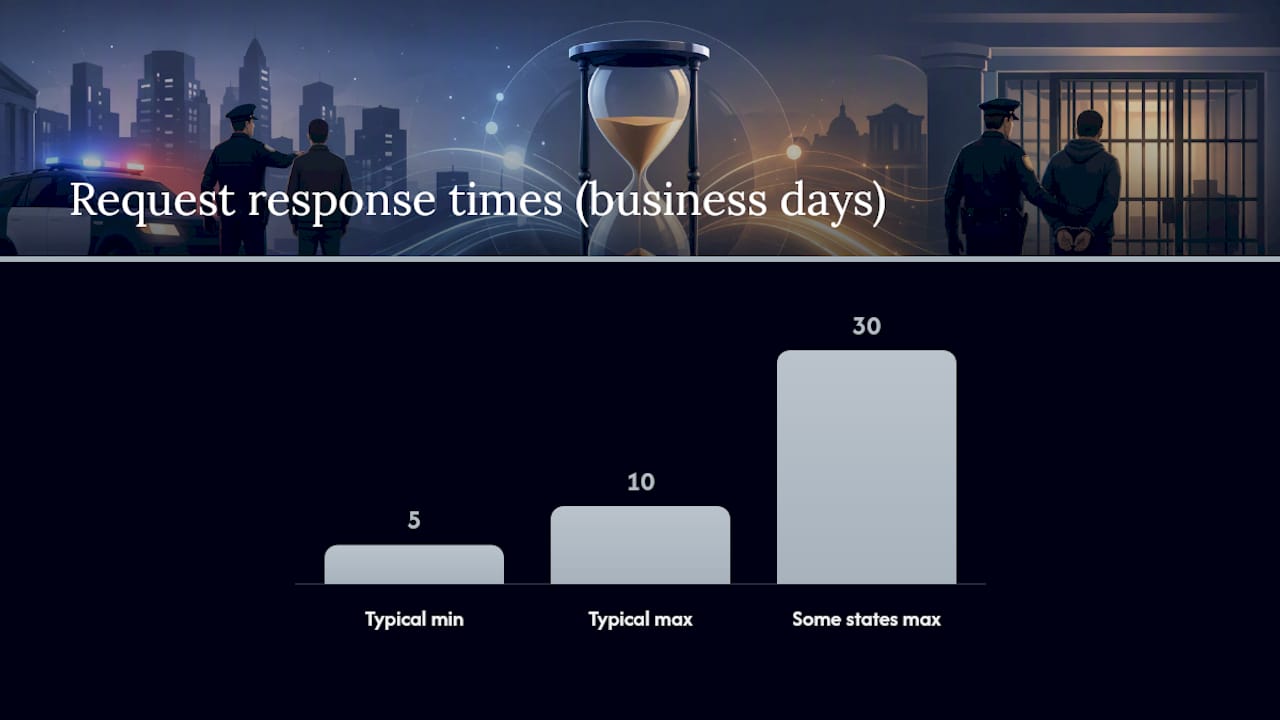
Expect a response within 5–10 business days in most states, though some allow up to 30 days. Fees vary: many agencies provide electronic records free or for a nominal copying charge. Redactions are common and legal; if you believe a redaction is improper, most states have an administrative appeal process.
Pro Tip: If the agency denies your request or over-redacts, your state's attorney general office or press freedom organization can often provide a free template appeal letter. The Reporters Committee for Freedom of the Press maintains state-specific open-records guides at rcfp.org.
What are the limitations of relying on blotters and arrest logs?
Both records are snapshots, not final verdicts. An arrest log entry reflects what an officer believed at the time of booking. Charges get dropped, reduced, or upgraded after that moment — and neither the blotter nor the arrest log will reflect those changes.
Common errors and gaps to watch for:
- Misidentification: Name misspellings, wrong dates of birth, and confusion between people with similar names are more common than agencies admit.
- Charge changes: Initial charges at booking often differ from what a prosecutor ultimately files. An arrest log showing "PC 187 — Homicide" may later become a manslaughter charge or be dropped entirely.
- Timing gaps: As noted with the Santa Clara arrest log, logs are updated on a schedule, not in real time. An arrest made at 11 PM may not appear until the next morning's update.
- Missing entries: Not every detention results in a booking, and not every booking gets entered promptly. Blotters can have gaps from shift changes, system outages, or simple human error.
- No final disposition: Neither record tells you whether the person was convicted, acquitted, or had charges dismissed. That information lives in court records.
The reputational risk is real. Publishing or sharing an arrest log entry as though it represents a conviction is legally and ethically problematic. Arrests are not convictions. LegalClarity recommends relying on court dispositions or certified records for definitive case outcomes rather than raw blotter entries.
Pro Tip: Before citing any blotter or arrest log entry in a story, background check, or legal proceeding, pull the corresponding court docket to verify the current charge status and any disposition. Court records are the authoritative source for outcomes.
When you need more than a blotter: better sources for serious research
Blotters and arrest logs are the fastest records to access, but they are also the least complete. Depending on your goal, you may need to go further.
- Certified disposition requests: — If you need proof of conviction or acquittal for employment, licensing, or legal proceedings, request a certified disposition directly from the court clerk. This is the only document that carries legal weight.
- Attorneys and licensed investigators: — For anything with legal stakes — a custody dispute, a business background check, a civil lawsuit — a licensed attorney or private investigator can pull certified records and interpret them correctly.
The speed-versus-reliability tradeoff is straightforward: a blotter gives you the fastest signal that something happened; a certified court disposition gives you the authoritative answer on what it meant legally. If you discover an arrest and need to understand the next steps, resources on arrest warrants vs. bench warrants and the role of bail in felony cases can help clarify what typically follows booking.
How Registryrecognizer turns scattered logs into searchable records
An aggregated database solves the core problem with blotters and arrest logs: they are fragmented, inconsistently formatted, and spread across hundreds of agencies. Registryrecognizer ingests daily logs from agencies across multiple counties, normalizes the fields, and surfaces them through name, location, and charge-type filters — turning what would otherwise require dozens of individual records requests into a single search.
What Registryrecognizer provides:
- Search by name, county, or charge category
- Booking details including arrest date, charges, and jail location
- Disposition flags where available
- Date-range filters for tracking activity over time
- Individual record pages showing the full booking metadata
Here is how the lifecycle of a single arrest typically flows through these systems: a patrol officer detains a suspect at 11:45 PM — that contact appears in the blotter within minutes as a case number and incident type. After booking at 2:00 AM, the arrest log is updated with the subject's name, formal charges, and bond information. Registryrecognizer then pulls that booking data into its searchable database, where a record like this one shows the full booking metadata in a single, readable page. Another example, a Rockland assault arrest, shows how local incidents are summarized with the same structured fields regardless of the originating agency.
What reporters, researchers, and private citizens should actually know
The most common mistake people make with these records is treating the arrest log as the final word. It is not. An arrest log tells you someone was booked; it tells you nothing about what happened next. Reporters who publish arrest log entries without checking the court docket risk defaming someone whose charges were dropped the following morning. Private citizens who run a name search and find an old arrest entry may be looking at a record that was expunged or resulted in acquittal years ago.
The second mistake is the opposite: dismissing blotters as too raw to be useful. For journalists covering a specific neighborhood or beat, the blotter is the most current signal available. A pattern of calls to the same address, a spike in a particular incident type, a detention that later becomes a high-profile arrest — these all show up in the blotter first.
The practical priority: use blotters for timeliness and geographic context; use arrest logs for custody facts and formal charges; use court records for anything that requires a verified outcome. None of these records is a substitute for the others, and none of them replaces a conversation with the agency's public information officer when the stakes are high.
Registryrecognizer gives you searchable arrest records without the paperwork
Tracking down arrest records across multiple counties normally means filing separate requests with each agency, waiting days for responses, and reconciling inconsistently formatted documents. Registryrecognizer cuts through that by aggregating public arrest and booking data into one searchable database, updated regularly across counties nationwide.
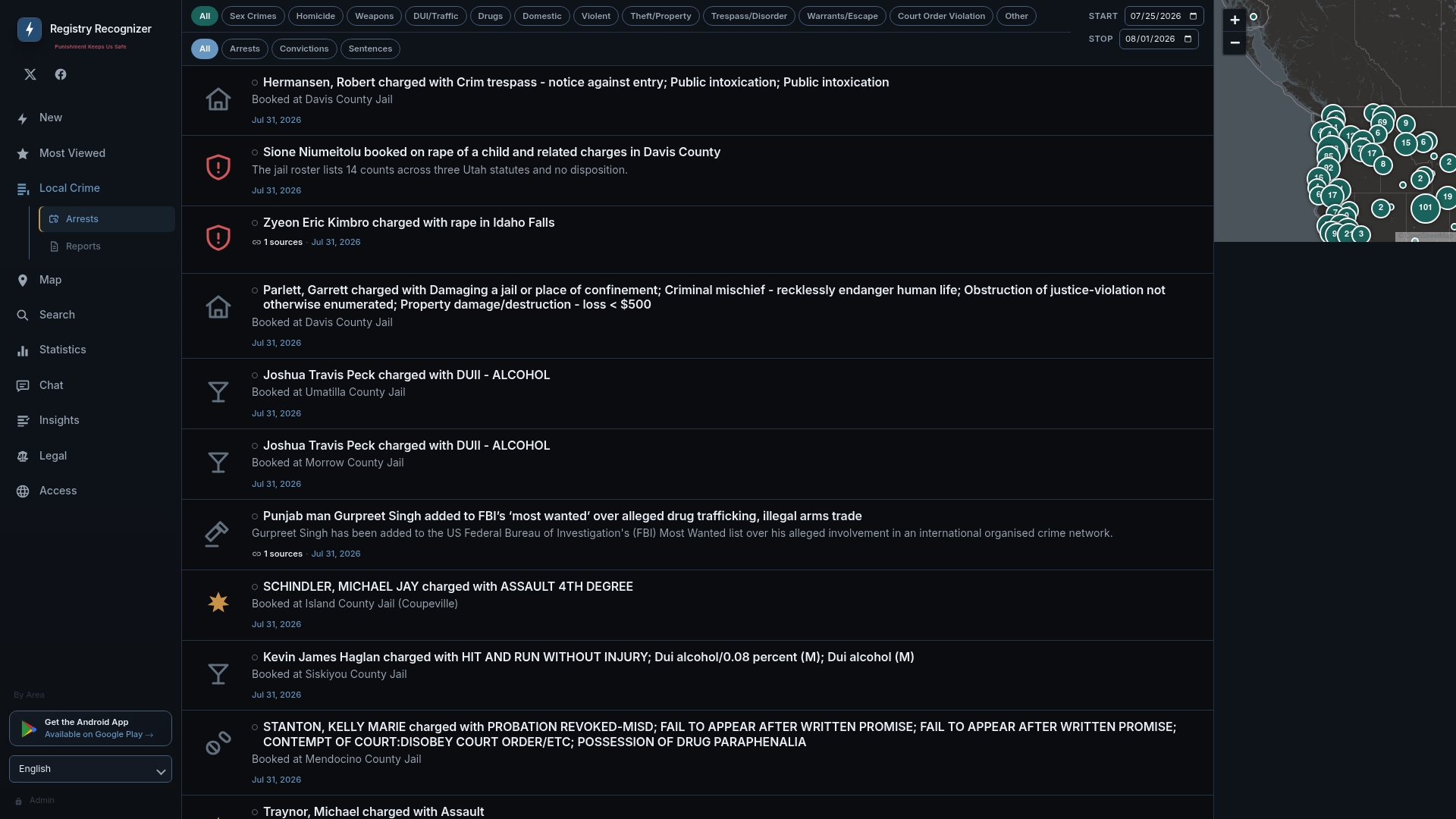
Search by name, county, or charge type. View booking details, arrest dates, charges, and jail locations for individual records. Filter by offense category to track specific crime types in your area. The database covers a wide range of charges, from DUI and drug offenses to assault and property crimes, with records like this felony firearm possession case showing the level of detail available. All data is sourced from public records and is provided for informational purposes only — not as a substitute for certified court documents. Start your search at Registryrecognizer to find publicly available arrest records by county.
Sources
The sources below are the primary references used in this article. Each one addresses a specific aspect of blotter and arrest log law or practice.
- What Is a Police Blotter and Is It a Public Record? - LegalClarity
- Opinino Letter Number 91-04
- Police blotter — RCFP
- City of Santa Clara arrest log
- The Committee on Open Government
This article is general information, not a substitute for advice from a qualified lawyer. Consult a qualified legal professional about your own circumstances before acting on anything here.
Recommended
- Registry
- Crowd throws drinks, glass at Boston cop in viral video · Registry Recognizer
- BALFOUR, GLENN THOMAS charged with Arrest: 50B-4 - DV PROTECTIVE ORDER VIOL (M); Arrest Date 07/02/2026; Bond - No Bond; Set By MILLER; · Registry Recognizer
- Leesburg man arrested on trafficking and other drug charges after traffic stop in Tavares · Registry Recognizer