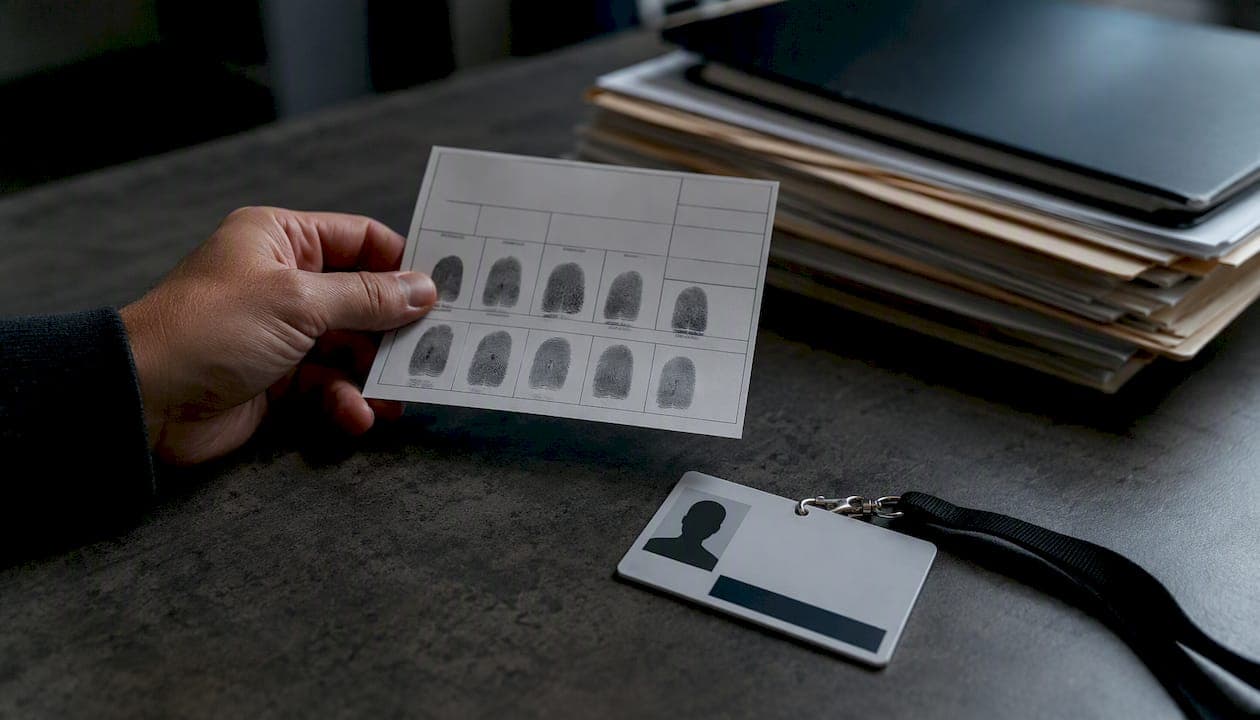
A State Identification Number (SID) is the unique identifier a state assigns to a person's criminal-history and fingerprint record the first time that person's prints enter the state's system. Every arrest, charge, and disposition recorded in that state gets linked to this single number. You'll see it on RAP sheets, booking reports, and background-check forms, and it's the key field you need when requesting a state criminal-history record through Nlets or a state Bureau of Criminal Identification (BCI). The SID is strictly state-managed; it is separate from the FBI's Universal Control Number (UCN), which operates through the federal NGI system.
Key Takeaways
A State Identification Number is a permanent, state-issued identifier tied to a person's fingerprint record, and it is the primary field used to retrieve a state RAP sheet through Nlets or a state BCI portal.
| Point | Details |
|---|---|
| SID definition | A unique state-level number assigned at first custodial or felony arrest, permanently tied to that individual's fingerprint record. |
| SID vs. FBI/UCN | The SID covers in-state records only; the FBI UCN is a federal identifier issued through the NGI system and covers all participating states. |
| Where to find it | Look in the header block of a RAP sheet or booking report, near the subject's name and date of birth, labeled "State ID" or "SID." |
| Correcting errors | Contact the state BCI or AFIS unit in writing, provide fingerprints or identifying documents, and request written confirmation of any fix. |
| Registryrecognizer | Search the database by name and county to locate booking records that surface SIDs and charges before requesting a certified RAP sheet. |
Table of Contents
- What does a SID number mean, and who issues it?
- Where does an SID appear on official documents?
- How does a SID differ from an FBI number or UCN?
- How do you use an SID to request criminal-history records?
- How do SID formats vary across states?
- What causes SID errors, and how do you fix them?
- Who can access SID records, and what do the fees look like?
- How this guide was compiled
- Registryrecognizer makes finding arrest records faster
- Sources
What does a SID number mean, and who issues it?
Per Law Insider's legal dictionary, a State Identification Number is assigned to an individual following their first custodial or felony arrest and remains uniquely assigned to that person regardless of subsequent arrests. Once created, it doesn't change or get reassigned.
SIDs are generated and managed by state-level agencies, not federal ones. The specific agency varies by state:
- State Bureau of Criminal Identification (BCI): The most common issuing authority, operating under the state attorney general or department of public safety.
- Department of Public Safety (DPS) AFIS centers: Automated Fingerprint Identification System centers that process incoming fingerprint cards and generate the SID when a new identity is confirmed.
- State criminal-history repositories: Central databases that store the SID alongside arrest and disposition records submitted by courts and law enforcement.
The SID is created at the moment a fingerprint submission can't be matched to an existing record in the state's AFIS. That's the system's signal that this is a new individual, and a new SID gets minted. From that point forward, every in-state arrest, court outcome, and supervision record attaches to it.
Where does an SID appear on official documents?
The SID shows up on more document types than most people expect. Courts, law enforcement agencies, and background-check processors all reference it:
- RAP sheet (criminal history record): The SID typically appears near the top, often in a header block alongside the person's name, date of birth, and physical descriptors. Look for fields labeled "State ID," "SID," or "State Identification #."
- Booking and arrest reports: Jail intake forms usually carry the SID in the identifier section, near the FBI number field if one exists.
- Court filings and probation/parole records: Supervision agencies use the SID to pull the full criminal history when preparing pre-sentence reports or violation petitions.
- Background-check request forms: The SID is the field you fill in to retrieve a specific individual's in-state record.
On a RAP sheet, the FBI number (UCN) often appears directly below or beside the SID. If you see two identifier fields in the header, the state-issued one is the SID. Registryrecognizer's booking record pages show how these identifiers and charges appear in a public-facing arrest record.
Pro Tip: On a RAP sheet, scan the header block first. The SID is almost always in the top third of the document, near the subject's name and date of birth. If you see a field starting with your state's two-letter abbreviation followed by digits, that's likely the SID.
How does a SID differ from an FBI number or UCN?
This is where most people get tripped up. The two numbers look similar on a RAP sheet, but they come from entirely different systems.
FBI guidance on identity-history summary checks makes clear that the FBI Number (now called the Universal Control Number, or UCN) is a federal identifier tied to the FBI's Next Generation Identification (NGI) system. It is issued only when a ten-print fingerprint card reaches the FBI, and it covers the person's record across all states that have submitted prints federally.
| Feature | SID | FBI Number / UCN |
|---|---|---|
| Issuer | State BCI / DPS / AFIS | FBI / NGI |
| Scope | In-state records only | National, across all participating states |
| Created when | First in-state fingerprint submission | First ten-print card received by FBI |
| Primary use | State RAP sheet retrieval | Federal identity-history summary checks |
| Appears on | State RAP sheet, booking reports | Federal rap sheet, may also appear on state RAP |
A person can have a SID in multiple states if they've been arrested in more than one. They have only one UCN. Mixing the two up when submitting a record request sends the query to the wrong system and returns nothing useful.
- If a RAP sheet shows no FBI number, it typically means no ten-print card was ever submitted to the FBI from any state for that individual, per Utah's criminal-history reading guide.
- A missing SID on a booking record usually means the fingerprint submission hasn't been processed yet, not that the person has no history.
How do you use an SID to request criminal-history records?
The Nlets/QR procedural guide describes the process clearly: copy the SID from a QH (Query Hit) response and paste it into the State ID # field when submitting a QR (Record Request). The returned RAP sheet is linked directly to that SID.
Here's the practical sequence:
- Locate the SID. Find it on the existing booking record, RAP sheet, or QH response. Write it down exactly, including any leading zeros or state prefix.
- Select the destination state. Enter the Nlets destination code for the state that issued the SID. Sending a query to the wrong state returns nothing.
- Enter the purpose code. Purpose codes define why you're requesting the record (criminal justice, employment screening, licensing, etc.). Use the code that matches your authorized purpose.
- Fill in the requestor name. Enter the name of the authorized agency or individual making the request.
- Paste the SID into the State ID # field. This is the field that drives the query. Do not enter the UCN here unless the form specifically asks for it.
- Submit and review the response. The returned RAP sheet lists all arrests and dispositions tied to that SID in the queried state.
Pro Tip: If both a SID and a UCN appear on the source document, copy both before you start. Some forms accept either; having both ready prevents a second lookup.
How do SID formats vary across states?
Formats differ enough between states that entering a SID from one state into another state's form will almost always fail or cause an error.
- Some states use purely numeric SIDs of a fixed length.
- Others prefix the number with a state code or letter string (e.g., "TX" followed by digits).
- A few states embed a check digit or use the last character to encode record type.
The Illinois State Police Bureau of Identification publishes one of the clearest state-specific rules: the Illinois SID field contains exactly eight numeric characters, and the last character must be 0 or 1. The guide explicitly warns against entering out-of-state SIDs on Illinois forms.
Warning: Entering a SID issued by another state into a state-specific form doesn't just return a blank result. It can generate a false "no record" response or, in some systems, trigger an error that flags the query for review. Always confirm the issuing state before submitting.
Before submitting any request, check the target state's BCI website for its format rules. Most state BCI pages publish a background-check guide or submission instructions that specify the exact SID format they accept.
What causes SID errors, and how do you fix them?
Duplicate SIDs, missing SIDs, and SID-to-FBI number mismatches are more common than the system's design intends.
Common causes:
- Fingerprint-based splits: AFIS initially links two arrests to one SID, then a closer comparison reveals they belong to different people. The system creates a second SID, leaving one person with two records.
- Data-entry errors: A transposed digit during manual entry creates a phantom SID or attaches a record to the wrong person.
- Out-of-state records: An arrest in a second state creates a new SID there, which doesn't automatically merge with the home-state SID.
How to fix them:
- Contact the state BCI or AFIS section directly. Most states have a dedicated records-correction unit.
- Provide fingerprints or certified identifying documents to support the correction request.
- Include the SID(s) in question, the subject's full legal name, date of birth, and the specific discrepancy you're reporting.
- Ask for written confirmation of the correction and a revised RAP sheet once the fix is complete.
Pro Tip: When contacting a state BCI for a correction, put the request in writing even if you call first. A written record of the discrepancy and the agency's response protects you if the error reappears in a future background check.
Who can access SID records, and what do the fees look like?
Access rules and fees vary by state and by the purpose of the request. Not every SID-linked record is publicly available.
- Law-enforcement queries: Authorized agencies can query state repositories directly through Nlets with no public-facing fee, using criminal-justice purpose codes.
- Public background checks: Many states allow individuals to request their own criminal history for a fee, typically through the state BCI's public portal. Fees vary by state.
- Employer and licensing checks: These require specific purpose codes and, in many states, written consent from the subject.
- Journalists and researchers: Access depends on state open-records laws. Some states treat RAP sheets as public records; others restrict them to authorized requestors.
An SID-linked record lists arrests and dispositions. An arrest is not a conviction. A charge that was dismissed, reduced, or resulted in an acquittal still appears on the RAP sheet tied to that SID. Reading a RAP sheet without understanding disposition codes can lead to serious misinterpretation of a person's legal history.
For any use in legal proceedings, request a certified RAP sheet directly from the state BCI rather than relying on a third-party database. Consulting a qualified attorney before acting on criminal-history data is advisable. This article is general information, not legal advice; verify current rules with your state's BCI or a licensed attorney.
How this guide was compiled
This guide draws on official procedural documents and legal-reference definitions:
- FBI identity-history summary guidance for UCN/NGI distinctions
- DOJ/Nlets QR procedural PDF for step-by-step query instructions
- Illinois State Police BCI background-check guide for state-specific format rules
- Utah UCJIS-TAC criminal-history reading guide for RAP-sheet interpretation
- Law Insider legal dictionary for the formal SID definition
To verify anything in this guide, follow the links above to the original source documents, or request a certified RAP sheet from the relevant state BCI when you need authoritative confirmation.
Registryrecognizer makes finding arrest records faster
Registryrecognizer indexes arrest and booking records from counties across the United States, surfacing the charges, booking dates, jail locations, and identifier fields that appear on those records. When you need to locate a record before you have the SID in hand, searching the Registryrecognizer database by name and county can surface the booking entry that carries it.

Records like the probation violation filing for Keion Jacquese King show how booking metadata, charges, and identifiers appear in a searchable format. Registryrecognizer does not provide certified court documents or official RAP sheets. For legal proceedings, contact the state BCI directly and request a certified record. To start a search, visit Registryrecognizer and enter the name and county.
A note on reading criminal-history data carefully
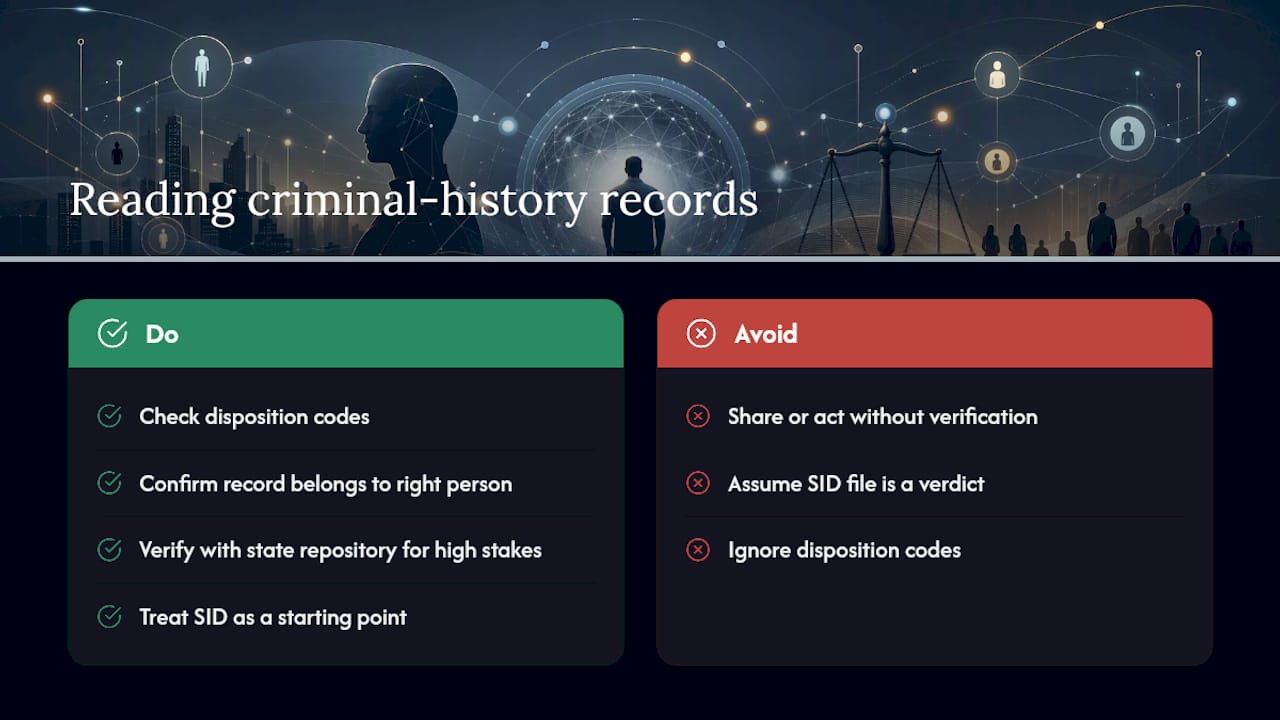
Criminal-history records carry real consequences for real people. An SID links every arrest in a state to one file, but that file is not a verdict. Dispositions matter: a dismissed charge and a conviction look similar to an untrained eye but mean entirely different things legally. Before sharing or acting on any SID-linked record, check the disposition codes, confirm the record belongs to the right person, and verify the data against the state repository when the stakes are high. Responsible use of this information means treating it as a starting point for verification, not a final answer.
Sources
- Informational tools — identity history summary checks (FBI)
- December 2019 | V4
- Background Check Guide - Illinois State Police Bureau of Identification
- How to read a criminal history (UCJIS-TAC / Utah) 2025/03
- State identification (SID) number Definition | Law Insider
This article is general information, not a substitute for advice from a qualified lawyer. Consult a qualified legal professional about your own circumstances before acting on anything here.
Recommended
- ANTHONY QUINTON ORAN SMITH charged with FAIL TO ID FUGITIVE INTENT GIVE FALSE INFO PC 38.02(D)(2) · Registry Recognizer
- Kevin John Sattler charged with Possess Drug Paraphernalia Cash Only in Def Name - · Registry Recognizer
- Dangelo Sanchez charged with PC 3455(A) - VIOLATION OF POST RELEASE SUPERVISION · Registry Recognizer
- WASHINGTON, CHRISTOPHER DEANDRE charged with DC26-904336 TAMPERING WITH PHYSICAL EVIDENCE; DC26-904334 TRAFFICKING-METHAMPHETAMINE; T9915348 NO INSURANCE; T9915349 DRIVE W/SUSPENDED LIC; T9915347 NO SEAT BELT · Registry Recognizer