
"No bond" means a judge has ordered that the defendant cannot be released before trial, no matter what they pay. But the same words on a booking sheet sometimes mean the opposite: a zero-dollar release with no payment required at all. If you see "no bond" attached to someone's name, the first move is finding out which one it is, then calling a defense attorney to confirm.
TL;DR:
- "No bond" may indicate either a court order denying release or a zero-dollar bond on a booking sheet, and context determines which applies.
- A zero-dollar release involves no payment but requires court-mandated conditions, while a true no bond means the defendant remains incarcerated without the option of immediate release.
- Most jurisdictions require a bond hearing within a few days, but some entries marked "no bond" at intake may not reflect a formal ruling yet.
- Challenges to a no-bond order are possible through legal motions or appeals, emphasizing the importance of prompt legal representation.
- Verifying the actual bond status requires checking court dockets or official booking records, as jail records are often placeholders until a hearing occurs.
Table of Contents
- No Bond Meaning: Two Opposite Definitions You Need to Tell Apart
- Why Judges Deny Bond: The Factors Behind a No-Bond Order
- How Long Can Someone Be Held Without Bond?
- How to Challenge a No-Bond Order: Steps Families Can Take Now
- Checking Booking and Bond Status: What to Look For
- What It's Like Being Held Without Bond: Practical Fallout for Families
- What Registry Records Actually Tell You
- Check a Booking Record Before You Assume Anything
- Where to Verify the Details Yourself
- Sources
No Bond Meaning: Two Opposite Definitions You Need to Tell Apart
"No bond" carries two contradictory meanings, and county jail websites rarely explain which one applies to a given entry. Reading it wrong leads families to either panic unnecessarily or miss a real emergency.
A zero-dollar release, sometimes called release on recognizance, means the person walks out without posting any money. They sign a promise to appear in court and usually accept conditions such as no contact with an alleged victim, travel restrictions, or scheduled check-ins with a pretrial officer. This is common for lower-level, nonviolent charges where the court decides jail isn't necessary to guarantee a court date. Registryrecognizer's guide on release on recognizance breaks down what those conditions typically look like.
A true denial of bond means the opposite: the defendant stays locked up, and there is no dollar amount that buys their way out. According to LegalClarity's explanation of "zero bond", context is everything. The same two words describe a free pass out of jail or a court order keeping someone in custody indefinitely.
Booking-record notations add another wrinkle. Some jail systems list "no bond" as a placeholder the moment someone is booked, before any judge has looked at the case. Others use it only after a formal detention hearing. If you're trying to figure out which situation applies, our breakdown of bail versus bond explains how these terms function differently across systems.
Quick reference for reading a booking entry:
- "Bond: $0" or "PR bond" usually signals recognizance release, not detention.
- "No bond" combined with a case status of "pending review" often means no hearing has happened yet.
- "No bond" tied to a specific judge's name or order number usually reflects a formal ruling.
- Any notation should be cross-checked against the court docket, not treated as final on its own.
Why Judges Deny Bond: The Factors Behind a No-Bond Order
Judges don't deny bond arbitrarily. They weigh a specific set of factors, and most states require them to document the reasoning in writing.
According to the Shouse Law Group's overview of reasons courts deny bail, the standard factors include:
- The severity of the alleged offense, especially violent felonies or crimes involving weapons.
- Flight risk, based on ties to the community, prior bench warrants, or access to resources to leave the jurisdiction.
- Danger to the community or to a specific victim, particularly in domestic violence or repeat-offense cases.
- A history of failing to appear at prior court dates.
- Active probation or parole status at the time of the new arrest.
Federal courts apply a similar framework under the Bail Reform Act, weighing danger and flight risk through a detention hearing rather than a simple bail schedule. State courts vary, but the same core questions tend to show up: how serious is this charge, and how likely is this person to skip town or hurt someone if released?
Written findings matter more than most people realize. When a judge denies bond, many jurisdictions require the order to spell out exactly which factors drove the decision. That paper trail becomes the foundation for any later motion to reconsider or appeal. A vague, undocumented denial is often easier to challenge than one backed by specific findings tied to the case record.
How Long Can Someone Be Held Without Bond?
Most jurisdictions require an initial appearance quickly. The window typically runs 24 to 96 hours after arrest, depending on the state and whether the arrest happens on a weekend or holiday. That first hearing is where a judge usually addresses bond for the first time, and it's the moment that turns a booking-sheet placeholder into either a release order or a formal detention ruling.
The Bureau of Justice Statistics reports the average pretrial incarceration stay runs about a few weeks nationally. That average masks huge variation. Someone facing a minor charge with a documented no-bond placeholder might see a judge within a day and get released. Someone charged with a violent felony and formally denied bond can sit in custody for months while the case moves toward trial.
If you're looking at a booking sheet and see "no bond," check whether a hearing has actually occurred. LegalClarity notes that this label sometimes appears automatically at intake, before any judge has reviewed the case. The fastest way to tell the difference is pulling the court docket. A scheduled or completed bond hearing, along with a named judge and an order number, signals a formal ruling. An empty docket with no hearing date listed usually means the case hasn't reached a judge yet.
How to Challenge a No-Bond Order: Steps Families Can Take Now
A no-bond order isn't necessarily permanent. Courts allow challenges, and moving fast matters because every day in custody makes it harder for a defendant to help prepare their own defense.
- Contact a defense attorney immediately. If one hasn't been retained or appointed, request a public defender at the first appearance. Counsel can request an expedited bond or redetermination hearing rather than waiting for the case to move at its normal pace.
- File a motion for bail review or bond reduction. Defense attorneys commonly use this route when the initial detention order was issued without full information about the defendant's ties to the community.
- Gather supporting evidence before the hearing. Proof of steady employment, a stable address, family responsibilities, and any completed treatment or counseling programs all give a judge a reason to reconsider.
- Propose supervision conditions. Offering electronic monitoring, regular check-ins, or a third-party custodian can persuade a court that release doesn't mean losing track of the defendant.
- Escalate if necessary. Some states allow an emergency writ or appeal to a higher court when a trial-level judge denies a bond review request outright.
Pro Tip: Bring documentation to the first meeting with your attorney, not just to the hearing. A lease, pay stubs, and a letter from an employer take days to gather, and an attorney can't request an expedited hearing until that evidence is ready to present.
The American Bar Association's materials on pretrial appearances outline the basic rights defendants have at these early hearings, including the right to be present and the right to counsel.
Checking Booking and Bond Status: What to Look For
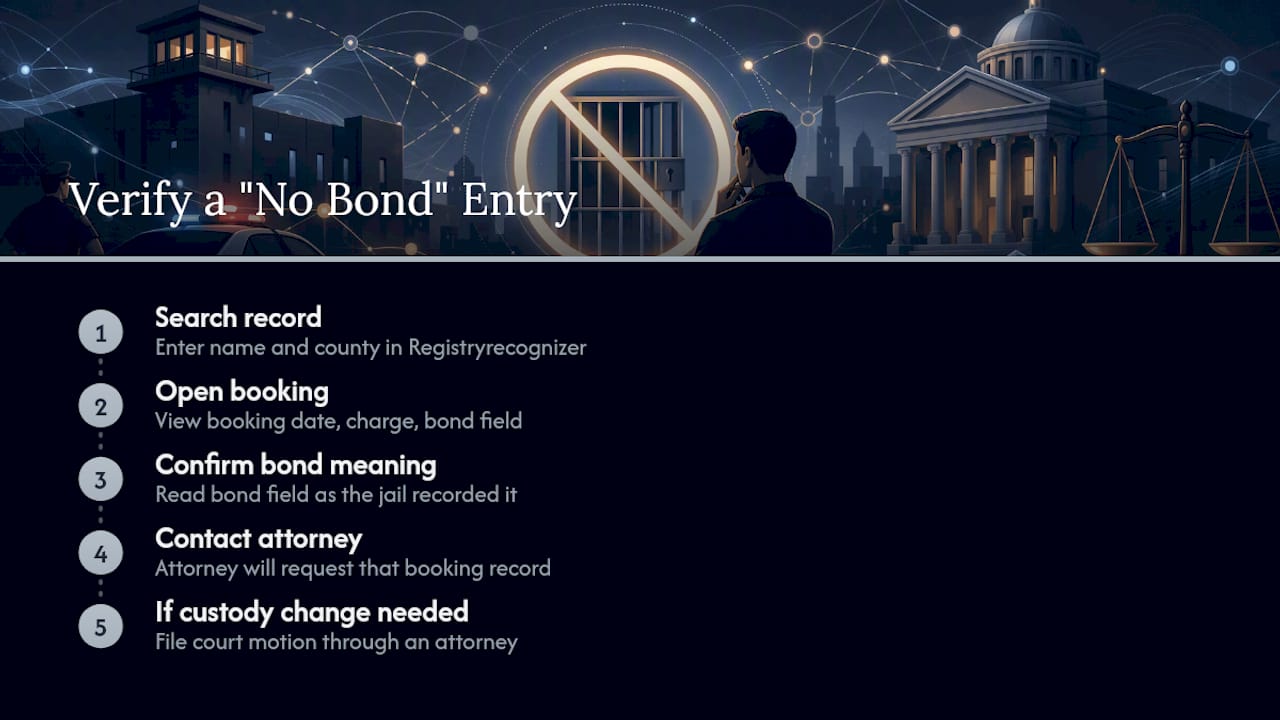
Before assuming the worst, verify what's actually on record. Registryrecognizer's county-level arrest database lets you search a name and pull up booking details, including the bond field, charge description, and jail location. An example record showing a Bond - No Bond notation illustrates exactly how these fields appear on a real booking sheet.
When reviewing a record, pay attention to:
- The bond amount field, whether it lists a dollar figure, "$0," or "no bond."
- Any note showing which judge or agency set the bond status.
- The booking date and time, which tells you how recent the entry is and whether a hearing has likely happened yet.
- The offense category, since charge severity often explains why bond was set the way it was.
Registryrecognizer's data is informational. Changing a custody status requires a court filing and an attorney, not a database lookup.
What It's Like Being Held Without Bond: Practical Fallout for Families
Detention before trial does more than keep someone in a cell. It changes how the case itself plays out.
Defendants held in custody have less time and fewer resources to help prepare a defense, and prosecutors know it. The Prison Policy Initiative's research on pretrial incarceration found that detention fractures employment, housing, and family stability, and it increases pressure to accept plea deals that might not otherwise look acceptable. A missed paycheck or two can cost someone their apartment before the case even reaches trial.
Families dealing with a no-bond situation should retain counsel immediately, start documenting ties to the community, gather proof of housing and employment, and track every court date closely. None of that changes the legal outcome by itself, but it builds the record an attorney needs when requesting a bond review.
What Registry Records Actually Tell You
Most of the "no bond" entries we see aren't final rulings. They're placeholders logged at intake, sitting there until a judge holds a hearing. The registry can't tell you which one applies to a specific case, but it gives you the booking date, charge, and bond field fast enough to know what question to ask next.
Treat the record as a starting point, not a verdict. Pair it with a call to the courthouse or a defense attorney before assuming anything about someone's custody status.
— Sean
Check a Booking Record Before You Assume Anything
A "no bond" entry on a jail roster can mean two very different things, and guessing wrong wastes time you might not have. Registryrecognizer gives you a direct way to pull the actual booking details instead of relying on rumors or outdated information from someone else's phone call.

Search by name and county to see the booking date, charge description, and bond field exactly as the jail recorded it. That's useful on its own, and it's also the first thing a defense attorney will ask for when you call about scheduling a bond hearing. Records like the Grab, Daniel John booking entry show how charge and bond information appear together, so you know what to look for.
Registryrecognizer's data is a starting point, not a legal filing. If you need to change a custody status, that still requires a court motion and an attorney. But before you make that call, check the registry for the person's current booking record and confirm what's actually on file.
Where to Verify the Details Yourself
For pretrial statistics, see the Bureau of Justice Statistics. For procedural rights, consult the American Bar Association.
This article is general information, not a substitute for advice from a qualified lawyer. Consult a qualified legal professional about your own circumstances before acting on anything here.