
Start at the county sheriff or jail roster. It usually lists recent bookings, mugshot, charges, and a booking number within hours of the arrest. For the final outcome of a case, that's a separate stop: the county clerk of court. Official government portals are the authoritative source; sites that aggregate records across counties are useful for speed, not for legal proof.
TL;DR:
- County arrest records typically include booking date, mugshot, charges, arresting agency, jail location, and bond status, but do not confirm guilt or final case outcomes.
- Searching the correct jurisdiction depends on the arresting agency; an arrest report in a city may be booked into a neighboring county's jail, risking time-wasting errors.
- Official records from sheriff or court sites are reliable, but booking information can be outdated or incomplete; certified copies for legal use cost around $15 or more.
- Sealing or expunging a record requires court petitioning; automatic removal of mugshots often varies by county and generally takes 30 to 90 days.
Table of Contents
- How Do You Search Arrest Records by County?
- What Do County Arrest Records Actually Show?
- Step-by-Step: Running an Arrest Search by County
- What Do Certified Copies Cost, and When Do You Need One?
- Can You Remove or Seal a County Arrest Record?
- How Registry Recognizer Speeds Up County Searches
- A Word on Using Arrest Records Responsibly
- Find County Arrest Rosters Faster With Registry Recognizer
- Sources
How Do You Search Arrest Records by County?
Every county splits its records across at least two systems, and knowing which one to hit first saves real time.
- Sheriff or jail inmate locators cover the basics: booking date, mugshot, booking number, and the charges listed at intake. The San Bernardino County Sheriff's Department Inmate Locator is a solid example. It filters by booking date and arresting agency, and some counties even link to inmate visit scheduling from the same page.
- Municipal police arrest lists fill a gap sheriff rosters sometimes miss. Chicago Police, for instance, publishes its own adult arrest search separate from the county jail system, because Cook County's booking data doesn't always capture city-level detail fast enough.
- County clerk of court sites hold the dockets: charges as actually prosecuted, court dates, and dispositions. This is the record that matters if you need to know how a case ended, not just how it started.
- State DOC or state public-records portals matter when someone has moved past county jail into state custody, or when you need a criminal history that spans multiple counties.
Confirming jurisdiction first matters more than people think. An arrest that happened in a city can be booked into a neighboring county jail, and searching the wrong one wastes time. When you're not sure, check the arresting agency's name on any news report or public record; it usually tells you exactly which county to search.
What Do County Arrest Records Actually Show?
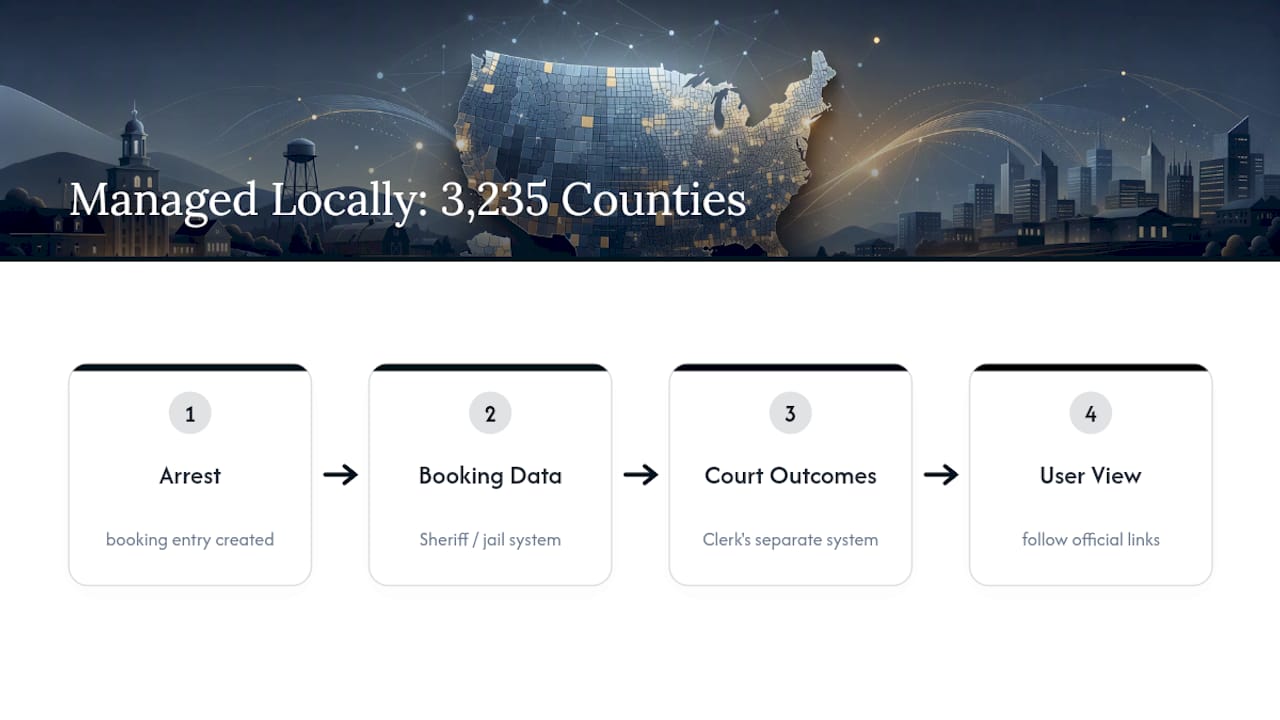
A typical booking entry includes the booking date and time, a booking number, charges as booked, the arresting agency, current jail location, and bond status. None of that is the same as a conviction.
Charges listed at booking often change. Prosecutors reduce them, add them, or drop them entirely before a case ever reaches trial, which is why booking data and court outcome data live in two different systems maintained by two different offices. Pinellas County's Sheriff's Office posts this distinction directly on its inmate inquiry page, warning that online booking information doesn't reflect final case outcomes and pointing users to the clerk of court instead.
Retention windows vary by county, and that inconsistency trips people up constantly. Utah County's Sheriff's Office keeps booking photos online for 30 days, though booking records themselves can stay searchable much longer.
Statistic to know: Arrest and jail records are managed separately across 3,235 U.S. counties and county-equivalents, which is exactly why there's no single national arrest database you can search once and trust completely.
Trust indicators worth checking before you rely on any result: an official .gov domain, a visible last-updated timestamp, and a posted disclaimer about what the data does and doesn't represent.
Step-by-Step: Running an Arrest Search by County
Follow this order and you'll skip most of the dead ends.
- Pin down the county. Check the arresting agency's name, since an arrest in one city can land in a neighboring county's jail.
- Search the sheriff or jail roster first, using the full legal name. If nothing comes back, try nicknames, maiden names, or partial last names, since spelling errors at intake are common.
- Check municipal police arrest lists and state inmate locators if the county roster comes up empty. Some agencies publish their own separate records outside the county jail system.
- Take the booking number to the clerk of court once you've found a booking, to check whether the case has a filed docket, a hearing date, or a final disposition.
- Use a consolidated county index, like Registry Recognizer, when you don't know which of the 3,000-plus county portals to even try first.
Pro Tip: A blank search result doesn't always mean no record exists. Some sheriff's offices update rosters every 30 minutes; others sit on new bookings for up to 24 hours. Try again the next day before assuming there's nothing there.
What Do Certified Copies Cost, and When Do You Need One?
Online rosters are informational. If you need proof that will hold up for a legal filing or formal background check, you need a certified copy from the court or sheriff's office, not a screenshot of a website.
- Fees are modest but real. Wake County, North Carolina charges $15 for a certified copy of an arrest record, even though the same information appears free on its online portal.
- Requesting one usually means filling out a form with the clerk or sheriff's records division, providing identifying information, and choosing in-person pickup or mail delivery.
- Certified copies matter most for legal filings, immigration paperwork, and employment vetting roles that specifically require certified documentation rather than a printout.
- Processing time varies from same-day to a couple of weeks. Follow up if you haven't heard back within the window the office quoted you.
Some counties, like Lee County, Florida, state outright that their online arrest search is a courtesy tool and not a substitute for a formal public-records request under state law.
Can You Remove or Seal a County Arrest Record?
Sealing or expunging a record is a legal process, and only a court or state agency can actually do it. No commercial website has that authority, no matter what its marketing promises.
- Sealing/expungement requires petitioning the court in the county where the case was handled, and eligibility depends on the charge, the outcome, and state law.
- Booking photo removal happens automatically in some counties after a set window, commonly 30 to 90 days, but policies differ widely and plenty of counties keep records indefinitely.
- Third-party takedown requests to aggregator sites require documentation, usually a certified court order showing the record was sealed or expunged.
- Skip anything that promises a quick fix for a fee. If a site claims it can erase your record instantly for a payment, that's not how the legal system works.
Pro Tip: Start with the clerk of court in the county where you were booked, not with a mugshot removal service. They can tell you in one phone call whether you're even eligible for sealing.
How Registry Recognizer Speeds Up County Searches
Registry Recognizer indexes county rosters into one searchable format, with booking metadata, jail locations, and links back to the official source for each entry. It doesn't replace the sheriff's office or the clerk of court. It just cuts down the time spent figuring out which of 3,000-plus county sites to check first.
For deeper walkthroughs on specific counties, see the guides on finding arrests in Maricopa County and checking recent arrests in Los Angeles County.
A Word on Using Arrest Records Responsibly
Arrest records are public, but that doesn't mean every detail belongs in a group chat or a social post. A booking is a snapshot of a charge, not a verdict, and sharing it carelessly can damage someone who was later cleared entirely.
If you spot an error, a duplicate entry, or outdated information, contact the county clerk of court directly rather than a data broker. For disputes tied to identity theft or mistaken bookings, an attorney is worth the conversation before you post anything publicly. Treat the difference between a charge and a conviction as the line you never blur, especially when someone's job or reputation is on the line.
— Sean
Find County Arrest Rosters Faster With Registry Recognizer
Chasing down the right sheriff's site, then the right clerk of court, across county lines eats an afternoon fast. Registry Recognizer solves the actual bottleneck: it's a county-organized index that puts booking summaries and links to official portals in one place, so you're not guessing which of 3,000-plus jurisdictions to check first.
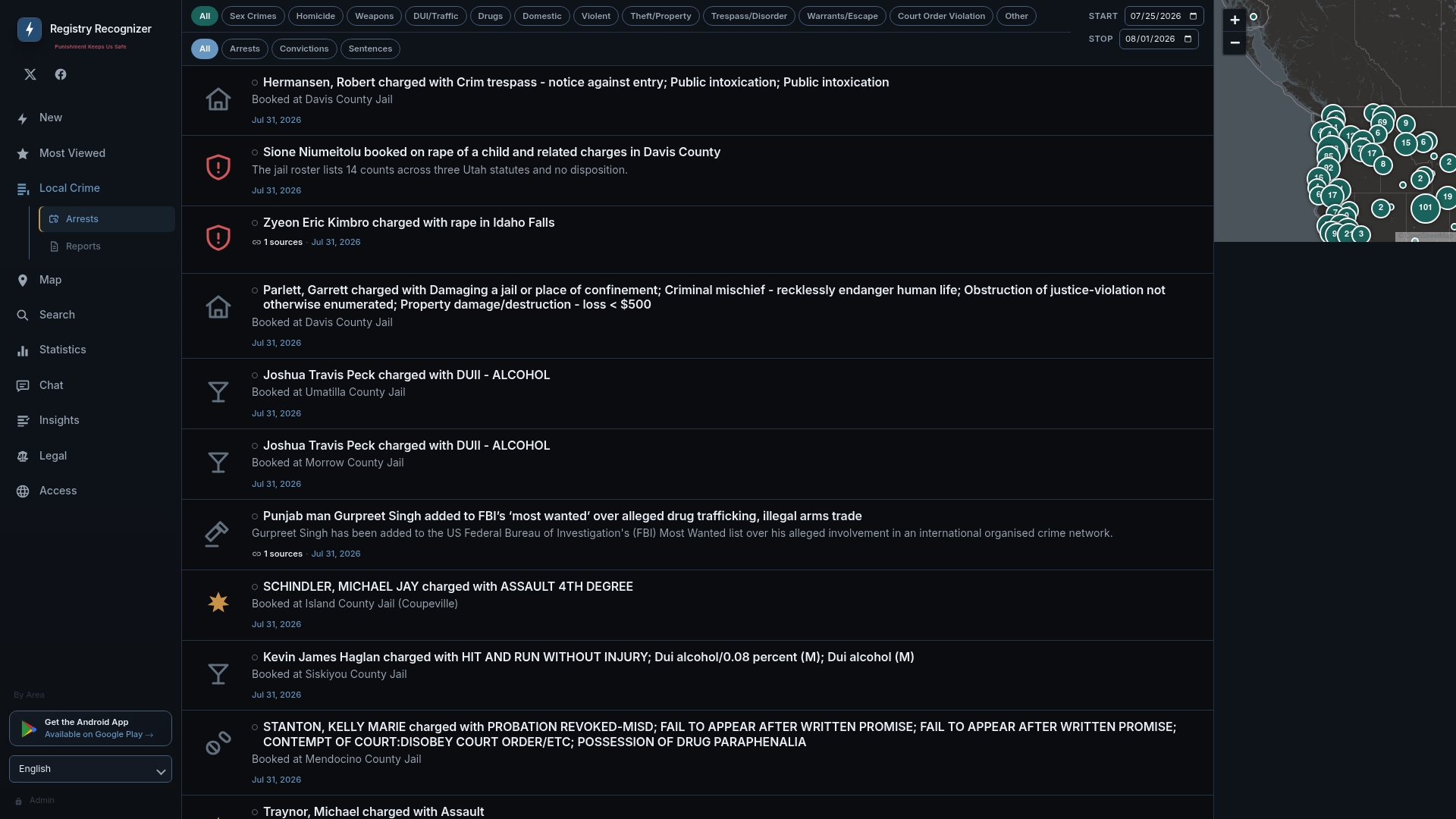
Every listing shows the charge, jail location, and booking details as reported, structured the same way no matter which county the record comes from. If you want to see the format before you search a specific name, browse an example booking record to see exactly what fields come back. When you're ready, start a search on Registry Recognizer and pull up county-level results without hopping between a dozen government sites.
Sources
For deeper county-specific steps, see how to find county jail records after an arrest and what case disposition actually means once a court decides an outcome.
- Arrest Records — Wake County, NC
- Utah County Sheriff's Office Inmate Search
- Pinellas County Sheriff's Office Arrest Inquiry
- San Bernardino County Sheriff's Department — Inmate Locator